Founder's Note
Tony Stark had Jarvis. Your CSMs have six spreadsheets and blind faith.
Six tools. 45 minutes of tab-switching. Signals missed. Accounts churned. After 10 years in CS, I kept waiting for someone to build the Jarvis of customer success. Nobody did, so we built Larry in Clynto AI.
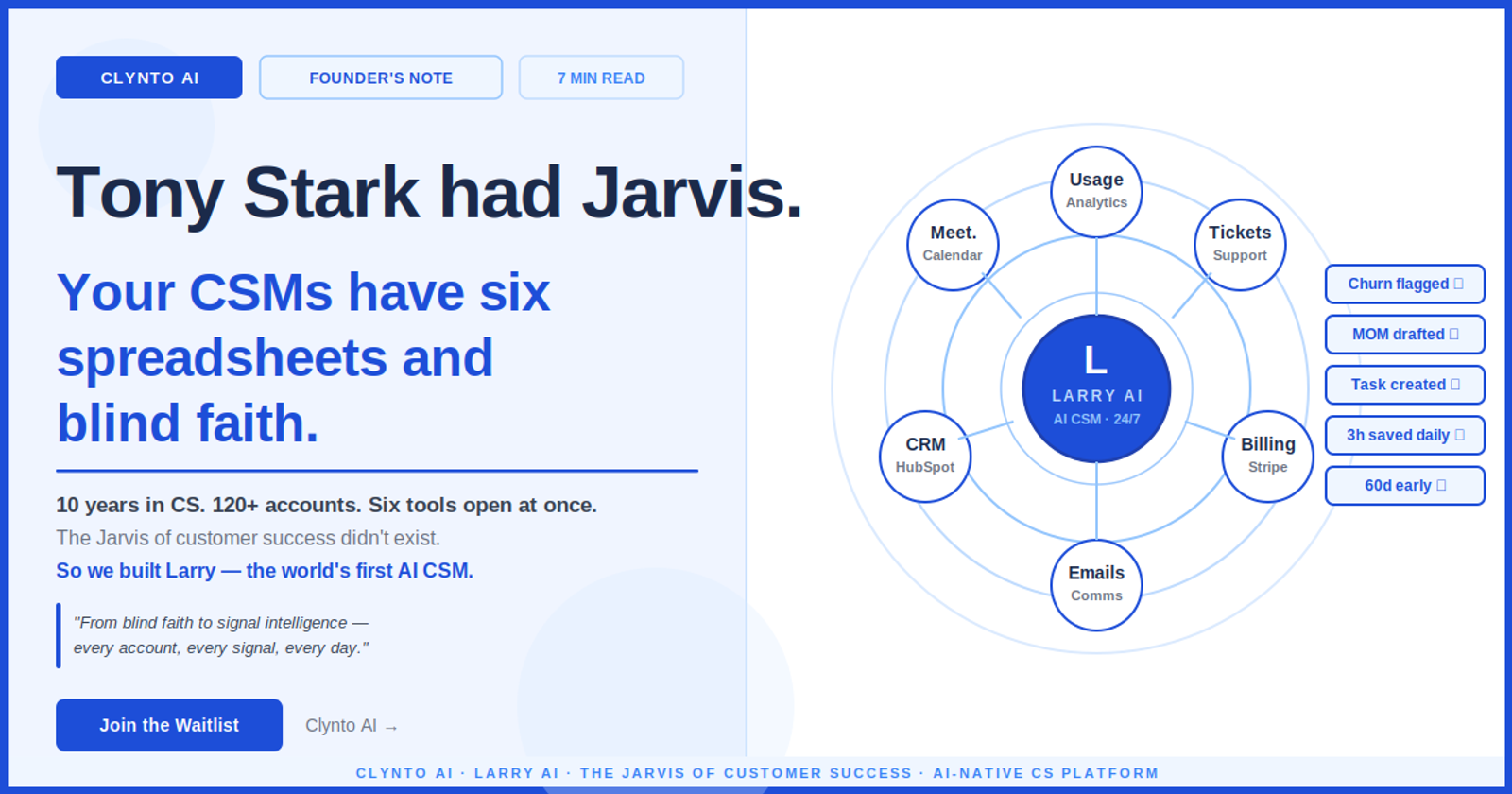
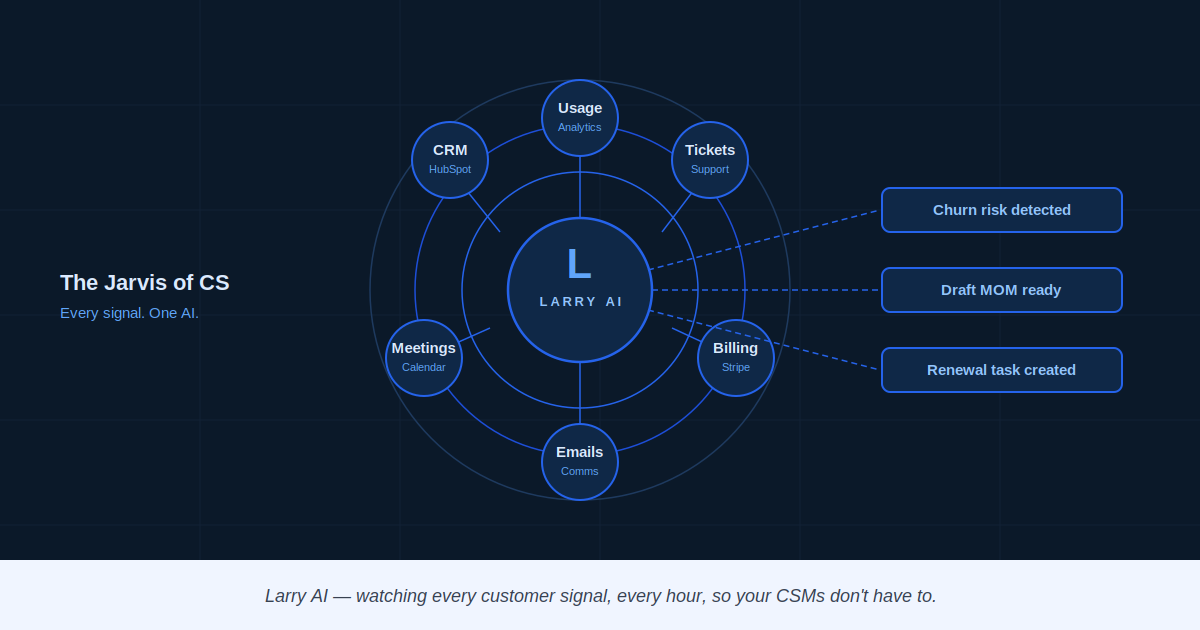
In every Tony Stark movie, there's a moment where he's in trouble — outnumbered, outgunned, working against the clock. And Jarvis is already three steps ahead. Not waiting to be asked. Not generating a report. Acting. Alerting. Recommending. Executing — while Stark stays focused on the decisions that actually require a human mind.
I've spent over a decade in customer success — as an associate, an account manager, a senior CSM, a team lead, a CS leader, and a consultant who has built CS functions from the ground up across multiple companies and markets. And the entire time, I kept thinking: why doesn't a Jarvis exist for customer success?
Not a dashboard. Not a health score widget. Not another integration. A real AI — one that watches every signal across every account, every hour of every day, understands your specific CS process, and tells you exactly what needs to happen before things go wrong.
It didn't exist. So we built it.
Let me tell you what ten years of CS actually looks like
I started in customer-facing work at the frontlines — phone calls, tickets, fast resolutions. Hundreds of interactions a day. It trained me to find root causes quickly and understand what customers actually mean versus what they say. That skill never left me.
From there, I moved into SaaS — account management, then customer success. At one point I was managing 120+ accounts with over a million dollars in portfolio ARR. I was doing renewals, expansions, upsells, onboarding, training, escalations, and internal reporting — simultaneously, every week.
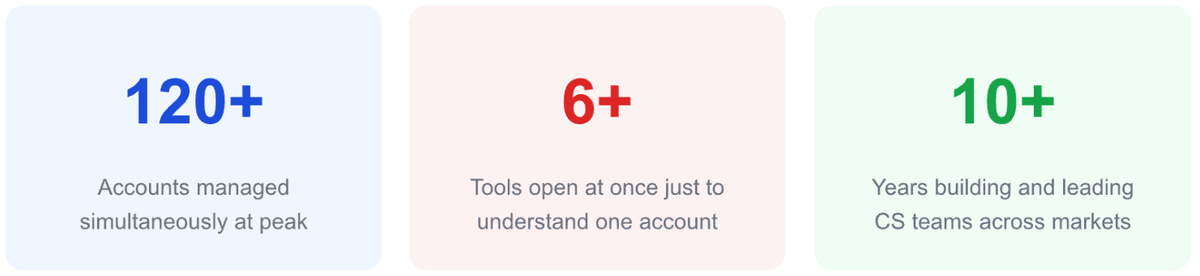
And through all of it — through every role, every company, every consulting engagement where I trained teams, wrote SOPs, hired CSMs, and designed renewal processes from scratch — the workflow was always some version of the same broken thing.
Open CRM. Check renewal dates. Open spreadsheet. Update health scores manually. Open ticketing tool. Check for spikes. Open analytics platform. Look at logins. Open email. See if the champion replied. Open Slack. Ask the team what's going on with that one account that feels off.
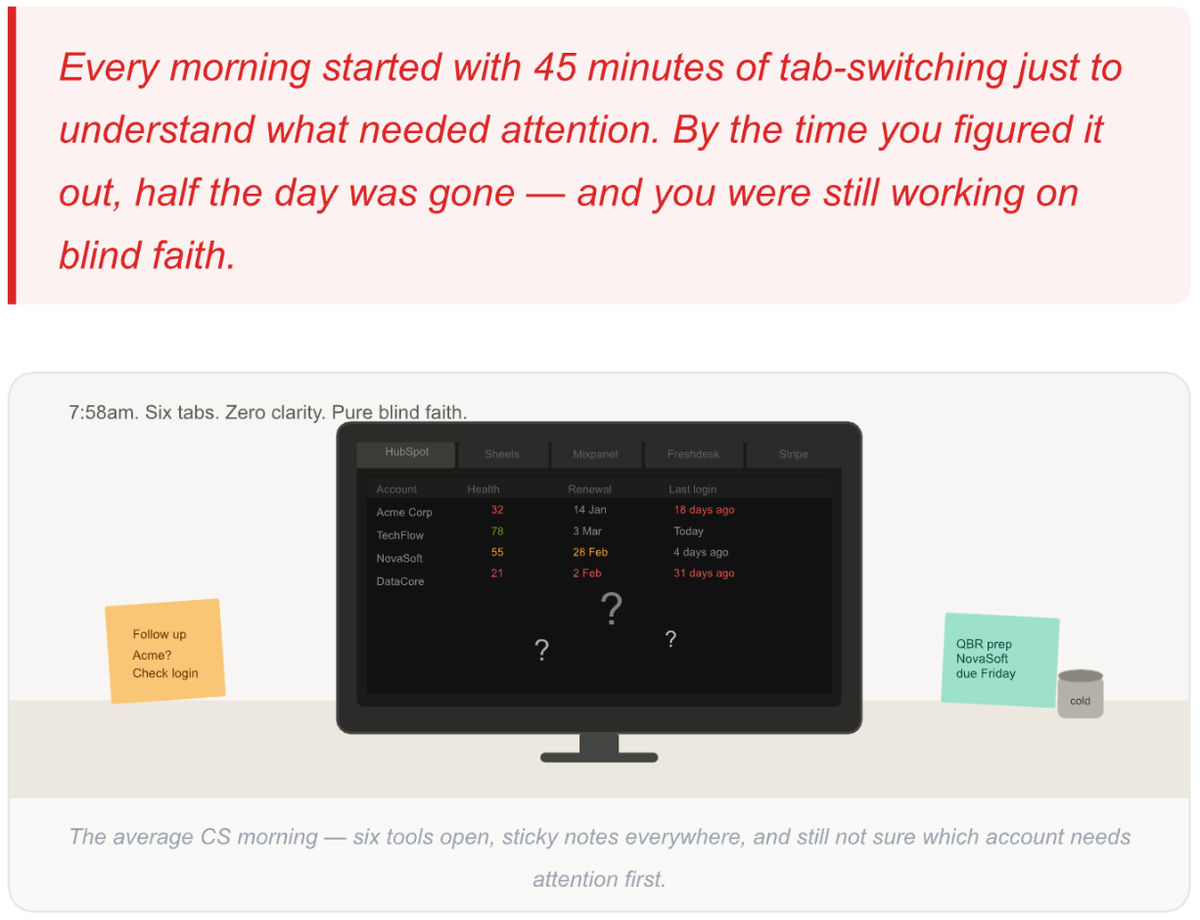
The data existed. The signals were there — declining logins, spiking tickets, a champion who had gone quiet, a payment that was two weeks late. But no single place surfaced all of it together, in context, with a recommended action attached. The CSM had to be the intelligence layer. Manually. Every day.
Across dozens of accounts.
That's not a people problem. It's an infrastructure problem.
The account I'll never forget
Early in my career, I lost a large account that I shouldn't have lost. The renewal conversation two months prior had felt fine. Cordial. Positive, even.
But after they churned, I went back through everything. The champion had left the company six weeks earlier — I didn't know because no one flagged it.
Logins had dropped 40% over the prior month. There had been three support tickets in two weeks, all frustrated in tone. And a payment had been delayed, which I'd written off as an admin issue.
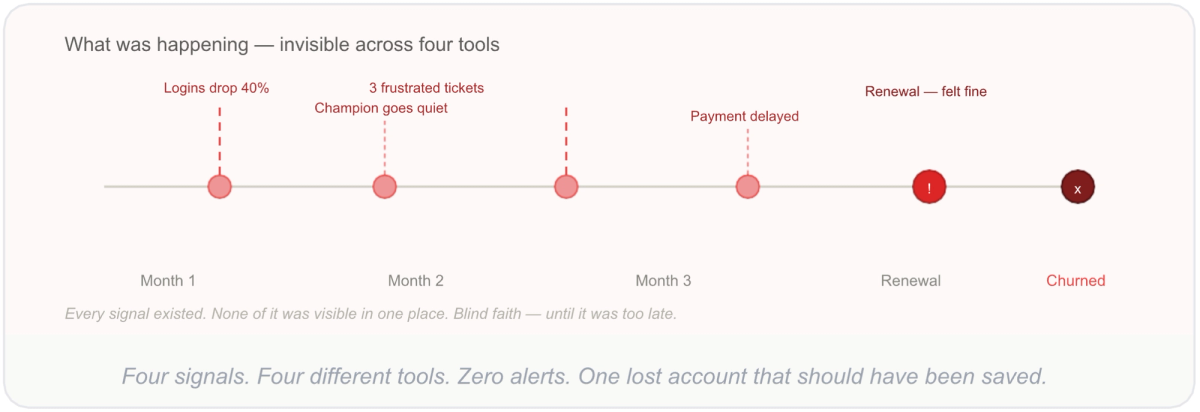
Every single signal was there. In four different tools. Visible to no one at once. I've seen this story play out at every company I've worked with since. Not because CSMs are careless — they're some of the most dedicated people I know. But because the tools demand that humans do the work that software should be doing. Connecting dots. Spotting patterns. Flagging risk before it becomes a resignation letter from your customer.
The AI CSM — a concept that didn't exist until now
When I started thinking seriously about what to build, I kept coming back to one question: what would a perfect CSM do if they never slept, never missed a
signal, had perfect memory of every interaction, and could act the moment something needed attention?
They'd watch every account, every hour. They'd read every support ticket for sentiment. They'd notice when a champion goes quiet. They'd know that three weeks of declining logins plus one frustrated ticket plus a delayed payment equals a customer who's about to leave — and they'd act on it 60 days before the renewal, not two weeks after the decision is made.
They'd remember everything you've ever told them about how your CS team works. Your segmentation logic. Your renewal process. Your definition of a healthy account. And they'd apply that context to every recommendation they made — not generic best practices, but advice calibrated to your specific business.
That's what we built. We call it Larry.
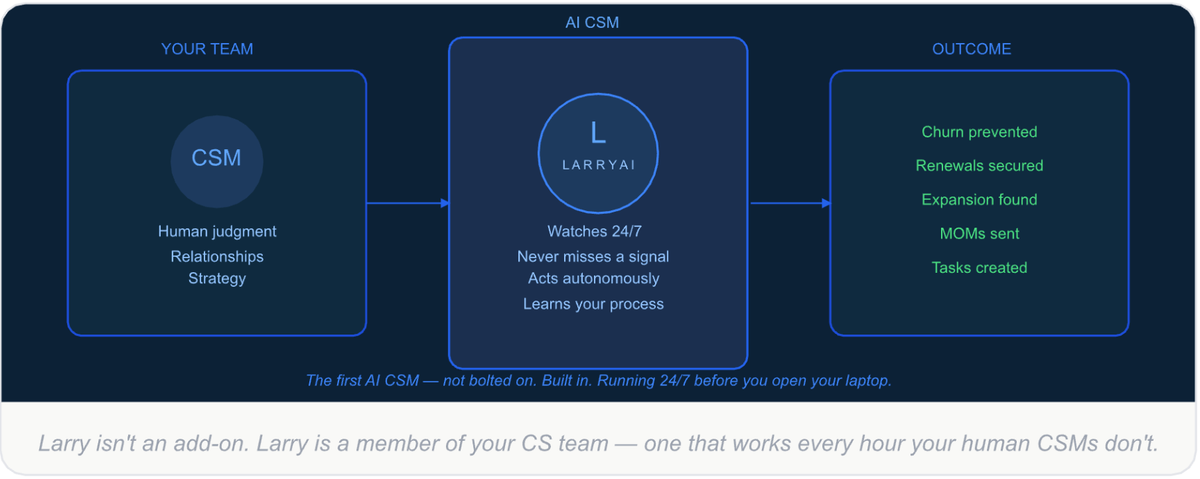
MEET LARRY — THE AI CSM
Larry is not a chatbot. Larry is not a dashboard with an AI label on it. Larry is an autonomous AI CSM that runs alongside your human team — watching every signal, generating every insight, drafting every MOM, flagging every risk, and executing tasks without waiting to be asked. Your CSMs stay in control. Larry makes sure nothing falls through the cracks. Think of it as giving every CSM on your team a tireless, infinitely attentive AI colleague who has memorised every account and never has a bad day.
What this looks like in practice — real numbers, real accounts
I want to be specific, because vague AI promises are everywhere. Here is what actually changes when Larry is running alongside a CS team.
The first thing you notice is the mornings. Before Clynto AI, the first 45 minutes of every CS day was a manual archaeology exercise — digging through tabs to figure out what needed attention. With Larry, that briefing is waiting when you log in. Which accounts need attention today. Why. What to do. No digging required.
The second thing you notice is what you stop worrying about. The accounts that used to slip through the cracks — the ones you checked in on when there was time, which meant rarely — are now being monitored continuously. Larry is watching them even when you're not. That changes the feeling of the job fundamentally. You go from hoping nothing has fallen through the cracks to knowing nothing has.
And then the numbers start to change.
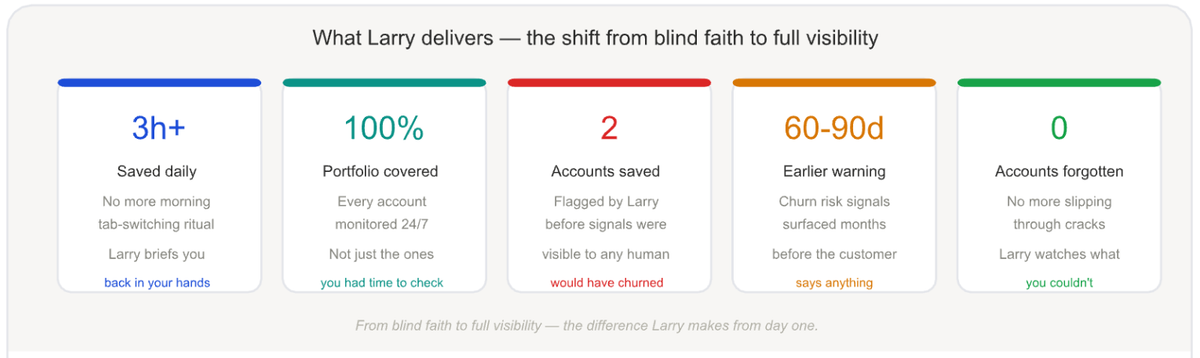
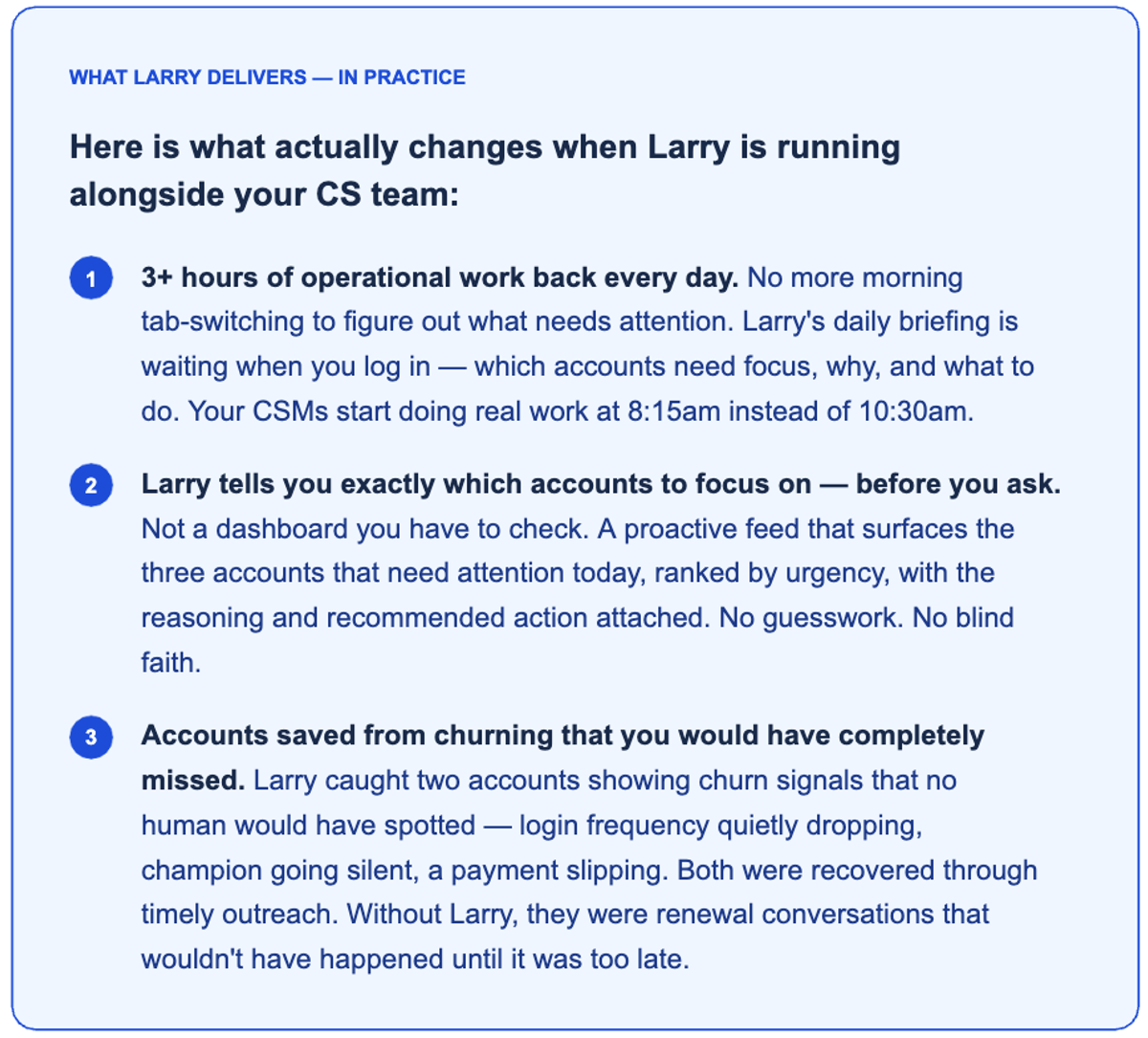
This is not theoretical. This is what happens when you replace blind faith with signal intelligence — when the platform does the watching so your CSMs can do the relationship work that actually requires a human being.
This has never been built before
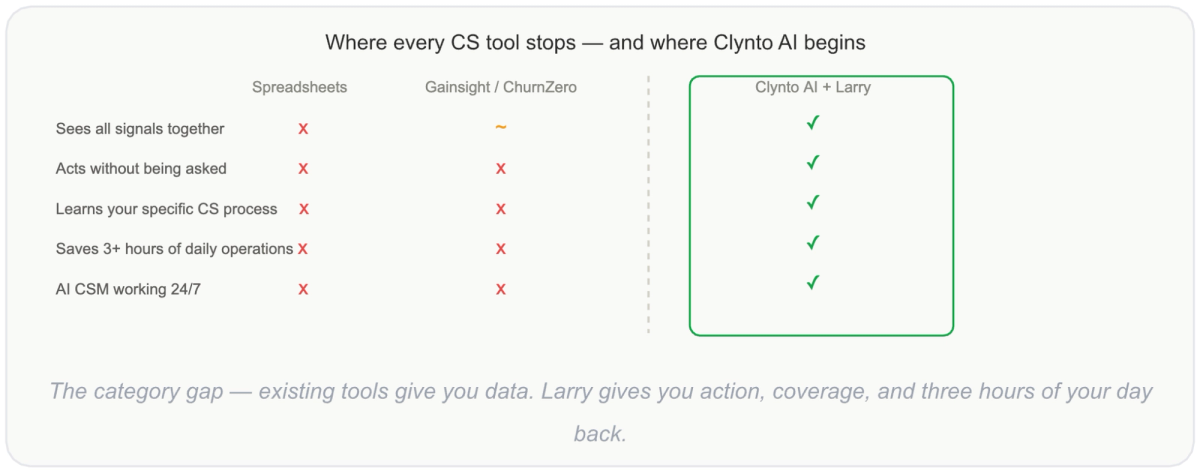
There are CS platforms. There are AI tools being bolted onto CS platforms. But an AI CSM — a system that understands your specific workflow, acts autonomously, runs your playbooks, and operates as a genuine member of your CS team — this doesn't exist yet anywhere in the market.
Gainsight gives you data. ChurnZero gives you alerts. Spreadsheets give you control you spend all day maintaining. None of them give you an AI that actually does the work.
We're not building a smarter dashboard. We're building the Jarvis of customer success — and we're the first ones doing it.
Why I'm writing this
I'm not a blogger. I'm a CS practitioner who got frustrated enough to build something. This blog exists because I want to share what a decade in this function actually taught me — the patterns, the mistakes, the frameworks that worked in the real world, not in a whitepaper.
Every post will come from experience. If you're a CSM who feels like you're always one step behind your accounts — this is for you. If you're a CS Director who can't get your team to actually use the tools you've invested in — this is for you. If you're building a CS function from scratch and you're not sure where to start — this is absolutely for you.
We're pre-launch. The platform isn't out yet. But the waitlist is open, and the people who join now will get early access, shape the product, and be the first CS teams in the world to have an AI CSM on their roster.
The question isn't whether AI changes customer success. It already is. The question is whether you're one of the teams that leads that change — or one of the teams that catches up to it later.
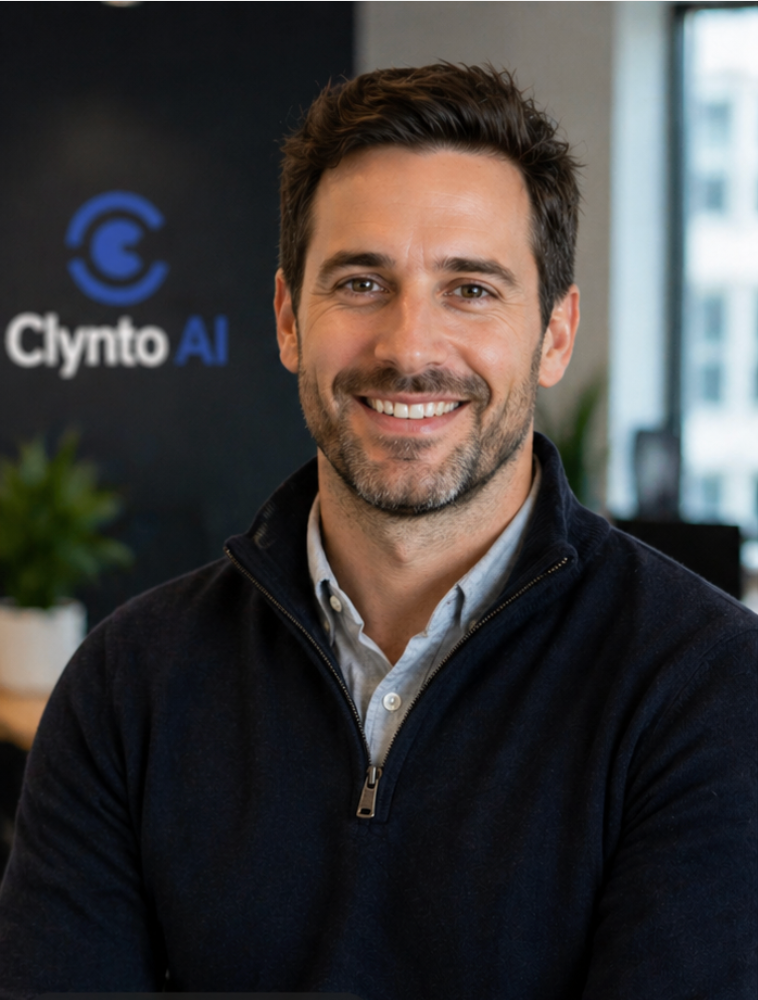
Lucas Bennett
Clynto AI
Customer Success practitioner with over 10 years building CS teams from scratch across US, Canada, Singapore as a CSM, team lead, CS leader, and consultant.
Book 20 min with Lucas