Field Tactics
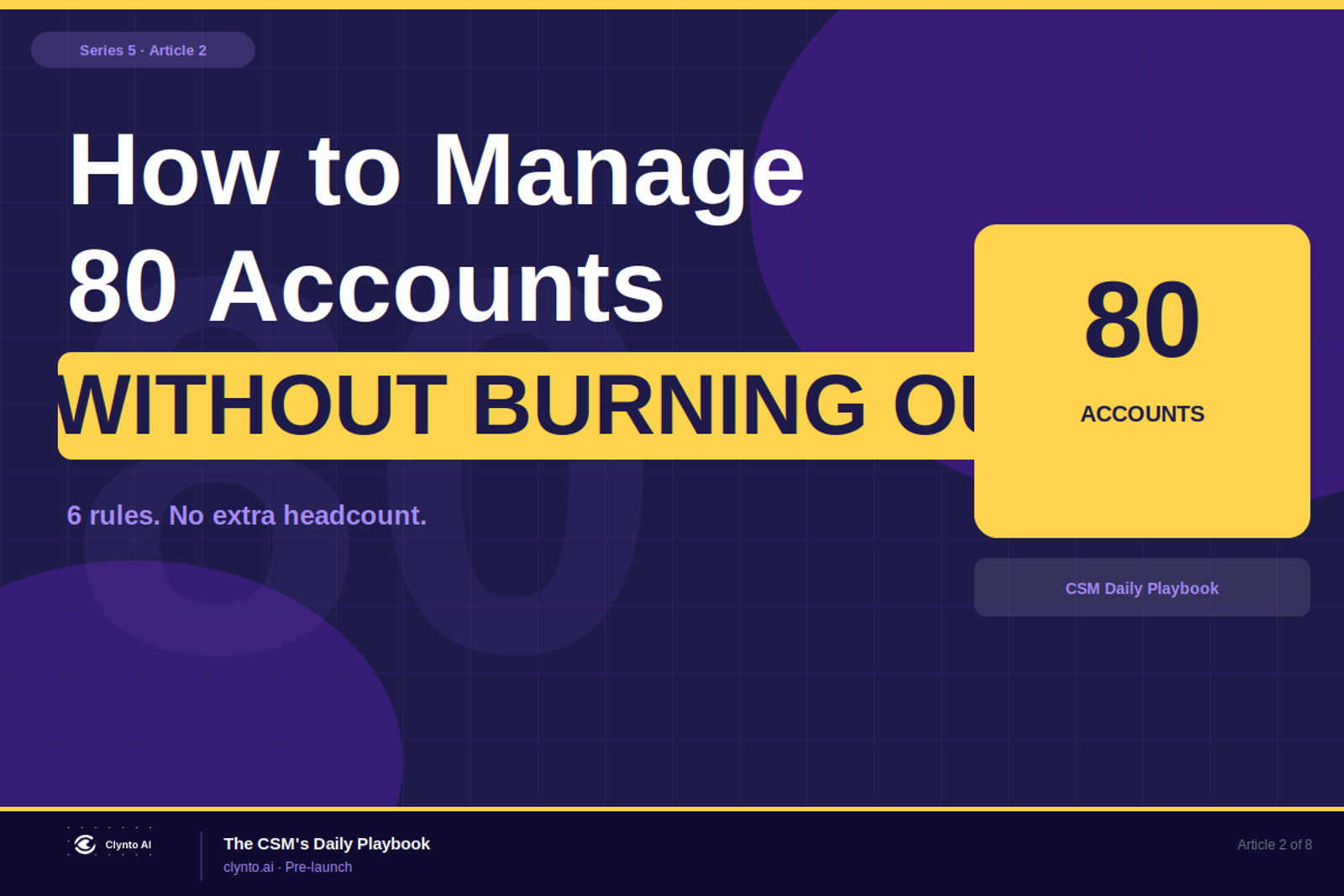
How to Manage 80 Accounts Without Losing Your Mind
How to manage 80 accounts without losing your mind — the 6-rule CSM system for large portfolios

How to Manage 80 Accounts Without Losing Your Mind
The CSMs who manage large portfolios well aren't superhuman. They've just accepted one thing: monitoring is not their job.
The Portfolio Math Problem
At 80 accounts, if you spend 30 minutes per account per month — which is already a very low bar for meaningful CS — that's 40 hours per month of portfolio management time before you've run a single QBR, responded to a single ticket, or made a single proactive outreach.
That's not a time management problem. It's a structural problem. Human monitoring doesn't scale to 80 accounts. It never has.
The CSMs who manage large portfolios without burning out have accepted a fact that most CS programmes resist: the monitoring work — watching signals, tracking trends, reviewing health — has to move to an AI layer. The human work — relationships, conversations, judgment calls — stays with the CSM.
Here are the six rules that make 80 accounts manageable.
Rule 1: Stop Trying to Monitor Everything
The first and most important shift: accept that you cannot proactively monitor 80 accounts and also do relationship work at the level that retains them.
Something has to give. And the thing that should give is the monitoring — not the relationships.
Larry monitors every account continuously. Usage trends, engagement patterns, billing changes, champion activity, support volumes — all of it, every day, across all 80 accounts simultaneously. When something matters, it surfaces. When it doesn't, you don't need to look.
Your job is not to watch. Your job is to act on what Larry finds.
Rule 2: Work From a Priority List — Not a Portfolio List
Every morning, Larry surfaces the accounts that need attention today. Not a list of 80. Not a list of 20. The 5 accounts — ordered by severity and ARR — that need a human right now.
This is the rule that changes how large-portfolio management feels. Instead of a Monday morning triage that takes 90 minutes and leaves you with 30 things to do, you have a clear, prioritised action list that focuses your entire day on what actually matters.
The other 75 accounts are being watched. They'll appear on the list when they need you. Until then, they don't need you.
Rule 3: Triage Takes 10 Minutes With Larry
Manual portfolio triage — opening each account, checking health, reviewing recent activity, deciding what to prioritise — takes 60–90 minutes per week for an 80-account portfolio.
With Larry, it takes 10 minutes. The signal feed shows you everything that changed since your last review, ordered by priority. You read the signal, you understand the context, you decide your action. Done.
This 50-minute reclaim, every week, over 48 working weeks, is 40 hours per year. One full working week given back — and it's only the triage saving.
Rule 4: Batch Your Reactive Work
Reactive work — email, Slack, ad-hoc customer requests — is unavoidable at 80 accounts. What's avoidable is letting it consume the entire day.
The best large-portfolio CSMs check email twice: once at 9:30am (after the morning routine) and once at 2pm. Everything in between is proactive CSM work — calls, outreach, renewals, QBRs.
This batching pattern sounds simple. It requires real discipline. And it produces a measurable difference in the quality of proactive work because your best thinking and energy isn't depleted by reactive context-switching.
Rule 5: Prep Takes 2 Minutes Per Renewal
Manual renewal prep for an 80-account portfolio — pulling data, reviewing account history, checking stakeholder status — takes 45–60 minutes per renewal call.
With Larry's renewal brief, it takes 2 minutes. The brief covers 90-day trajectory, stakeholder changes, unresolved friction, usage trends, and the recommended opening. Everything you need is there before you open a single other tool.
Over a year, for a CSM handling 2 renewal calls per week across an 80-account portfolio, that's 213 hours saved. The math is in the Clynto AI ROI model — but you'll feel it in your Wednesday afternoon energy levels.
Rule 6: Protect Your Proactive Hours
The most valuable work a CSM does — proactive outreach, expansion conversations, relationship building — requires a specific type of energy: open, curious, unhurried. This energy is not available at 4pm after a day of reactive work.
Block 9–11am every day as relationship time. Calls, outreach, and proactive account work only. No email. No Slack. This is the time where the accounts that matter most get your best version.
Everything else — admin, CRM updates, internal meetings — goes in the afternoon. Your accounts get the morning. The morning is when things get done.
Lucas Bennett
Clynto AI
Customer Success practitioner with over 10 years building CS teams from scratch across US, Canada, Singapore as a CSM, team lead, CS leader, and consultant.
Book 20 min with Lucas