Churn & Retention
How to Save an At-Risk Account in 30 Days
Most save attempts fail because they start too late and diagnose too vaguely. Here's the exact 30-day playbook — day by day — for turning an at-risk account back into a healthy one.

On this page
How to Save an At-Risk Account in 30 Days
Most save attempts fail not because the account was unsaveable — but because the CSM started with the wrong diagnosis.
The 30-Day Window Is Real — If You Use It Right
When Larry flags an at-risk account, the window for intervention is real and time-sensitive. The research across B2B SaaS is consistent: most churn decisions are made 30–60 days before the renewal date, not at the renewal conversation.
This means that if you're starting your save attempt at renewal, you're often starting after the decision. The 30-day playbook works because it starts when the signal appears — not when the renewal calendar fires.
Here's exactly what that looks like, day by day.
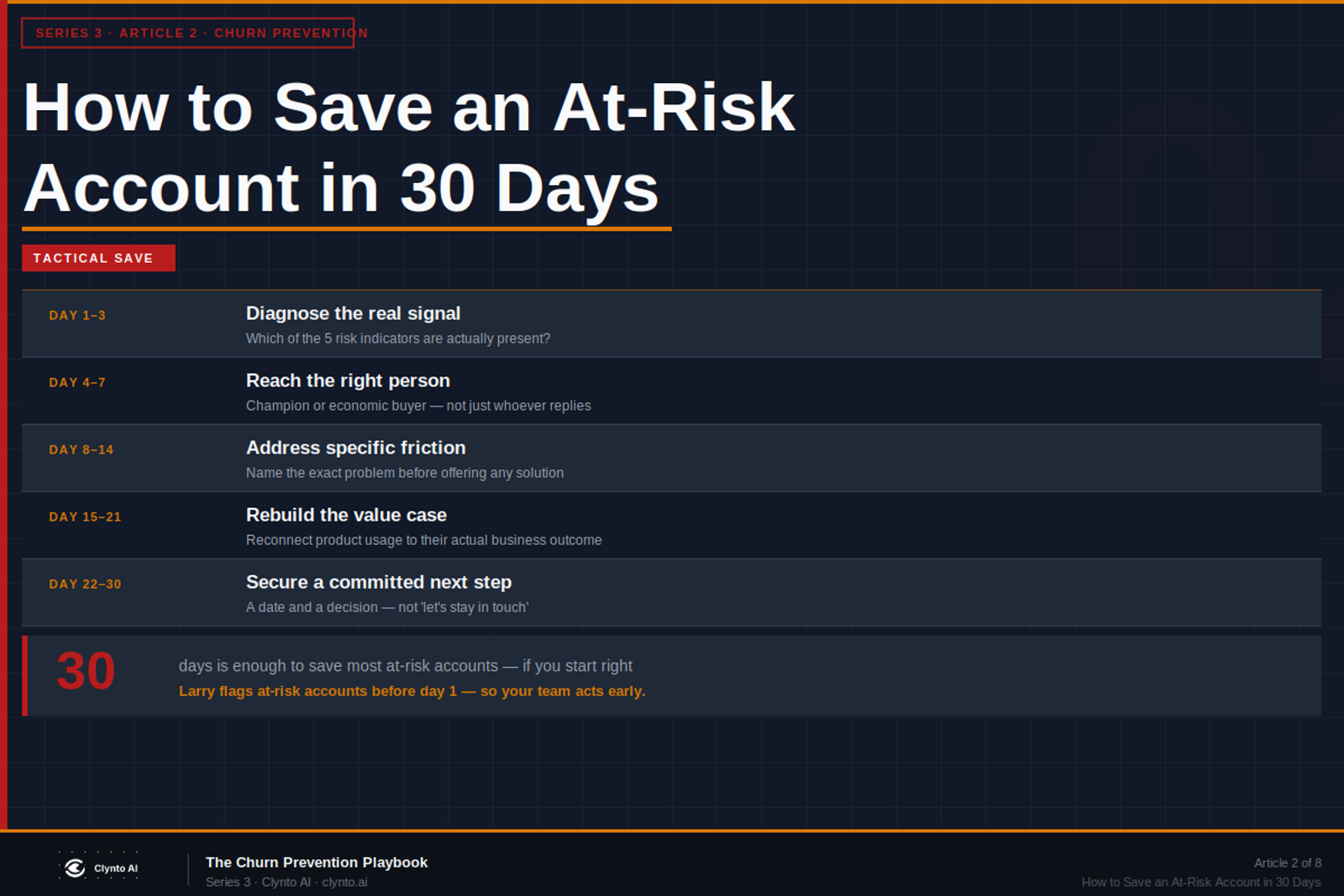
Days 1–3: Diagnose Before You Move
The most common save failure is premature action. A CSM sees the at-risk flag and immediately schedules a call, sends a check-in email, or — worst — forwards a discount offer.
None of these work without a diagnosis first.
Before any outreach, answer four questions:
Which signals are present? Is this a usage signal, an engagement signal, a billing signal, or a relationship signal? The type of signal determines the intervention.
Who is the real decision-maker? Not necessarily the main contact. The economic buyer, the champion, the internal advocate — identify who actually decides whether this contract renews.
What's changed in the last 90 days? Larry's renewal brief covers this — stakeholder movements, usage trends, unresolved friction. Read it before doing anything else.
What does a successful 30 days look like? Define the outcome you're trying to reach before the first touchpoint.
Days 4–7: Reach the Right Person
Most save attempts fail because they reach the wrong person. The CSM calls the main contact — the day-to-day user — and has a productive conversation that changes nothing, because the day-to-day user doesn't make the renewal decision.
Your job in days 4–7 is to get in front of the economic buyer or champion. Not through an escalation. Through a value-forward reason to talk.
The opening: "I've been looking at how your team is using [product] and I saw something I wanted to bring to you directly — it'll take 15 minutes."
Not: "Just checking in." Not: "Wanted to catch up." Not: "I heard there might be some concerns."
A specific, value-forward reason. That gets the meeting.
Days 8–14: Address the Friction Directly
By now you've had the first real conversation. You know what the problem actually is — not the polite version, the real one.
The instinct at this point is to offer something. A feature, a workaround, a discount, an introduction to your product team. Resist this instinct.
First, name the friction. Say it out loud in the meeting before they do: "From what I'm seeing, the issue is X. Is that accurate?"
This does something important: it signals that you've been paying attention, that you're not in denial, and that this is a real problem-solving conversation — not a retention pitch.
Once the friction is named, address it specifically. Not with a roadmap promise. With a concrete next step that resolves the specific issue within the 30-day window.
Days 15–21: Rebuild the Value Case
With the immediate friction addressed, the conversation shifts from retention to value. Your job in days 15–21 is to reconnect the product to the customer's actual business outcome.
Not features. Outcomes.
"Your team has processed 2,400 support tickets through the platform in the last quarter. At your previous manual rate, that's approximately 180 hours of work your team didn't have to do."
This is the conversation that moves the needle on renewal — not the one where you defend your product against objections. Find the number. State it clearly. Make the business case for continuation concrete and specific.
Larry's account brief gives you this context before the meeting. Usage data, adoption trends, the business outcome the customer defined in their original onboarding.
Days 22–30: Secure a Committed Next Step
The 30-day save fails when it ends with a handshake and good vibes but no commitment. Customers who say "I'll think about it" at day 28 almost always churn.
Your close is not a discount. Your close is a committed next step with a specific date and a specific decision attached to it.
"Let's set up a 30-minute call on [date] to confirm the renewal direction. I'll have [specific thing] ready for you to review."
If they agree to the date: the renewal is very likely. If they delay the date: there's something else you haven't addressed yet. Find it now.
The Larry Advantage — Starting on Day 1
The 30-day playbook works when it starts at day 1 with a full diagnosis. The challenge for most CS teams is that day 1 only comes when the signal is seen — which requires someone to be watching.
Larry flags at-risk accounts automatically — often 60–90 days before renewal — with a full explanation of which signals are present and what they indicate. Your CSMs don't start the clock at day 30 of a 30-day window. They start at day 1.
That's the difference between a save rate and a surprise churn.
Clynto AI is currently in pre-launch. Larry flags at-risk accounts — your team runs the 30-day playbook.
[Click for the demo → clynto.ai]
Lucas Bennett
Clynto AI
Customer Success practitioner with over 10 years building CS teams from scratch across US, Canada, Singapore as a CSM, team lead, CS leader, and consultant.
Book 20 min with Lucas