Churn & Retention
How to Turn a Churn Conversation Into an Expansion
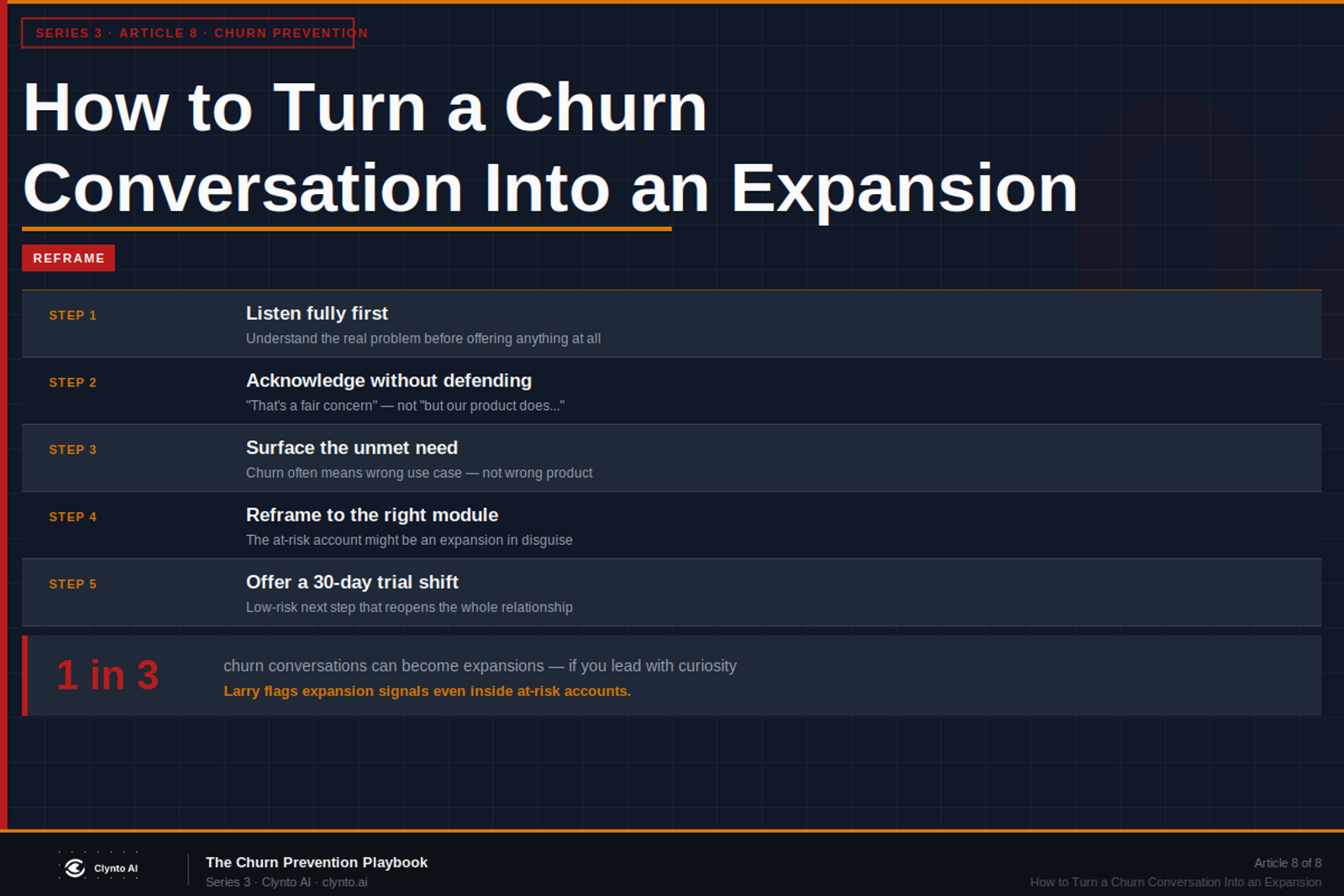
1 in 3 churn conversations can become expansions — but only if the CSM leads with curiosity instead of panic. Here's the 5-step reframe that turns a customer who's leaving into one who grows.

How to Turn a Churn Conversation Into an Expansion
The customer who says they're leaving is often telling you something more useful than the customer who quietly doesn't renew. Here's how to hear it.
The Reframe That Changes Everything
A customer announcing they're leaving feels like the end of a conversation. It isn't.
In most cases, a customer who tells you they're considering churning is doing something rare and valuable: they're giving you information about an unmet need. They're telling you — directly or indirectly — that something isn't working. That they expected more. That the value case has broken down somewhere specific.
That information, if you listen for it rather than react to it, is almost always actionable.
1 in 3 churn conversations contain the seeds of an expansion. Not because the customer secretly wanted to buy more — but because the underlying problem is often a wrong use case, a missing configuration, or an unidentified need that a different part of your product actually addresses.
Here's how to find it.
Step 1: Listen Fully Before Responding
The most important rule of a churn-to-expansion conversation: hear the complete picture before you offer anything.
Most CSMs hear "we're thinking about leaving" and immediately start building a defence. They're mentally preparing a counter-argument, a retention offer, a product roadmap point — before the customer has finished explaining why.
This is wrong for two reasons. First, the stated reason is rarely the whole story. Second, defending the product before understanding the problem signals that you're not really listening — which confirms the customer's worst fear about your company.
Ask two questions before saying anything else: "Can you tell me more about what's driving this?" and "How long have you been feeling this way?" The second question is critical — it tells you whether this is a new friction point or a long-building frustration that you've been missing signals about.
Step 2: Acknowledge Without Defending
When the customer finishes explaining, your first response should never be a counterargument. It should be an acknowledgement.
"That's a fair concern, and I appreciate you being direct about it."
This sentence does more work than most CSMs realise. It signals that you heard them, that you're not defensive, and that this is a problem-solving conversation rather than a retention pitch. Customers who feel acknowledged are dramatically more open to what comes next than customers who feel like they're being argued with.
You can address the specifics of the concern later. First, acknowledge it completely.
Step 3: Surface the Real Unmet Need
Churn intentions are almost always a symptom of an unmet need. The stated reason — "it's too expensive," "the product doesn't do what we need," "we're going in a different direction" — is usually a surface description of something more specific underneath.
Your job in step 3 is to find the specific need that isn't being met.
"When you say the product doesn't do what you need, can you help me understand — specifically — what you were hoping it would do?"
The answer to this question is where the expansion conversation begins. Because often — not always, but often — the unmet need is something your product does address. Just not in the way the customer has been using it, or in a module they haven't been shown, or in a configuration that was never set up.
Step 4: Reframe to the Right Solution
If the unmet need maps to a different part of your product, this is your moment — but the framing is everything.
Don't say: "Actually, we have a feature that does exactly that."
Do say: "What you're describing sounds like it might be a use case for [specific thing] — which works differently from how you've been using the platform. Would it be worth 20 minutes to see if that fits what you're trying to do?"
The distinction matters. The first response sounds like a sales pitch. The second sounds like a genuine problem-solving attempt. Customers in a churn conversation are hyperattuned to being sold to — they've often already mentally exited the vendor relationship. The curiosity-led approach reopens it.
Step 5: Offer a Bounded Next Step
Don't ask the customer to reverse their decision. Ask them to try one specific thing before they finalise it.
"Before you make a final decision, would you be willing to try [specific module/configuration/use case] for 30 days? If it doesn't address what you're describing, I'll understand completely — but I'd like us to at least know we explored this."
This works because it's low-risk. The customer doesn't have to abandon their churn intent — they just have to delay it slightly for a specific, time-limited trial. And if the reframed solution does address the unmet need, the expansion conversation opens naturally.
What Larry Surfaces Before the Conversation
The churn-to-expansion reframe works when the CSM knows which expansion signals are present inside an at-risk account.
Larry monitors expansion signals continuously — even in accounts that are flagged as at-risk. Feature gaps that match the customer's use case. Seat patterns that suggest growing teams. Modules that haven't been activated despite the account profile suggesting they'd benefit.
When your CSM walks into a churn conversation, Larry's brief includes not just what's driving the risk — but what the expansion opportunity looks like. The reframe isn't improvised. It's informed.
Clynto AI is currently in pre-launch. Larry flags expansion signals even inside at-risk accounts.
[click here for the demo → clynto.ai]
Lucas Bennett
Clynto AI
Customer Success practitioner with over 10 years building CS teams from scratch across US, Canada, Singapore as a CSM, team lead, CS leader, and consultant.
Book 20 min with Lucas