Field Tactics
The Art of the Proactive Check-In - Without Being Annoying
Just checking in" is the most sent and least effective message in CS. Here's what proactive outreach actually looks like - specific, signal-led, and 3× more likely to get a reply.

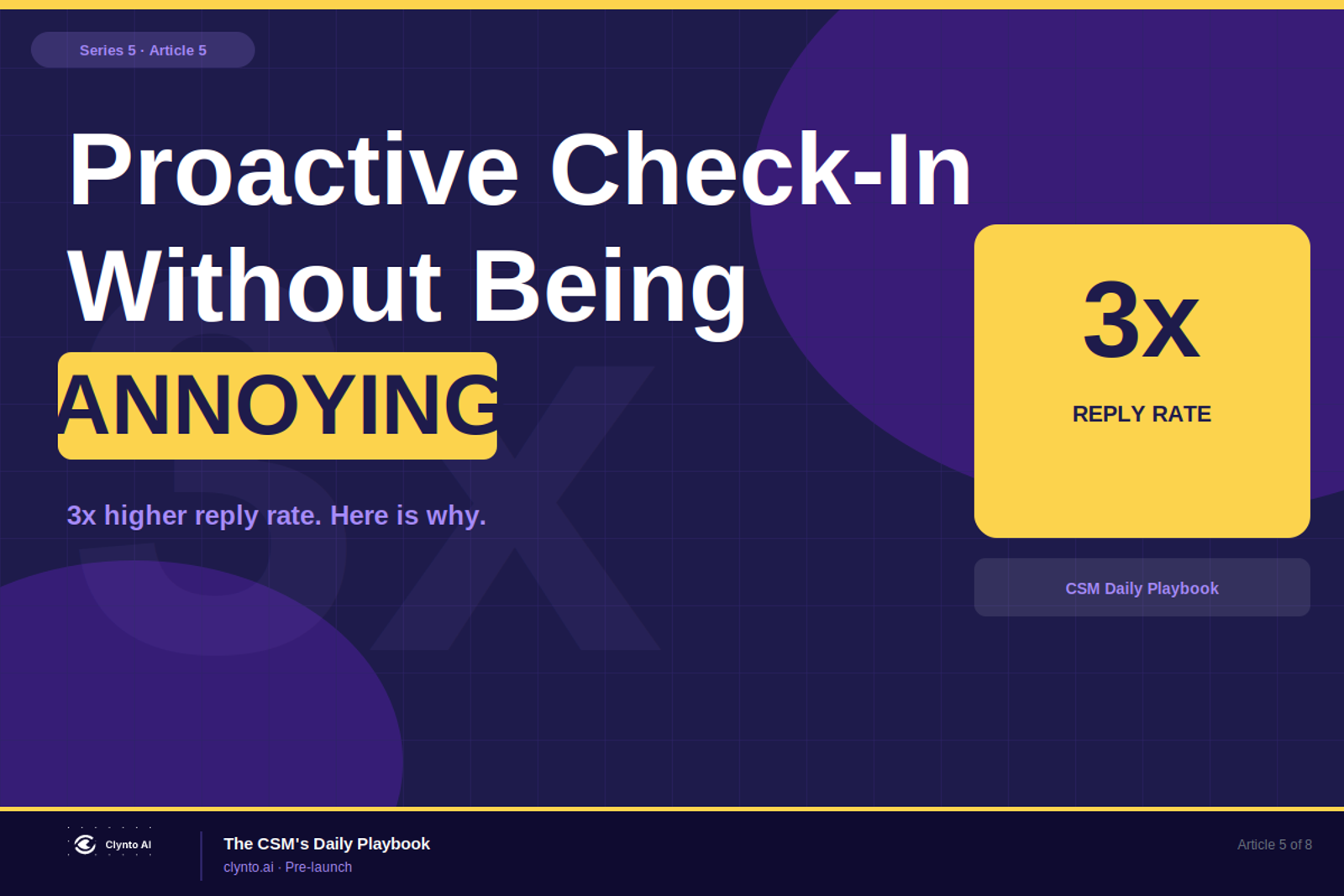
The Art of the Proactive Check-In — Without Being Annoying
"Just checking in" is not proactive CS. It's the absence of a reason to reach out, disguised as one.
Why "Just Checking In" Fails
Every CS team has a CSM who sends check-ins. The ones who do it well have a reply rate that drives expansion and retention. The ones who do it badly have a reply rate in the low single digits — and a growing suspicion that their customers are screening their calls.
The difference isn't personality. It's whether the check-in is built around the CSM's need to make contact or the customer's experience of receiving something useful.
"Just checking in" is the CSM's need to make contact. It communicates nothing about the customer, their account, or their situation. It asks them to create the agenda for a conversation the CSM initiated. It's the equivalent of knocking on someone's door and saying "just stopping by."
Here's what works instead.
What Not to Do
"Just checking in!" The most common CS message. Zero context. Zero value. No reason to reply. It places the burden of the conversation entirely on the recipient — they have to decide what this is about, what to say, whether it's worth their time.
"Wanted to touch base" A warmer version of the same problem. The customer hears: this person has nothing specific to tell me. The sentiment is pleasant. The utility is zero. They defer it until a day they feel like creating an agenda for someone else's meeting.
"Hope all is well — any updates?" The worst combination: a generic opener and a completely open-ended ask. The customer reads this and thinks: updates on what? From where? For whom? Most don't respond. The ones who do respond with "all good, thanks."
What Actually Works
Lead with a specific signal
Before every proactive outreach, pull the Larry brief. What changed in the account in the past week? A feature activation. A usage milestone. A support ticket that was resolved. A renewal approaching.
Lead with that. "I saw your team activated the reporting module last week — I wanted to share two quick tips that our fastest-adopting teams use in the first 30 days."
This tells the customer: you're paying attention to their specific account. Not sending a template. That one sentence gets replies that "just checking in" never will.
Offer something before asking
The proactive check-in that works leads with value: a relevant insight, a piece of data, a comparison to similar customers. Something the recipient gets by opening the email — before they have to do anything.
"We just published data on how teams in [their industry] are using [feature] — your usage pattern actually matches the highest-performing cohort. Thought you'd find it useful."
This creates genuine goodwill and a reason to engage — not just an obligation to reply.
Ask one specific question
If a question is needed, make it specific and small. "Is the onboarding team fully set up yet, or is there still work to do there?" A question with a specific scope and an easy yes/no structure.
Not: "How's everything going?" — which is both unanswerable and unactionable.
Time it to a real moment
Proactive outreach that lands at a random point in the customer's lifecycle gets a random response. Proactive outreach timed to a meaningful moment gets engagement.
Meaningful moments: 60 days before renewal (the relationship reactivation window). Feature launch that's relevant to their use case. A usage milestone they've reached. A signal that something changed in the account.
Larry surfaces these moments automatically — so the CSM's outreach is always timed to something real in the account rather than a calendar reminder that says "check in with account X."
Lucas Bennett
Clynto AI
Customer Success practitioner with over 10 years building CS teams from scratch across US, Canada, Singapore as a CSM, team lead, CS leader, and consultant.
Book 20 min with Lucas