Field Tactics
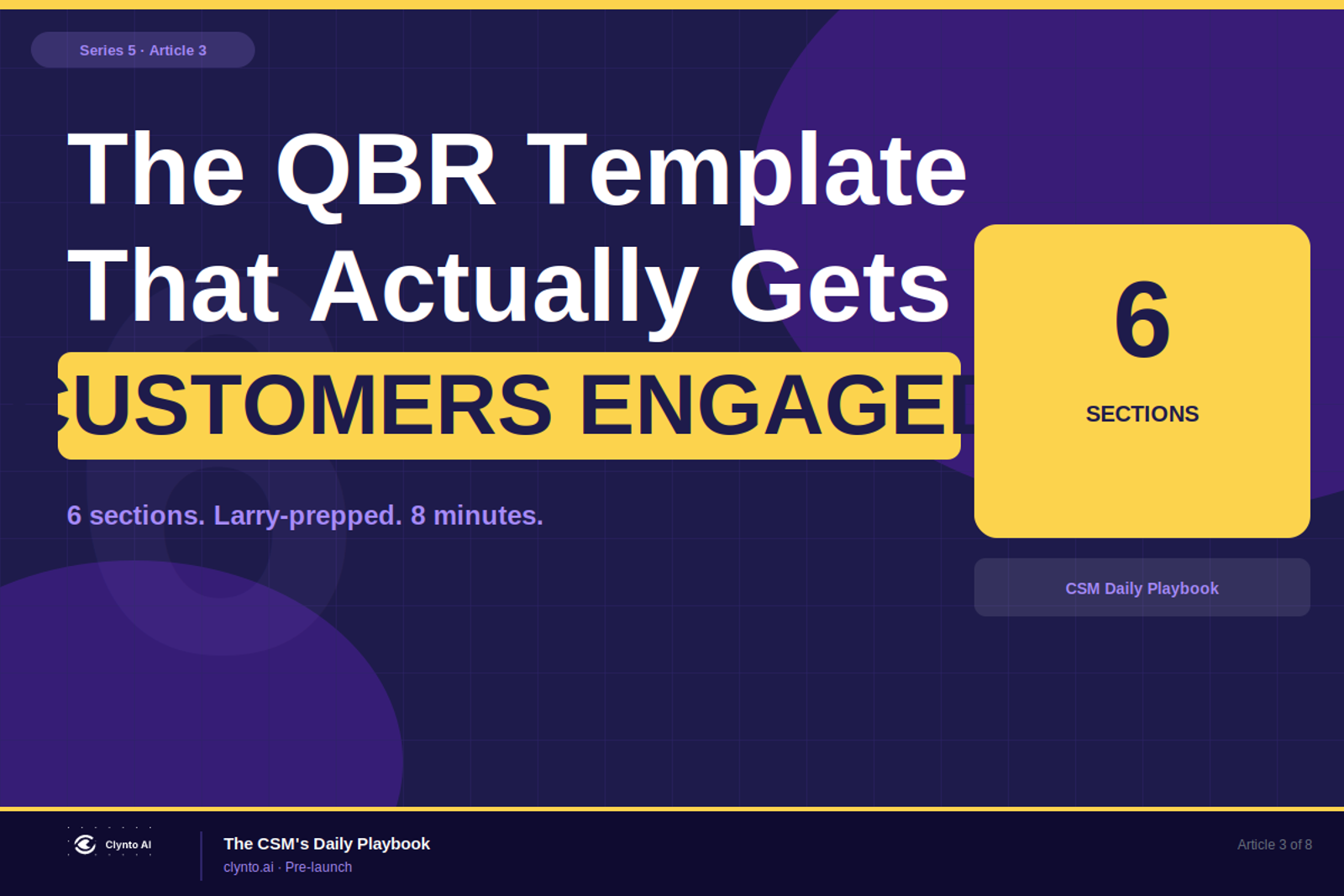
The QBR Template That Actually Gets Customers Engaged
Most QBR templates optimise for covering ground, not building engagement. Here's the 6-section structure - built for Larry-prepped CSMs — that turns QBRs into conversations customers want to have.

The QBR Template That Actually Gets Customers Engaged
Most QBR templates are built for the CSM's comfort. This one is built for the customer's experience.
Why Most QBR Templates Fail
The average QBR template asks the CSM to: open with a company update, review usage metrics, present feature highlights, discuss upcoming roadmap, close with next steps.
This template is built around what the CSM has access to — not what the customer cares about. It's a vendor update. It's the reason customers send a delegate to QBRs instead of attending themselves. It's the reason "QBR" has become a thing customers politely schedule and quietly dread.
The template below is built differently. It starts with the customer's world and keeps returning to it throughout. Here's the structure.
Section 1: Their Goals — Before Your Data (5 minutes)
Open every QBR with one question: "Before I walk through what we've built together, I want to make sure I understand what you're focused on going into next quarter. What are the one or two things that matter most for your team right now?"
Listen fully. Take notes. Then build everything you present in sections 2–5 around what they just said.
This does something most QBR templates don't: it tells the customer that this meeting is about their priorities, not your metrics. It also surfaces anything that's changed in their business that Larry might not have captured yet.
Section 2: One Specific Win — With a Number (8 minutes)
Not a feature list. Not a usage summary. One specific, quantified business outcome tied to something they told you mattered.
"Your team has reduced manual report generation time by 41% since we activated the reporting module in Q1. Based on your team size, that's approximately 180 hours back in your team's week over the quarter."
Specific. Numbered. Connected to their stated goal from the previous QBR (or from their onboarding). This is the moment where the customer believes the product is working — which is the foundation the rest of the QBR needs.
Section 3: Name the Friction — Before They Do (5 minutes)
Every account has friction. An open ticket that took too long. A feature that didn't work as expected. A commitment you made and didn't fully deliver.
The best QBRs name this before the customer does: "I want to address the [specific issue] from last quarter directly. Here's what happened, here's what we did about it, and here's what it means going forward."
This is the most trust-building move in a QBR. Customers who feel like their vendor is honest about problems are dramatically more likely to renew. Customers who feel like their vendor is avoiding them aren't.
Section 4: What's Changing Next Quarter (5 minutes)
Not a feature roadmap. A specific, relevant preview of one or two things that will affect this customer's experience in the next 90 days.
Connect it to their goals from Section 1: "Given that you mentioned [X], I want to flag that [specific change] is coming in Q3 — here's how it affects what you're trying to do."
This signals that you're thinking about their business specifically — not sending the same roadmap slide to every account.
Section 5: The Expansion Question (5 minutes)
Every QBR should include one natural expansion question. Not a pitch. A curiosity-led question that opens the possibility of more.
"Is there a team in your organisation that you think could benefit from this — that isn't using it yet?"
Or: "We've seen other companies in your space use [specific module] to solve [specific problem]. Is that something your team is facing?"
The worst thing that happens: they say no. The best thing: an expansion conversation that closes next quarter.
Section 6: A Committed Next Step — Not a Handshake (2 minutes)
The close of every QBR should produce a specific commitment: a date, a decision, an action.
"Based on what we've discussed, I'd like to [confirm the renewal timeline / explore the [expansion] / schedule the executive review] by [specific date]. Can we set that up before we hang up?"
Specific date. Specific deliverable. Not "let's reconnect soon." Not "sounds great — I'll send the notes."
A QBR that ends without a committed next step hasn't finished. It's just been paused.
How Larry Makes This Template Work
The template above requires knowing: what goals the customer stated in the last QBR, what specifically changed in the account in the past 90 days, what friction points are unresolved, what the quantified business outcome looks like, and what expansion signals are present.
Larry builds all of this in 8 minutes — before the CSM opens any other tool. The template works when the CSM is prepared. Larry makes the preparation effortless.
Lucas Bennett
Clynto AI
Customer Success practitioner with over 10 years building CS teams from scratch across US, Canada, Singapore as a CSM, team lead, CS leader, and consultant.
Book 20 min with Lucas