Churn & Retention
The Renewal Conversation Checklist That Actually Works
Most renewal conversations fail because the CSM walks in under-prepared. Here's the exact checklist — before the call, during, and at close — that turns renewal meetings into committed outcomes.

The Renewal Conversation Checklist That Actually Works
The renewal conversation isn't where the renewal is won. It's where the preparation pays off — or doesn't.
Why Most Renewal Conversations Fail
The single most common cause of renewal failure isn't price, product gaps, or competitor pressure. It's an under-prepared CSM walking into a conversation they haven't built the context for.
When a CSM walks into a renewal without knowing what's changed in the account over the past 90 days, who the current decision-makers are, what friction points are unresolved, and what the customer cares about most this quarter — they're reacting in real time. And real-time reactions lead to defensive conversations, generic value pitches, and rushed concessions.
Here is the exact checklist that prevents this.
Before the Call
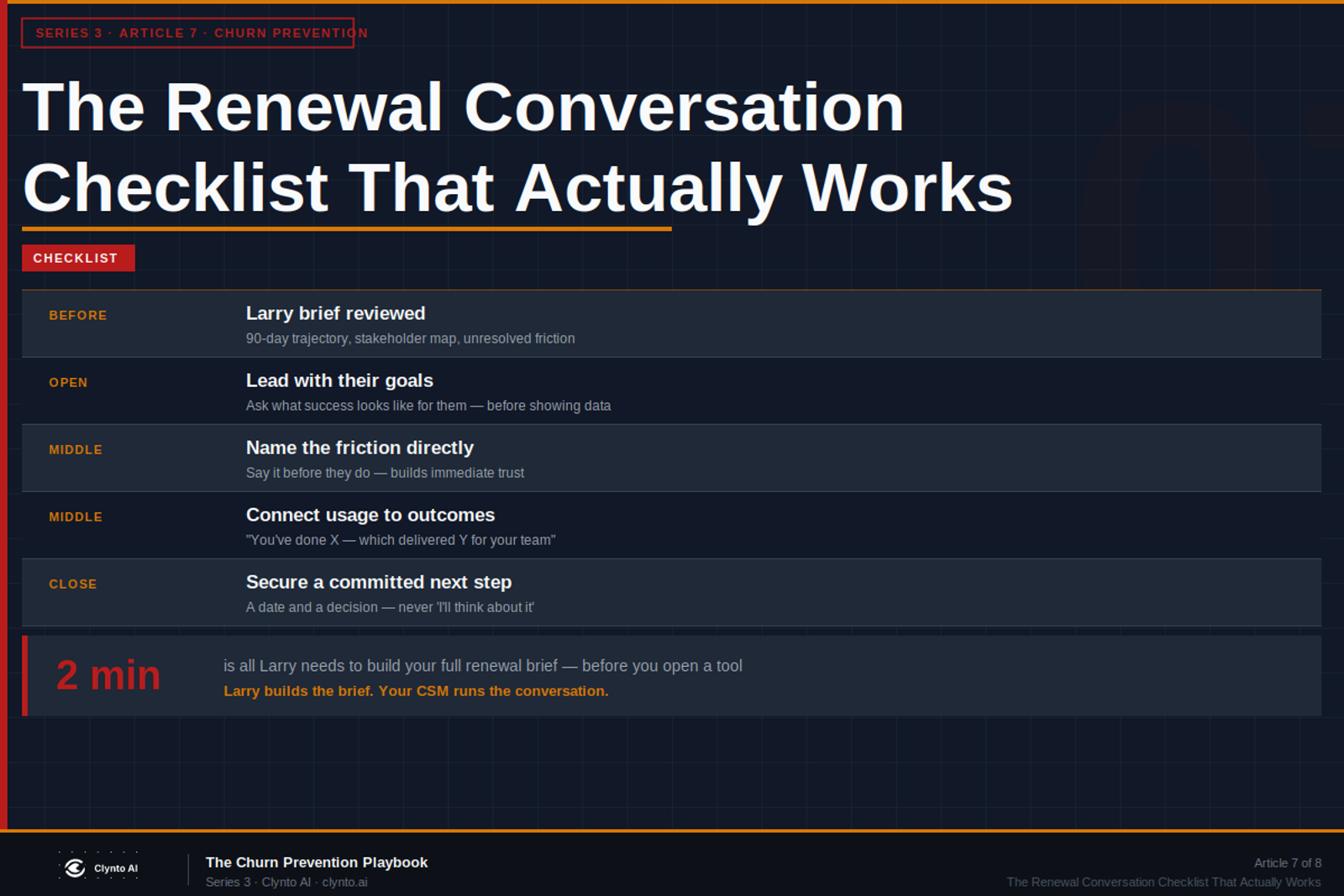
Review the Larry brief (2 minutes) Before opening any other tool, read Larry's renewal brief. It covers 90-day account trajectory, stakeholder activity, unresolved support friction, usage trends, and the account's current health across all five dimensions. Two minutes. Everything you need to walk in informed.
Identify who's in the room Not just who's listed on the calendar invite. Who is the current economic buyer? Who has influence over the renewal decision that might not be attending? Who needs to be there that isn't?
Know the one thing most likely to derail Every renewal has a risk. A pricing sensitivity, an unresolved product gap, a stakeholder who's been cold, a competing tool that's been mentioned. Name it before you walk in — don't discover it at the table.
Prepare the value statement One specific, quantified statement of what the customer has achieved with your product in the past year. Not features used. Business outcomes delivered. Have the number ready before the meeting starts.
Opening the Call
Lead with their goals, not your data
Open with: "Before I walk through what we've built together this year, I want to make sure I understand what success looks like for you going into next year. What are the one or two things that matter most?"
This does three things: it signals that you're customer-focused, it surfaces any concerns before they become objections, and it gives you the framing to connect everything you show to what they've just said matters.
Don't open with the contract
Nothing kills the tone of a renewal conversation faster than opening with pricing, contract terms, or timelines. Relationship first. Business case second. Contract last.
Middle of the Call
Name the friction before they do
If you know there's been an issue — a slow support resolution, a product gap, a missed QBR — raise it yourself. "I know there was an issue with X earlier this year and I want to address that directly before we talk about next year."
This is the single most trust-building move in a renewal conversation. Customers who feel heard and respected on the hard stuff are dramatically more likely to renew.
Connect usage to outcomes — specifically
"Your team has processed 3,400 reports through the platform this year. At the time you onboarded, you told us your goal was to reduce reporting time by 30%. You're at 41%."
Specific. Tied to their stated goal. Grounded in data. This is the value case that renews accounts — not a feature list.
Handle objections as information, not attacks
When a customer raises a concern, the natural instinct is to defend. Resist it. "That's a fair concern — can you tell me more about what's driving that for you?" An objection is almost always the beginning of a conversation, not the end of one.
Closing the Call
Always close with a committed next step
The renewal conversation that ends with "I'll send over the paperwork and you can think about it" has a failure rate that approaches the renewal conversation that never happened at all.
Close with: "Based on what we've talked about today, I'd like to send you the renewal terms by [date] and schedule a 20-minute call on [date] to confirm. Does that work?"
Specific date. Specific deliverable. Specific decision point. Not "let me know what you think."
Document everything immediately
Every commitment made, every concern raised, every objection that wasn't fully resolved — write it down within an hour of the call. This becomes the input for the follow-up and the context for any future renewal with this account.
The Larry Advantage
The before-the-call preparation described above — account trajectory, stakeholder map, unresolved friction, value data — takes a CSM 45–60 minutes to pull manually from multiple tools.
Larry does it in 2 minutes. Automatically. Before every renewal call. Whether your team thinks to check or not.
The checklist still requires a skilled CSM to execute. Larry just makes sure they walk in ready.
Clynto AI’s Larry builds the renewal brief. Your CSM runs the conversation. [Click here for the demo→ clynto.ai]
Lucas Bennett
Clynto AI
Customer Success practitioner with over 10 years building CS teams from scratch across US, Canada, Singapore as a CSM, team lead, CS leader, and consultant.
Book 20 min with Lucas