CS Education
What Is a QBR in Customer Success — And Does Anyone Actually Like Them?
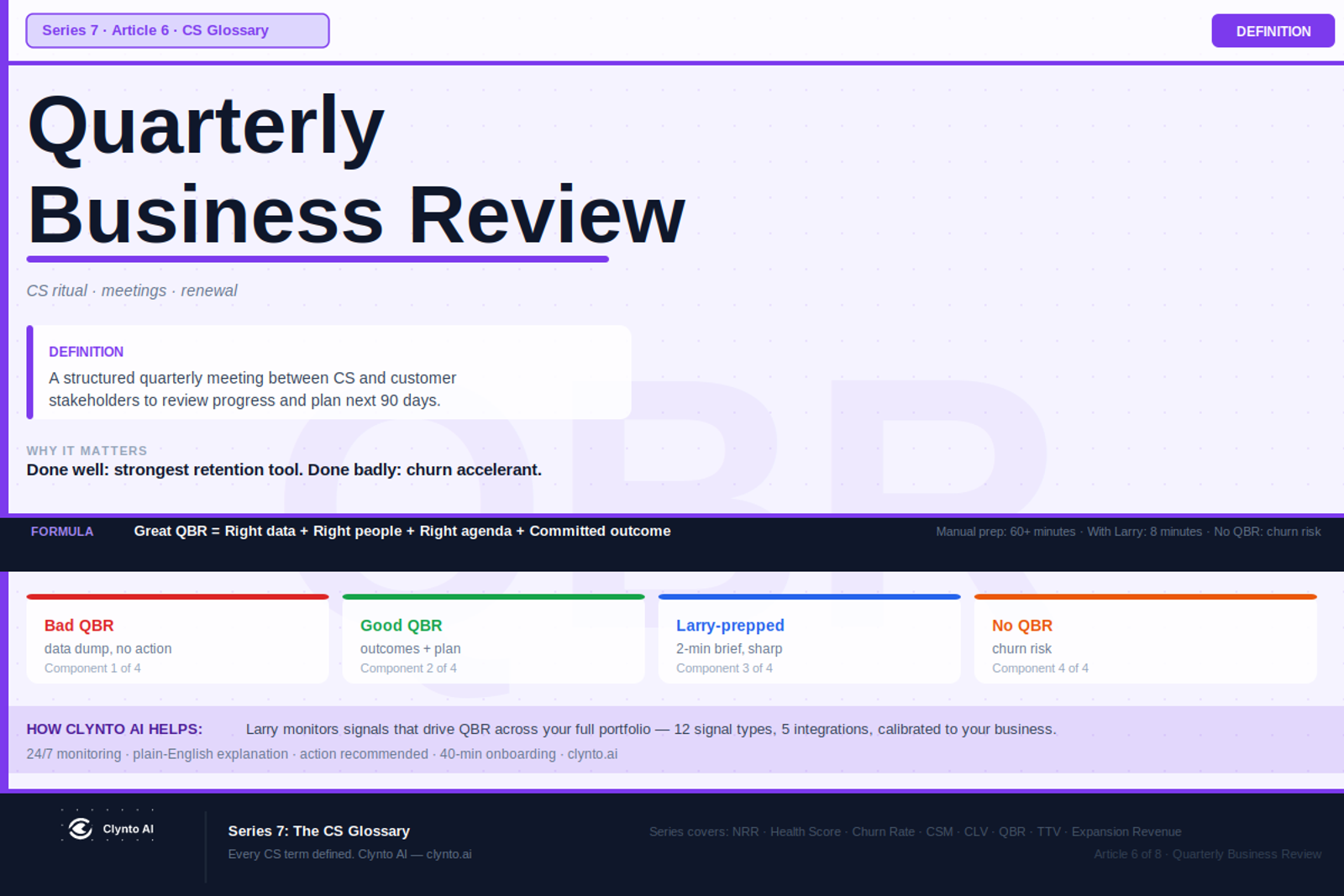
A QBR is a Quarterly Business Review — a structured meeting between your CS team and customer stakeholders to review progress, align on outcomes, and plan the next 90 days. In theory. Here's the real definition, what makes them work, and why most don't.

What Is a QBR in Customer Success — And Does Anyone Actually Like Them?
The QBR is either your strongest retention and expansion tool or your most reliable churn accelerant. There's very little in between.
The Definition
A Quarterly Business Review (QBR) is a structured meeting — typically held every 90 days — between a CSM and key customer stakeholders to review progress against goals, discuss product usage and outcomes, align on the next quarter's priorities, and deepen the strategic relationship.
In theory: a senior-level conversation about business outcomes, grounded in data, ending with a committed next step.
In practice: a slide deck recapping usage data the customer already knows, presented to whoever showed up, ending with "sounds good, let's reconnect next quarter."
The gap between theory and practice is why QBRs have a complicated reputation in CS circles — and why getting them right is one of the highest-leverage skills a CSM can develop.
What Makes a QBR Fail
Wrong room. QBRs that don't reach economic buyers or executive sponsors are status updates, not business reviews. If the only person in the meeting is the day-to-day user, you're not having a strategic conversation.
Wrong data. Showing product usage metrics without connecting them to business outcomes tells the customer what they already know. A great QBR answers "so what?" — not just "here's what happened."
No committed outcome. A QBR that ends without a specific next step — a date, a decision, an action — is a meeting that didn't work. The close of a great QBR is a commitment, not a handshake.
Under-prepared CSM. Walking in having pulled data that morning, without knowing what's changed in the account, who the current stakeholders are, or what the customer cares about this quarter — is the most common QBR failure mode.
What Makes a QBR Work
Start with their goals, not your data. Open with: "What does success look like for you this quarter?" Then connect everything you show to that answer.
Bring insight, not just information. The customer can see their own usage data. What they can't see — without you — is what it means, how it compares, and what they should do next.
Earn the room. The QBR is a trust-building exercise. Customers who feel genuinely understood in a QBR renew. Customers who feel like they're watching a vendor presentation churn quietly while being polite.
Prepare with intelligence, not just data. The best QBRs are built on knowing what's changed in the account — stakeholder movements, usage trends, NPS shifts, unresolved friction — before the meeting starts.
The Larry Angle — QBR Prep in 8 Minutes
The #1 QBR failure mode — an under-prepared CSM — is exactly what Larry eliminates.
Before every renewal or QBR, Larry builds a complete account brief: what changed in the last 90 days, stakeholder status, unresolved friction, NPS movement, usage trends, and recommended opening. In under 8 minutes. Before the CSM opens a single tool.
The CSM walks into the QBR knowing exactly what the landscape is, what the customer is feeling, what risks are live, and what to say. That preparation lands differently in the room. Customers feel it.
Clynto AI is currently in pre-launch.
[Get demo → clynto.ai]
Lucas Bennett
Clynto AI
Customer Success practitioner with over 10 years building CS teams from scratch across US, Canada, Singapore as a CSM, team lead, CS leader, and consultant.
Book 20 min with Lucas