CS Education
What Is Expansion Revenue — And How CS Teams Drive It
Expansion revenue is the growth hiding inside your existing customer base. It costs 5–7x less to generate than new customer revenue - and CS teams are the ones who unlock it. Here's what it is, how to measure it, and how to drive more of it.

What Is Expansion Revenue — And How CS Teams Drive It
The fastest-growing revenue in most SaaS businesses isn't coming from new customers. It's coming from the ones you already have.
The Definition
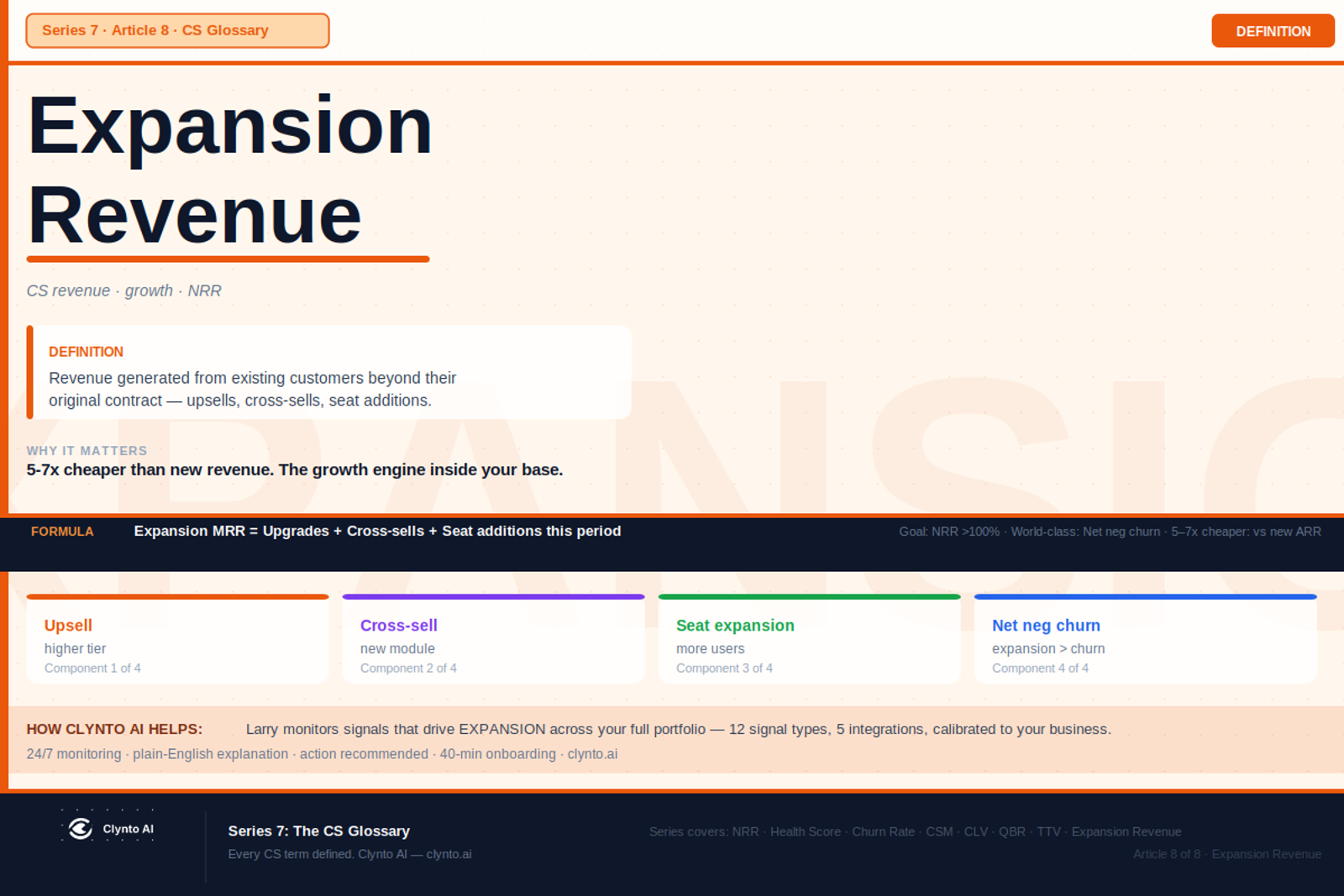
Expansion revenue is revenue generated from existing customers beyond their original contract value — through upsells to higher tiers, cross-sells to new modules, seat additions as teams grow, or usage increases in usage-based pricing models.
Formula: Expansion MRR = Upsells + Cross-sells + Seat additions this period
Expansion revenue is the primary driver of NRR above 100%. It's also the most capital-efficient revenue your business generates — no new acquisition cost, no new sales cycle, no new onboarding from scratch.
Why Expansion Revenue Is CS's Greatest Opportunity
Acquiring a new customer costs 5–7x more than expanding an existing one. No prospecting. No lengthy sales cycle. No trust to build from zero.
But expansion revenue requires something new customer revenue doesn't: an existing customer who is succeeding. Customers don't expand into products that aren't working for them. They don't add seats to tools their teams don't use. They don't upgrade tiers they haven't filled.
This is why expansion revenue is fundamentally a CS outcome — not a sales outcome. The CS team is the one that drives adoption, builds trust, and creates the conditions under which expansion becomes natural.
The Three Types of Expansion
Upsell: Moving a customer to a higher pricing tier — more features, more capacity, more support. Requires the customer to have outgrown or be close to outgrowing their current tier.
Cross-sell: Introducing a customer to a product or module they don't currently use. Requires the customer to have a problem that the new module solves — which CS identifies through regular engagement.
Seat expansion: Adding users within the same product. The most natural expansion motion for collaborative SaaS — happens when adoption within the customer's organisation grows.
The Net Negative Churn Goal
The pinnacle of CS expansion motion: net negative churn.
Net negative churn happens when the expansion revenue from existing customers exceeds the revenue lost to churn and contraction — meaning your existing customer base grows in value even as some customers leave.
This is the single most powerful growth mechanic in SaaS. Companies with net negative churn grow even with no new customer acquisition.
Benchmark: >100% NRR = growing base. Best-in-class aim for NRR 120%+ through systematic expansion.
How Clynto AI Drives Expansion Revenue
Most expansion opportunities are missed not because CSMs don't want to find them — but because they don't have the bandwidth to look across their full portfolio for the signals.
Larry flags expansion signals continuously: accounts whose usage breadth suggests readiness for additional modules, teams not yet onboarded to the platform, usage patterns that match the profile of customers who have historically expanded.
These surface as prioritised actions in the CSM Feed — not "accounts to check eventually" but "call this account today, here's why, here's the opening." CSMs who use Larry expansion signals convert more expansion opportunities at higher rates — because the timing is right and the context is already built.
Clynto AI is currently in pre-launch.
[Get demo → clynto.ai]
Lucas Bennett
Clynto AI
Customer Success practitioner with over 10 years building CS teams from scratch across US, Canada, Singapore as a CSM, team lead, CS leader, and consultant.
Book 20 min with Lucas