CS Education
What Is Time to Value (TTV) — The Metric That Predicts Churn
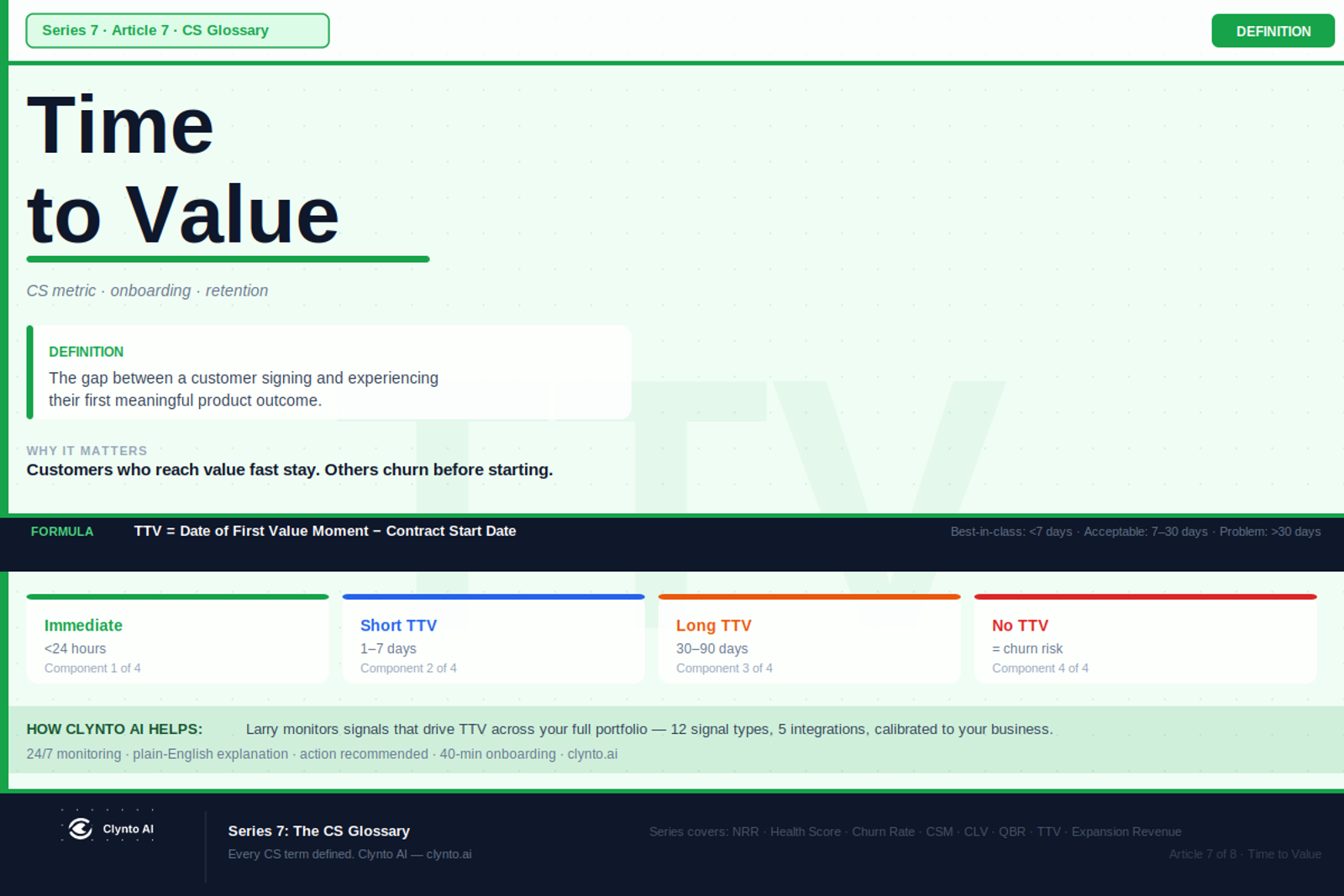
Time to Value is the gap between a customer signing and experiencing their first meaningful outcome. It's the onboarding metric most CS teams don't track — and the one that predicts long-term retention better than any other.

What Is Time to Value (TTV) — The Metric That Predicts Churn
Customers who reach value quickly stay. Customers who don't churn before they ever really start.
The Definition
Time to Value (TTV) is the time elapsed between a customer signing a contract and experiencing their first meaningful outcome from your product — their "first value moment."
Formula: TTV = Date of First Value Moment − Contract Start Date
The "first value moment" is the specific event that demonstrates your product is working for this customer. For a CS platform, it might be the first churn signal detected. For a project management tool, it might be the first project completed. It should be defined explicitly by your CS team — not assumed.
Why TTV Predicts Long-Term Retention
Customers who experience value quickly are significantly more likely to:
- Complete onboarding
- Adopt more features
- Expand their usage
- Renew at full ARR
- Refer other customers
Customers who reach their first value moment slowly — or never — are significantly more likely to churn before their first renewal, regardless of how good your product actually is.
The research is consistent across SaaS: the speed of first value is one of the strongest predictors of long-term retention. It matters more than deal size, industry, or customer sophistication.
The TTV Spectrum
Immediate TTV (<24 hours): The customer sees value on the same day they start. Clynto AI's 40-minute onboarding to first insight is designed around this.
Short TTV (1–7 days): The customer is fully onboarded and has reached a meaningful outcome within their first week. Best-in-class for most SaaS products.
Medium TTV (7–30 days): Acceptable for complex enterprise products with lengthy integration requirements.
Long TTV (30–90 days): A risk signal. Customers waiting 90 days for value have usually evaluated whether they made the right decision before value arrives.
No TTV: The customer never reaches a clear first value moment. This is the churn that's already decided — it just hasn't renewed yet.
What Drives Long TTV — And How CS Fixes It
Complex onboarding. Too many steps before the first win. CS fix: identify the fastest path to the first value moment and strip everything else out of the first session.
Generic onboarding. A standard onboarding that doesn't account for what this specific customer is trying to achieve. CS fix: personalise onboarding to the customer's primary use case before day one.
No first value moment defined. The CS team doesn't know what "first value" looks like for this customer type. CS fix: define it explicitly during the sales-to-CS handoff.
Slow data connection. Integration delays push TTV out before the customer ever uses the product. CS fix: prioritise fast connection above all else.
How Clynto AI Minimises TTV
Clynto AI's entire onboarding architecture is designed around a single constraint: first insight in 40 minutes.
Connect your CRM — accounts imported immediately. Connect your stack — each integration in under 2 minutes. Larry interviews your team — 8 topics, your CS motion captured. First signal surface — Larry reads your accounts, applies your context, and identifies the account that needs attention today.
Zero implementation team. Zero professional services. First value moment before you finish your first session.
Clynto AI is currently in pre-launch.
[Get demo → clynto.ai]
Lucas Bennett
Clynto AI
Customer Success practitioner with over 10 years building CS teams from scratch across US, Canada, Singapore as a CSM, team lead, CS leader, and consultant.
Book 20 min with Lucas