CS Tools & Strategy
Why Lean CS Teams Outgrow Enterprise Platforms - And What They Do Next
Enterprise CS platforms are excellent - for the teams they were built for. Here's why lean CS teams often find them the wrong fit, and what the right alternative actually looks like.

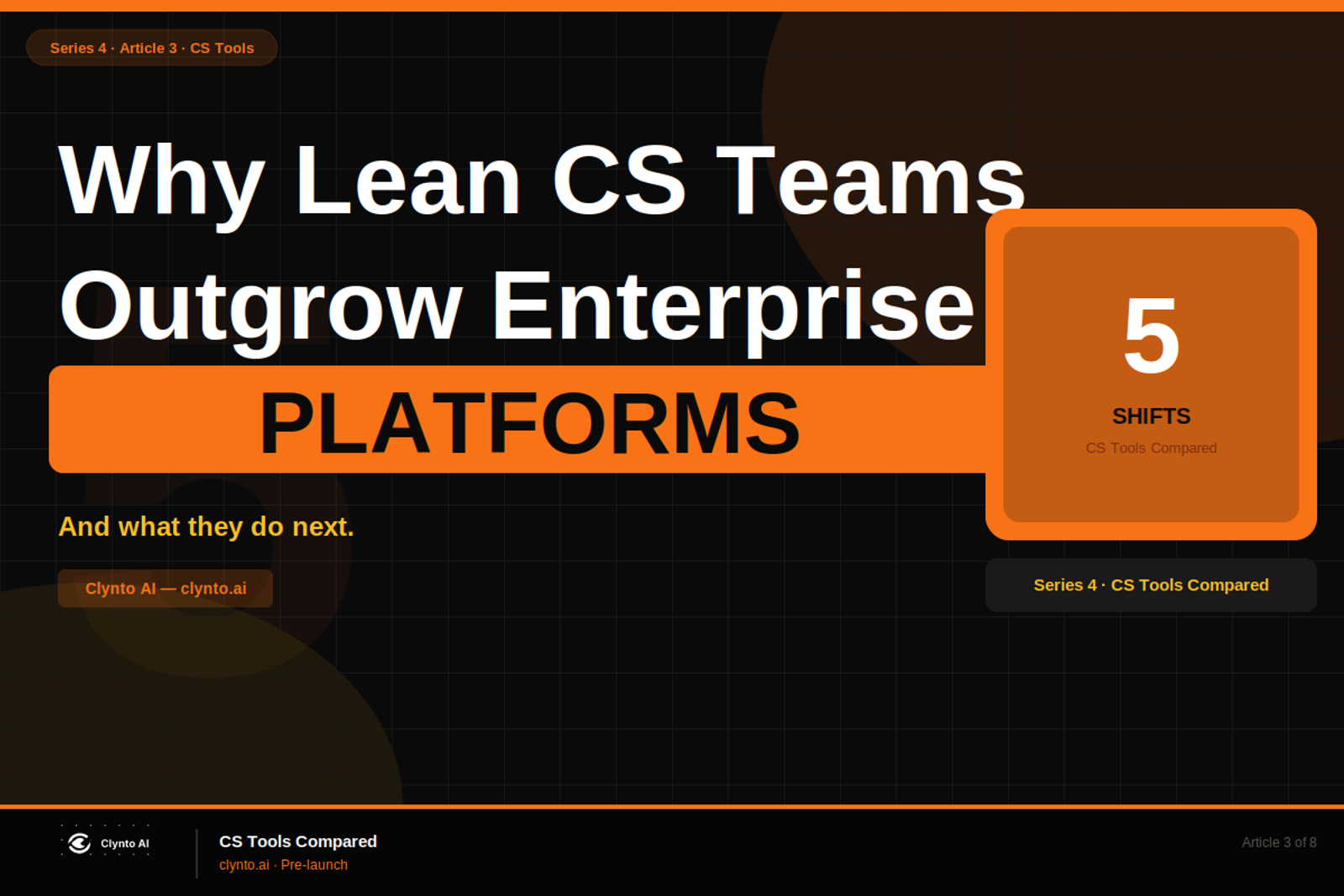
Why Lean CS Teams Outgrow Enterprise Platforms — And What They Do Next
Enterprise CS platforms are powerful. They're also designed for a specific type of CS team. If yours isn't that type, the fit problem is predictable — and fixable.
The Design Mismatch Nobody Talks About
Enterprise CS platforms are genuinely impressive pieces of software. They're built to handle complex account hierarchies, advanced workflow automation, sophisticated reporting, and the operational needs of a large, well-resourced CS organisation.
That's exactly the problem for lean CS teams.
A 2–5 person CS team evaluating an enterprise platform isn't making a bad decision because the platform is bad. They're making a mismatch decision — choosing a tool designed for a team ten times their size, with ten times their operational capacity.
The result is predictable: a long implementation, a configuration burden that exceeds the team's bandwidth, an adoption gap, and a renewal conversation that's harder to justify than expected.
This article isn't a critique of enterprise platforms. It's an honest explanation of the five ways lean CS teams tend to outgrow — or never grow into — the enterprise platform model.
Shift 1: Implementation Timelines Don't Match Team Velocity
Enterprise platforms are built to be deeply configurable. That configurability is the source of their power — and the source of the implementation challenge for lean teams.
A platform that can be configured to support a 50-person CS Ops organisation requires significant setup before it delivers value. Health score rules, playbook configuration, integration mapping, dashboard design — these are not light tasks, and they require someone with both platform expertise and CS motion knowledge to do well.
For a lean team without a dedicated CS Ops resource, this setup either doesn't get done properly, or it consumes bandwidth that should be going to actual customer work.
The right platform for a lean team delivers value in days or hours — not months.
Shift 2: The CS Ops Dependency Doesn't Exist
Enterprise CS platforms are architected around a CS Ops function that configures, maintains, and evolves the platform over time. When a health score rule needs updating, when a new playbook needs building, when an integration breaks — there's a dedicated person to fix it.
Most lean CS teams don't have this function. The CSM is also the CS Ops person. The team leader is also the platform administrator. This works when the platform demands little — and breaks down when the platform demands significant ongoing maintenance.
Lean teams need platforms that are self-maintaining by design: signal intelligence that updates automatically, integrations that don't require manual re-mapping, onboarding that calibrates to the business once and stays accurate.
Shift 3: The Daily Workflow Doesn't Match
Enterprise platforms surface data through dashboards, reports, and configurable views. The CSM navigates to the data they need. This works when the CSM has time to navigate — and when the platform has been configured to show them the right data.
Lean CS teams operating at high account-per-CSM ratios don't have navigation time. They need the insight to find them, not the other way around.
The shift: from a CS platform that stores and displays data, to a CS platform that proactively surfaces the account that needs attention today — with context, explanation, and a recommended action — before the CSM goes looking.
Shift 4: AI Features Need a Foundation to Work
Most CS platforms have added AI capabilities in recent years. These features are genuinely useful — but they're most effective when the underlying platform is already well configured, with clean data, calibrated health scores, and active workflows.
For a lean team still in the implementation phase, the AI features are the last things to become useful — because they depend on the foundation that takes months to build.
The alternative: an AI-native platform where the intelligence layer is the foundation, not a feature added on top. Where Larry monitors 12 signal types from day one, without requiring the workflow infrastructure to be built first.
Shift 5: The ROI Timeline Doesn't Match the Contract
Enterprise platform contracts are typically 12 months. Enterprise platform implementations often take 6–12 months. The lean CS team that signs a 12-month contract and reaches full capability at month 9 has had 3 months of actual value — in a 12-month billing cycle.
This is structurally misaligned for lean teams that need to demonstrate ROI quickly to justify CS investment internally.
The right platform for a lean team delivers a demonstrable ROI signal within the first 30–60 days: a churn risk flagged, a renewal prepped in 2 minutes, a champion silence caught before it became a surprise.
What Lean Teams Are Moving To
The common denominator in what lean CS teams are looking for when they recognise this mismatch:
Fast time to value. Days or hours, not months. First insight before the end of the first session.
AI that works without infrastructure. Signal intelligence that doesn't require playbooks, health score rules, and CS Ops configuration to function.
A daily workflow that requires no navigation. The platform tells the CSM where to go — not the other way around.
Pricing that matches team size. Not enterprise licence fees designed for large organisations.
Clynto AI is built specifically for this. 40-minute onboarding. Larry monitors 12 signal types from day one. No dedicated admin required. First signal before end of session.
For lean CS teams, this is what the right fit looks like.
Lucas Bennett
Clynto AI
Customer Success practitioner with over 10 years building CS teams from scratch across US, Canada, Singapore as a CSM, team lead, CS leader, and consultant.
Book 20 min with Lucas