Customer Success
How a 2-Person CS Team Can Manage 200 Accounts Without Burning Out
Most CS leaders think scale is a headcount problem. It isn't. A 2-person team managing 200 accounts isn't a staffing crisis - it's a systems problem. Here's exactly how Clynto AI makes it not just possible, but sustainable.
How a 2-Person CS Team Can Manage 200 Accounts Without Burning Out
Scale isn't a headcount problem. It's a systems problem. Here's the difference — and how to fix it.
The Math Every SMB CS Leader Knows Too Well
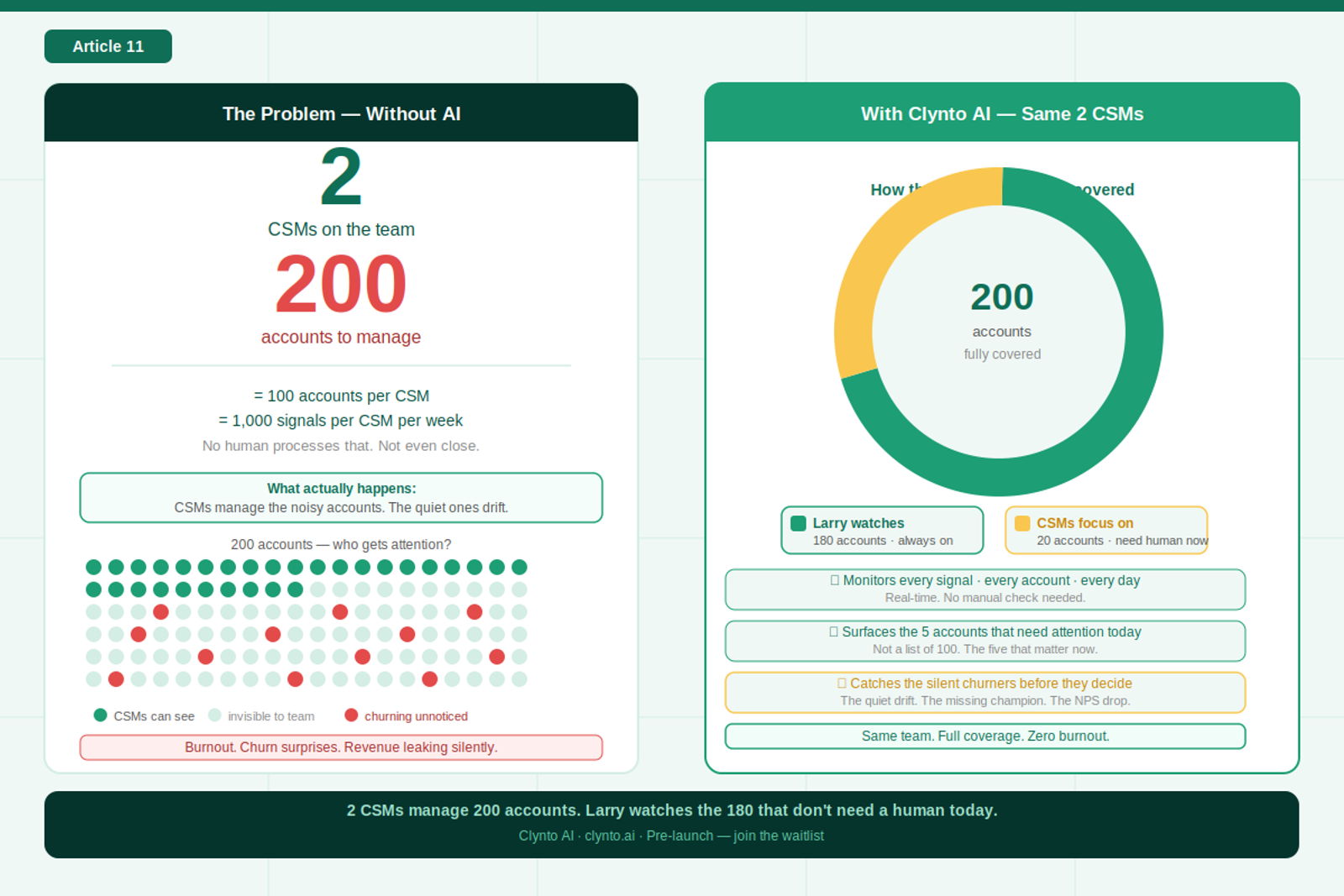
Two CSMs. Two hundred accounts.
That's one hundred accounts per person. Each generating signals across product usage, support, billing, stakeholder activity, and NPS — every single week.
At ten signals per account, that's one thousand data points per CSM per week to monitor, process, and act on.
No human does that. Not even close.
So what actually happens? The CSMs manage the accounts they know about. The ones that are noisy. The ones that email. The ones that are coming up for renewal.
The other sixty — the quiet ones, the drifting ones, the ones three weeks away from deciding not to renew — get a glance at best.
This isn't a failure of effort. It's a failure of infrastructure.
And the solution isn't to hire a third CSM. That gets you to sixty-seven accounts per person — still an impossible monitoring load, just with a bigger payroll.
Why Headcount Doesn't Solve the Scale Problem
The assumption buried in most CS scaling conversations is that if you add more CSMs, you add more coverage. And that's true — but only for the relationship work.
The monitoring work — the continuous, signal-by-signal watching of every account — doesn't get proportionally easier with more headcount. Because the work itself doesn't scale with humans. It scales with systems.
Here's what a third CSM actually adds:
- More relationship capacity ✓
- More renewal bandwidth ✓
- More hours for QBRs and check-in calls ✓
Here's what a third CSM doesn't add:
- The ability to monitor 67 accounts simultaneously, in real time ✗
- Pattern recognition across multiple signals at once ✗
- Awareness of the account that's drifting silently while the CSM is on another call ✗
The monitoring problem doesn't get solved by headcount. It gets solved by AI.
What a 2-Person Team Actually Needs
A 2-person CS team managing 200 accounts doesn't need more people. It needs a layer that handles everything that doesn't require a human — so the two humans can focus on everything that does.
That means:
The AI layer handles:
- Monitoring every signal across every account, continuously
- Identifying which accounts need attention today — and why
- Surfacing stakeholder changes before they become invisible risk
- Building renewal briefs before the CSM opens a tool
- Catching the slow drifters before they become churned accounts
- Flagging cross-signal patterns that no individual alert would catch
The humans handle:
- Building relationships
- Running renewal conversations
- Navigating internal politics
- Making judgment calls
- Expanding accounts
- Being the face of the product
This isn't theoretical. It's a division of labour. And it's the only division of labour that actually lets two people do the work of five — without burning out.
The Day-to-Day Reality With Clynto AI
Here's what a Monday morning looks like for a 2-person CS team running Clynto AI:
8:30am. Both CSMs open their Larry dashboard. Not a list of 100 accounts to review. A prioritised action list — the five accounts across their combined portfolio that need attention today, with specific context on why.
8:45am. CSM 1 sees that Acme Corp's champion went quiet 12 days ago and renewal is in 28 days. Larry has already built the renewal brief. She calls Acme Corp at 9am — informed, prepared, and not surprised by anything in the room.
9:00am. CSM 2 sees that TechFlow's usage dropped 30% in the reporting module over the last three weeks. Larry flagged it before it crossed into red territory. He sends a proactive email — not a check-in, a specific message about the reporting module with a fix attached.
Neither CSM spent Monday morning reviewing 100 accounts. They spent it acting on the five that mattered.
The other 195? Larry is watching them. Continuously. In real time. Without being asked.
The Accounts That Would Have Churned
In a traditional 2-person team running on a CS platform without AI, certain accounts churn predictably.
The ones that never complain. That log in but don't engage deeply. That have a champion who's been distracted for six weeks. That have a product friction point that went unresolved because the support ticket got closed but the CSM never followed up.
These accounts don't make noise. They don't end up in anyone's Monday morning triage. They just quietly reach renewal and decide not to continue.
With Larry, these are exactly the accounts that get caught — because Larry is specifically built to surface the signals that don't announce themselves.
The champion going quiet. The feature adoption plateauing. The NPS that dropped two points and had a comment nobody actioned. The billing contact that changed.
Larry watches for the absence of signal, not just the presence of it.
In a 200-account portfolio, if Larry catches three accounts per quarter that would otherwise have churned — at an average ARR of $40,000 — that's $120,000 in retained revenue per quarter.
That's not a nice-to-have. That's the business case for the entire CS function.
How Clynto AI Makes 200 Accounts Manageable
Clynto AI wasn't designed as an enterprise tool that gets parachuted into a 50-person CS org. It was built to be the AI layer for lean CS teams — the teams where every account matters and every churn has a name attached to it.
Here's what makes it work for a 2-person team specifically:
Setup in 40 minutes, not 6 months. A 2-person team doesn't have six months to spend on implementation. Clynto connects to your CRM, your analytics stack, and your support platform in under 40 minutes. First insight lands before the end of the day you sign up.
Larry learns your accounts, not just your data. Before Larry starts monitoring, it interviews your team about how your business works. What does a healthy 90-day account look like? What signals matter in your enterprise segment versus your SMB segment? Larry builds its pattern recognition around your answers — so every alert and recommendation is relevant to your specific portfolio, not a generic template.
Prioritised actions, not dashboards to manage. A 2-person team can't afford to manage a dashboard. They need to know where to go. Every morning, Larry surfaces the accounts that need attention today — with context on why, and a recommended opening move. The CSMs act. They don't triage.
Always-on coverage across all 200 accounts. When CSM 1 is on a call, CSM 2 is in a QBR, and the rest of the team doesn't exist — Larry is still watching every account. There's no coverage gap. No account goes dark. No signal gets missed because both humans were busy doing human work.
The Scalability Argument in One Sentence
A 2-person CS team with Clynto AI doesn't manage 200 accounts.
They manage the twenty accounts that need a human right now — while Larry manages the other 180.
That's not burnout. That's leverage.
Clynto AI is currently in pre-launch. Built for lean CS teams who need to punch above their weight — without burning out.
[Get the early access → https://clynto.ai/demo]
Lucas Bennett
Clynto AI
Customer Success practitioner with over 10 years building CS teams from scratch across US, Canada, Singapore as a CSM, team lead, CS leader, and consultant.
Book 20 min with Lucas