Churn & Retention
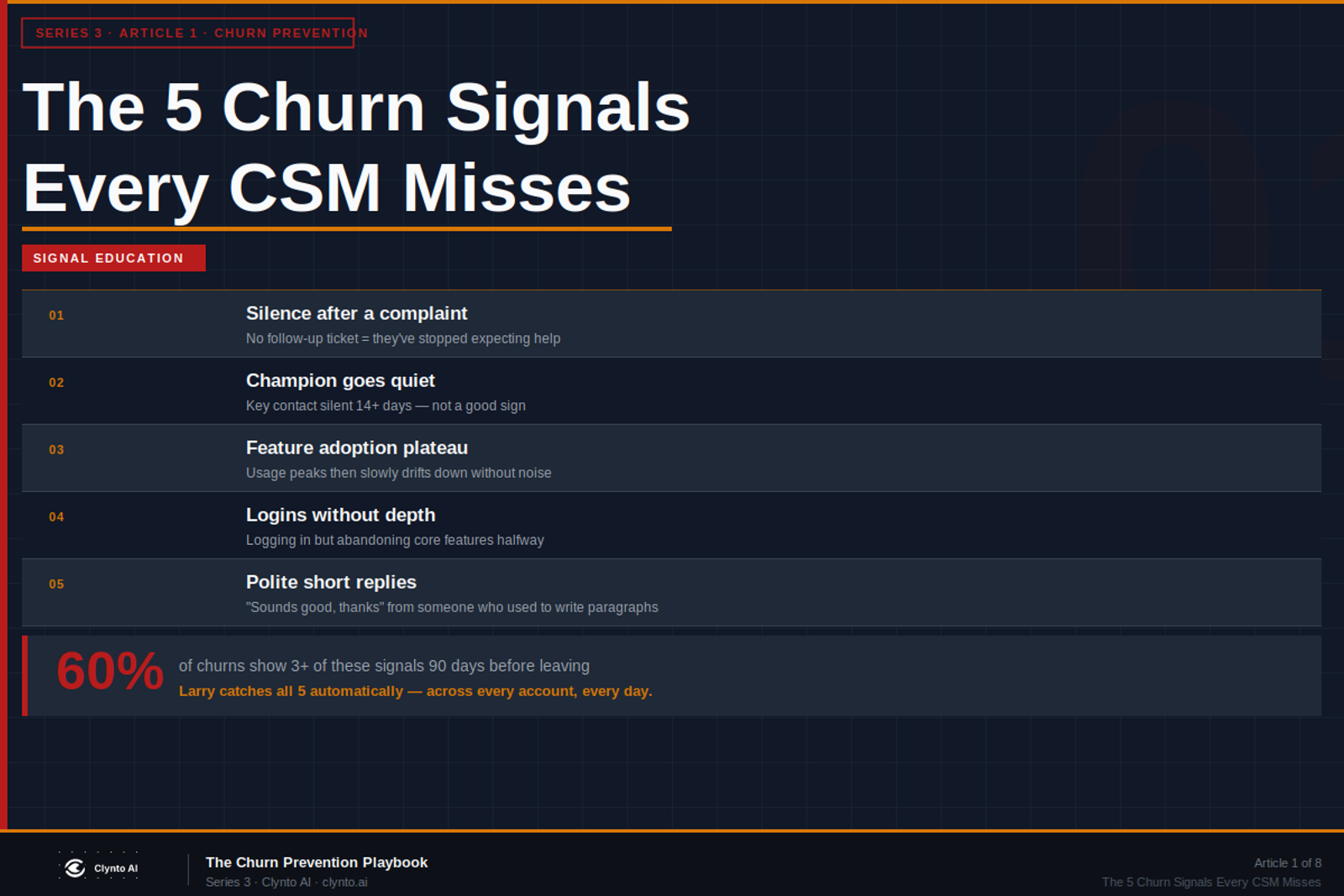
The 5 Churn Signals Every CSM Misses
Your accounts don't churn without warning. They warn you 90 days out — in signals most CSMs are trained to overlook. Here are the five your team is missing right now.

On this page
The 5 Churn Signals Every CSM Misses
Your accounts don't churn without warning. They warn you — but in signals that don't announce themselves. Here are the five most commonly missed.
Why CSMs Miss Churn Signals
The churn signals CSMs watch for are the obvious ones. Red health scores. Escalated tickets. Direct complaints. A customer who emails and says "we're evaluating alternatives."
These signals matter. But by the time they appear, the decision is often already made.
The signals that actually predict churn — the ones that appear 60 to 90 days before renewal — are quieter. They don't arrive in your inbox. They require someone to be watching for them systematically, across every account, every day.
Most CS teams aren't built to do that. Here's what they're missing.
Signal 1: Silence After a Complaint
When a customer raises an issue and your team resolves it, the natural assumption is that the issue is closed. But silence after a complaint is one of the clearest early churn signals in CS.
A customer who complains and gets no resolution eventually stops complaining. Not because the problem went away — because they've stopped expecting it to. They've mentally begun the process of leaving.
What to watch for: Accounts that logged support tickets 60–90 days ago, had one exchange, and then went quiet. No follow-up ticket. No CSAT. Just silence.
Larry catches this by correlating ticket closure dates with subsequent engagement drops. The absence of follow-up is the signal.
Signal 2: Champion Goes Quiet
Your champion — the person who championed your product internally, who was your main contact, who showed up to every QBR — hasn't replied to your last two emails. Not with a complaint. Not with an objection. Just… nothing.
Champion silence is one of the highest-predictive churn signals that exists. When the person who cared most about your product stops engaging, it means one of three things: they're overwhelmed, they've lost faith, or they're preparing to leave the company.
All three are dangerous. None of them look alarming on a health score dashboard.
What to watch for: Contacts who previously replied within 24 hours and are now at 14+ days without response.
Larry flags Champion Loss when a key contact has been silent for 21+ days — before the relationship goes cold.
Signal 3: Feature Adoption Plateau
In a healthy account, feature adoption grows over time. New users onboard. New use cases emerge. The product gets deeper into the workflow.
When feature adoption plateaus — when the account was growing and then simply stopped — it's a signal that the customer has reached the limits of how they intend to use the product. They're not expanding. They're waiting to see whether to continue.
What to watch for: Accounts where Mixpanel shows feature breadth flat for 4+ consecutive weeks after a period of growth.
Larry monitors feature breadth against workspace median and flags accounts where adoption has stalled without explanation.
Signal 4: Logins Without Depth
Usage data is one of the most misleading metrics in CS because it measures activity, not value. An account with daily logins but zero core feature usage is not a healthy account — it's a habitual one.
Customers who log in out of habit — checking a dashboard, reviewing a report — without engaging deeply with the product are often the closest to churning. They're present without being invested.
What to watch for: Accounts with consistent login frequency but declining time-on-feature and declining feature breadth over 30 days.
Larry reads the difference between active engagement and habitual logins through Mixpanel event depth tracking.
Signal 5: Short, Warm Replies From Power Users
This is the signal almost nobody catches — and one of the most reliable predictors of impending churn.
A customer who used to write you three-paragraph emails is now replying with "Sounds good, thanks." The warmth is still there. The engagement is gone.
This pattern — polite, brief, non-committal replies from previously engaged stakeholders — indicates that the customer has mentally stepped back from the relationship. They're still in contract. They're no longer invested.
What to watch for: Contacts with a history of detailed, engaged responses who have shifted to one-line replies over the past 30 days.
Larry tracks engagement cadence and flags accounts where stakeholder response depth has measurably declined.
Why These Five Signals Are Missed
They all share one characteristic: they require someone to be watching for the absence of something, not the presence of something.
Traditional CS monitoring is alert-based. Something fires because a condition was met. These five signals fire when a condition stops being met — and rule-based systems don't catch absence.
AI does.
Larry monitors all five signal types across every account daily. When the combination of signals reaches a threshold, Larry surfaces the account with a plain-English explanation of what's changed and a recommended next action. Your CSMs don't triage — they act.
Clynto AI’s Larry catches churn signals before they become surprises.
[Click for demo → clynto.ai]
Lucas Bennett
Clynto AI
Customer Success practitioner with over 10 years building CS teams from scratch across US, Canada, Singapore as a CSM, team lead, CS leader, and consultant.
Book 20 min with Lucas