Customer Success Leadership
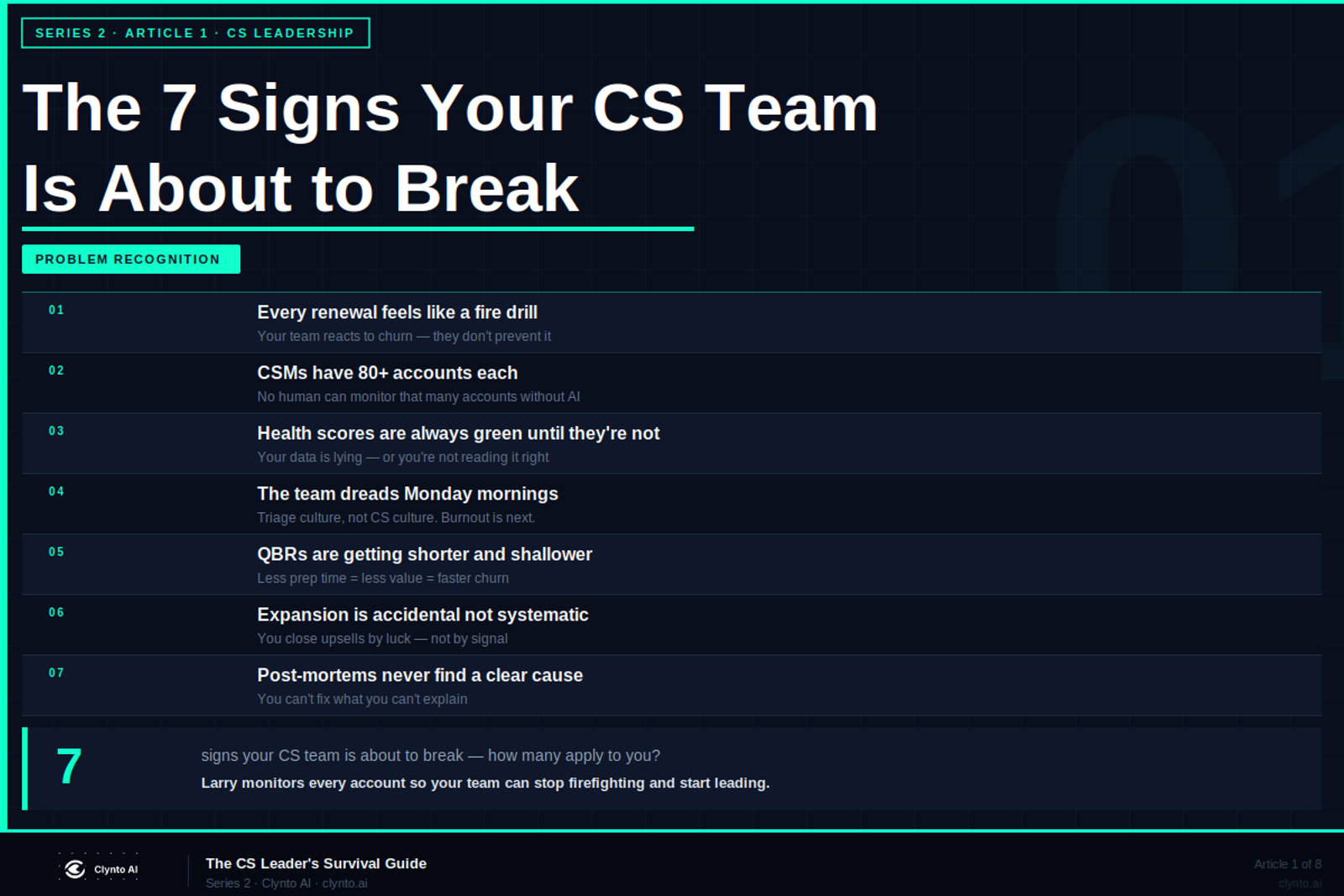
The 7 Signs Your CS Team Is About to Break
Every CS team has warning signs before it breaks. Most leaders miss them until it's too late. Here are the 7 signals your team is heading toward breakdown — and what to do before it lands.

On this page
The 7 Signs Your CS Team Is About to Break
Every CS team breaks eventually. The leaders who catch it early are the ones watching for the right signals.
Why CS Teams Break Quietly
CS team breakdown doesn't arrive with an announcement. It accumulates. It's a renewal that almost didn't close. A CSM who resigns without a clearly articulated reason. A churn that nobody saw coming. A post-mortem meeting where the team sits in silence because there's no clear cause and no clear fix.
By the time a CS leader realises their team is in trouble, the breakdown is usually already months in the making. Here are the seven signals that precede it — in order of how early they typically appear.
Sign 1: Every Renewal Feels Like a Fire Drill
When renewals require full-team mobilisation, emergency outreach, and leadership involvement to close — your CS motion is reactive, not proactive. The renewal isn't the problem. The problem is that the team has no early warning system to address at-risk accounts 60–90 days before the renewal conversation.
A fire drill culture compounds. Each crisis takes bandwidth from the accounts that are quietly drifting. Those accounts become next quarter's fire drills.
Sign 2: CSMs Are Managing 80+ Accounts Each
Portfolio size is one of the most direct predictors of team breakdown. At 80+ accounts per CSM, something important is happening: the CSM has mathematically given up on proactive monitoring.
They're not choosing to be reactive — they don't have the capacity to be anything else. Human monitoring breaks down somewhere around 30–40 accounts without an AI layer. Everything above that is covered by gut feel and squeaky wheels.
Larry gives CSMs back the coverage they lost above that threshold — monitoring every account continuously so humans can focus on the ones that need them today.
Sign 3: Health Scores Are Always Green Until They're Not
If your CS platform has never shown you a red account that surprised you — it's not because your portfolio is healthy. It's because your health scoring is too slow, too averaged, or too dependent on activity metrics that miss what matters.
Accounts that churn with green health scores are the leading indicator of a broken monitoring system. When this happens repeatedly, the team stops trusting the data — and starts relying on instinct. That's when things break fastest.
Sign 4: The Team Dreads Monday Mornings
Triage culture is the clearest signal of impending CS team breakdown. When Monday morning means opening a list of firefighting tasks from the weekend rather than a prioritised action plan for the week — you have a structural problem, not a people problem.
CSMs who spend their energy on triage don't have energy for relationships. Relationships are what renew accounts. When the energy runs out, so does the retention.
Sign 5: QBRs Are Getting Shorter and Shallower
QBR preparation time is one of the most reliable leading indicators of CS team health. When CSMs are pulling data manually the morning of the QBR rather than building deep account context over weeks — the QBRs become update calls. Customers notice. The relationships get shallower. Expansion conversations stop happening.
Larry builds full QBR briefs in under 8 minutes. The preparation problem is solvable — but only if CS leaders recognise it as a structural issue, not a CSM effort issue.
Sign 6: Expansion Is Accidental, Not Systematic
When expansion revenue comes from customers who asked for more — rather than from CSMs who proactively identified and proposed the opportunity — expansion is accidental. Accidental expansion doesn't scale. It doesn't compound. And it creates a false sense of NRR health that masks the absence of a real expansion motion.
A CS team with no systematic expansion process is sitting on significant revenue it isn't accessing — while misattributing its NRR to CS effectiveness.
Sign 7: Post-Mortems Never Find a Clear Cause
The most demoralising sign of a breaking CS team: the churn post-mortem that ends without a clear cause. The team runs through the account timeline. The health score was green. The last call was fine. The product was working. Nobody can explain why the customer left.
When post-mortems repeatedly fail to find a clear cause, it means the monitoring system can't see what's actually driving churn. That's not a signal to investigate further — it's a signal to replace the monitoring system with one that can.
The Common Thread
All seven signs share one root cause: the CS team is operating without an intelligent layer that can process the volume of signals required to be genuinely proactive at scale.
The solution isn't more CSMs. The solution is an AI layer underneath the existing team that handles monitoring, prioritisation, and signal intelligence — so the humans can do the human work that actually prevents breakdown.
Clynto AI’s Larry monitors every account so your team can stop firefighting and start leading.
[Get the demo → clynto.ai]
Lucas Bennett
Clynto AI
Customer Success practitioner with over 10 years building CS teams from scratch across US, Canada, Singapore as a CSM, team lead, CS leader, and consultant.
Book 20 min with Lucas