AI in Customer Success
AI vs. Automation in CS — What's the Difference?
CS leaders use "AI" and "automation" interchangeably. They shouldn't. One executes rules. The other reads context. The difference between them determines whether your CS team gets more efficient — or actually more effective. Here's the distinction that matters.

On this page
AI vs. Automation in CS — What's the Difference?
Both words appear on every CS vendor's homepage. They mean completely different things — and the difference determines what your team actually gets.
Why This Distinction Matters
When CS leaders say they want "AI in their CS platform," they often mean one of two very different things.
Some mean: "I want workflows that run automatically without my team triggering them manually."
Some mean: "I want a system that reads what's happening across my accounts and tells my team what to do."
The first is automation. The second is AI. They are not the same thing — and buying one when you need the other is one of the most common expensive mistakes in CS technology.
What Automation Does
Automation executes rules.
If an account's health score drops below 40, send an email. If a renewal is 30 days away, create a task. If a support ticket is open for 72 hours, notify the CSM.
This is genuinely useful. Automation removes the manual trigger — the human who has to remember to check, remember to act, remember to send. It reduces the admin burden and ensures consistent process execution.
But automation has a hard ceiling.
It only fires when conditions are explicitly met. It doesn't read context. It doesn't notice that the account with a 72-hour open ticket is also 45 days from renewal with a champion who's been silent for three weeks. It fires the notification because the rule said to. It has no idea what it means.
Automation is fast. It is not intelligent.
What AI Does
AI reads context.
It doesn't wait for a single rule condition to trigger. It reads multiple signals simultaneously — usage, engagement, support, billing, stakeholder activity — and understands what they mean in combination, calibrated to your specific business.
An account with stable logins but declining feature adoption, a champion who responded to your last three emails in under an hour but hasn't opened the last two, and a renewal in 28 days — no single automation rule catches that pattern. AI reads it and surfaces it immediately.
AI is the difference between a system that fires when conditions are met and a system that understands what's happening.
The Side-by-Side
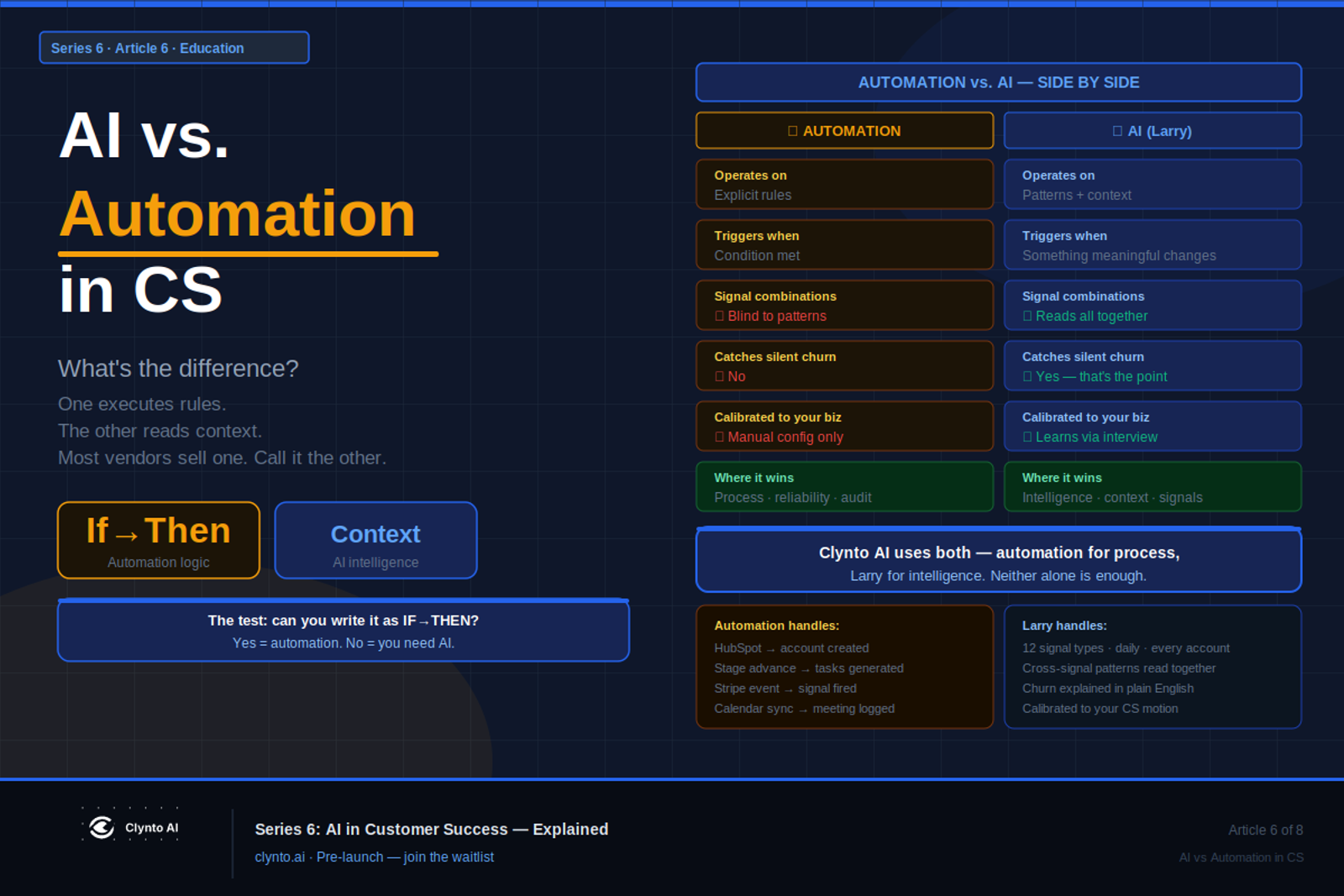
| Automation | AI | |
|---|---|---|
| Operates on | Explicit rules | Patterns + context |
| Triggers when | Condition met | Something meaningful changes |
| Understands combinations | No | Yes |
| Calibrated to your business | Manually configured | Learns from interview |
| Catches silent churn | No | Yes |
| Gets smarter over time | No | Yes |
| Replaces human judgment | No | No |
| Reduces manual work | Yes | Yes |
Where Automation Still Wins
Automation is not obsolete. There are things it does better than AI — and CS teams that eliminate automation in favour of AI miss this.
Consistent process execution. When a deal closes, create the account in Clynto. When a workflow stage advances, generate the next set of tasks. When a billing event fires, log it immediately. These are deterministic actions that don't require intelligence — they require reliability. Automation delivers that.
High-volume routine touchpoints. Renewal reminder sequences, onboarding check-in cadences, NPS survey triggers — these are rule-based by design. They should run automatically and consistently. AI doesn't need to be involved.
Audit trails and compliance. When your process requires that something always happens — not intelligently, just always — automation is the right tool. AI makes judgment calls. Automation follows rules.
How Clynto AI Combines Both
Clynto AI uses automation for what automation is good at and AI for what automation cannot do. They work together — not as substitutes.
Automation handles:
- HubSpot closed-won → account created in Clynto automatically
- Workflow stage advance → next stage tasks generated instantly
- Stripe billing event → signal fired immediately
- Google Calendar event → meeting logged in account timeline
Larry handles:
- Reading 6 signal types across every account daily — combinations no rule could catch
- Calibrating pattern recognition to your specific business through the onboarding interview
- Surfacing the accounts that need attention today — with context on why and what to lead with
- Explaining churn risk in plain English — not a rule firing, an analysis
The result: Your team gets the reliability of automation for process execution and the intelligence of AI for signal detection. Neither alone is as good as both together.
The One-Sentence Test
If you can write the rule in an if-then statement, you want automation.
If the value comes from reading context across multiple signals simultaneously, you want AI.
Most CS teams need both. Most CS vendors sell one and call it the other.
Book a demo: https://clynto.ai/demo
Lucas Bennett
Clynto AI
Customer Success practitioner with over 10 years building CS teams from scratch across US, Canada, Singapore as a CSM, team lead, CS leader, and consultant.
Book 20 min with Lucas