Customer Success Leadership
The CS Hiring Mistake Every Growing SaaS Makes
Most SaaS companies make the same 5 CS hiring mistakes — and they all compound. Here's what they are, why they happen, and how to build a CS team that actually scales without burning out.
On this page
The CS Hiring Mistake Every Growing SaaS Makes
The mistake isn't a single bad hire. It's a pattern that compounds — and most SaaS companies run it all the way to burnout before noticing.
Why CS Hiring Goes Wrong
Growing SaaS companies hire CS reactively. Churn rises, accounts pile up, CSMs burn out — and the response is to hire more CSMs. This feels rational. It is often exactly the wrong move.
The five mistakes below compound on each other. Each one makes the next more likely. And by the time the fifth is fully established, the CS function has a structural problem that headcount can't solve.
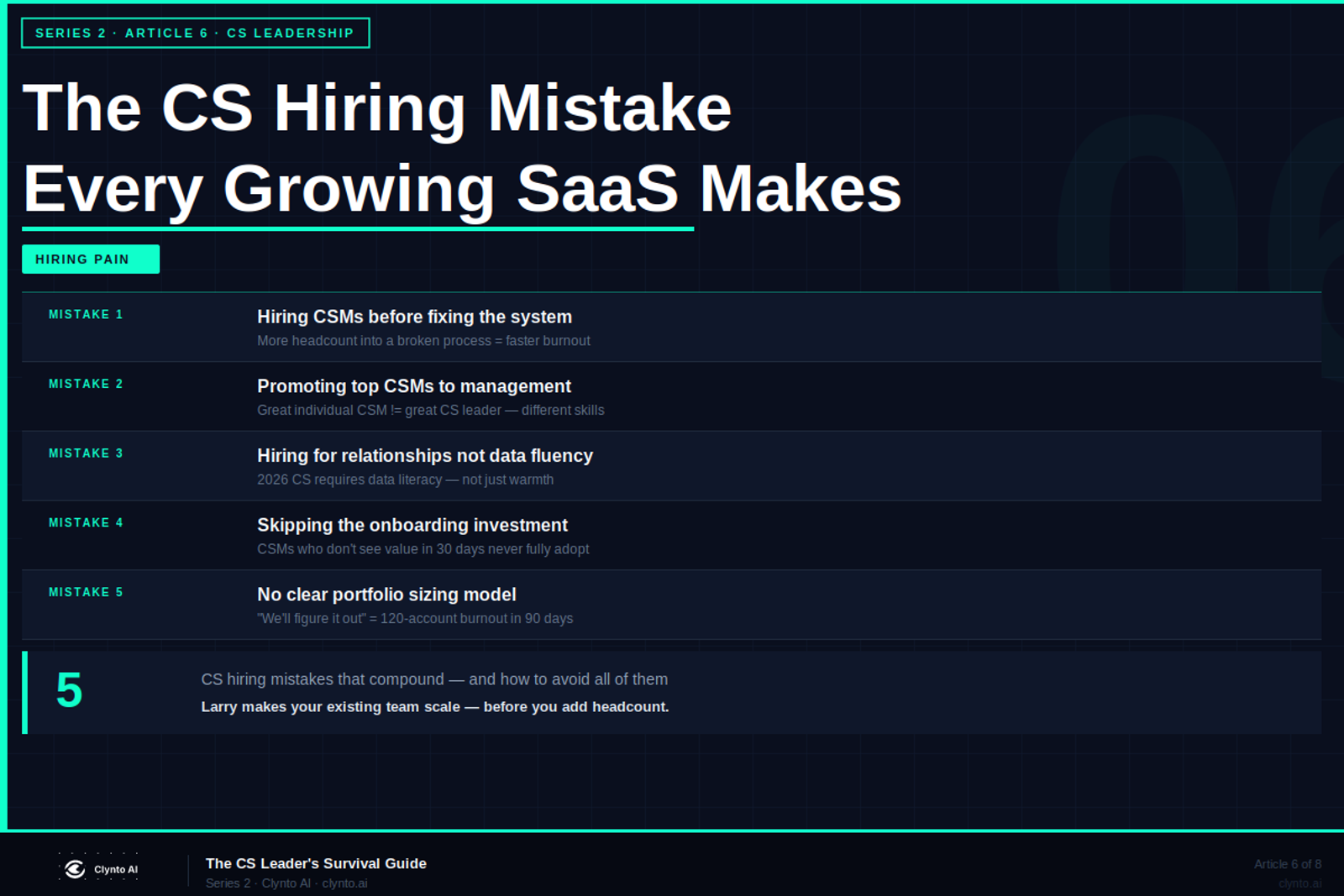
Mistake 1: Hiring CSMs Before Fixing the Process
The most expensive CS hiring mistake: adding headcount into a broken CS motion.
When the team is burning out because of too many accounts, reactive triage culture, and no intelligent monitoring layer — hiring more CSMs adds more people to the same broken process. They onboard, experience the same overload, and either underperform or leave.
The right sequence: fix the structural problem first (monitoring, prioritisation, tooling), then add headcount to execute the improved process. Headcount added before the structural fix is headcount wasted.
Mistake 2: Promoting Top CSMs to Management Without Training
The most well-intentioned CS hiring mistake: rewarding your best CSM with a management role because they're excellent at managing accounts.
The skills required to be an exceptional individual CSM — relationship depth, customer empathy, quick reactions to account signals — are not the skills required to be an exceptional CS manager. Management requires coaching, process design, data fluency, upward communication, and the ability to build and replicate systems. These can be learned, but they need to be developed deliberately.
Promoting without management development investment produces a burnt-out former CSM who misses their accounts and doesn't know how to help their team.
Mistake 3: Hiring for Warmth Over Data Fluency
In 2020, a great CSM needed relationship skills, empathy, and product knowledge. All of these still matter. But in 2026, the CS teams outperforming their peers have one additional trait: data literacy.
The ability to read a usage trend, interpret a signal combination, run a retention model, and build a quantified business case is now a core CS skill — not an advanced one. Hiring CSMs who can only manage relationships cannot be compensated for by better tooling. The tools give you the data. You still need someone who knows what to do with it.
Mistake 4: Skipping the CSM Onboarding Investment
The second-most common cause of CS attrition (after portfolio overload): CSMs who don't reach proficiency in their first 30 days.
When CSMs onboard into a role without clear tooling, clear account prioritisation, and a clear understanding of what success looks like in their first 90 days — they spend those 90 days learning by trial and error. They make avoidable mistakes on live accounts. They lose confidence. And at 90 days, they either stay and underperform, or leave.
The investment in a structured 30-day CSM onboarding program — including tooling training, shadowing, and defined early wins — pays back immediately in first-year retention.
Mistake 5: No Portfolio Sizing Model
"We'll figure out the portfolio sizes as we grow" is how CS teams end up with CSMs managing 120 accounts each with no AI layer and no clear prioritisation framework.
Portfolio sizing should be decided before hiring — and it should account for the monitoring capability of the team. Without an AI layer, human CSMs can proactively manage somewhere between 30–50 accounts. With an AI layer like Larry, that number scales significantly because the monitoring work is handled by the system, not the human.
Define the portfolio model first. Hire to it deliberately. Adjust it as tooling improves. "Figure it out as we grow" is a burnout plan, not a scaling plan.
Lucas Bennett
Clynto AI
Customer Success practitioner with over 10 years building CS teams from scratch across US, Canada, Singapore as a CSM, team lead, CS leader, and consultant.
Book 20 min with Lucas