AI in Customer Success
The Future of Customer Success: Where AI Takes It Next
The CS industry is at an inflection point. The tools are catching up to the ambition. Here's where AI takes customer success next - what the next three years look like for CS teams that embrace it and for the ones that don't.
The Future of Customer Success: Where AI Takes It Next
The tools are finally catching up to what CS has always tried to be. Here's what that looks like — and what it means for the teams that get there first. #AI #AICSM
Where CS Has Always Been Trying to Go
The ambition of customer success has never been reactive.
Every CS leader who has ever set a team goal has said some version of the same thing: "We want to get ahead of problems before they become problems. We want to know what customers need before they tell us. We want to be the team that drives retention and growth — not the team that manages cancellations."
That ambition is as old as the CS function itself.
The gap has always been infrastructure. Human teams can't monitor everything. Data lives in too many tools. Signals arrive too quietly and too late. The bandwidth required to be genuinely proactive at scale has never existed — until now.
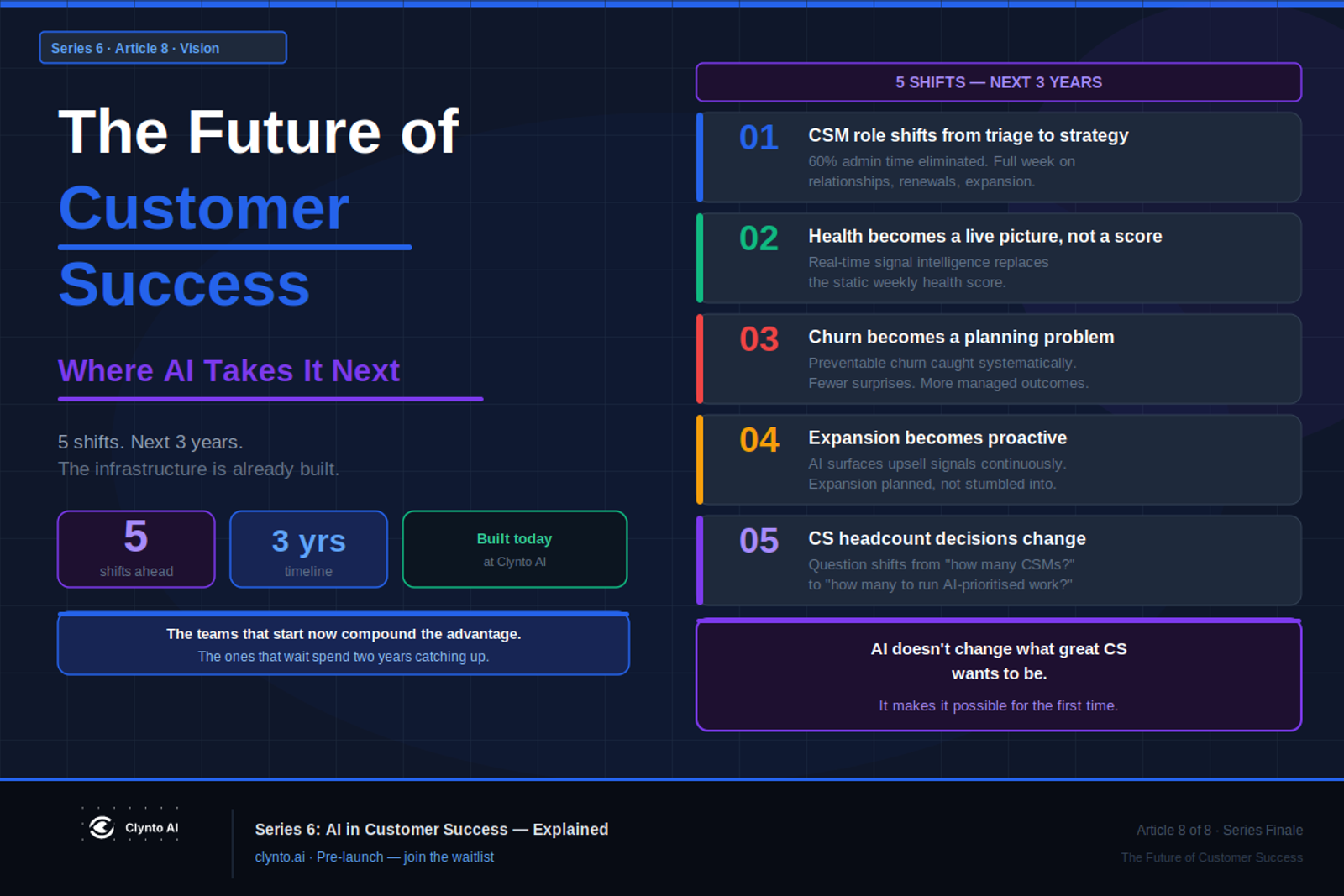
AI doesn't change what great CS wants to be. It makes it possible for the first time.
The Next Three Years — What Changes
1. The CSM's role shifts from triage to strategy
Today, the average CSM spends 60% of their week on work that doesn't require their skills — data-pulling, health score review, admin, template emails. AI eliminates that work systematically.
In three years, the CSMs who remain in the industry will spend the majority of their time on work that only humans can do: building relationships, navigating renewals, driving expansion, and advising customers on how to get more value from your product. The admin layer disappears. The strategic layer expands.
This is not a threat to CSMs. It's the job they wanted when they took it.
2. Customer health becomes a living picture, not a weekly snapshot
The static health score — recomputed weekly, averaging signals that shouldn't be averaged — will be replaced by continuous signal intelligence that updates in real time and reads context, not just conditions.
A customer's health profile will be a live view: what changed today, what's trending, what the combination of signals means in the context of their account history and your business. Not a number. Not a colour. A picture.
3. Churn becomes a planning problem, not a surprise
The surprise churn — the account that left with a healthy score and no warning — will become rare. Not because AI eliminates all churn, but because the signals that precede preventable churn will be caught systematically, weeks earlier than human teams can catch them today.
The CS teams running AI layers in three years will have churn data that looks different from today's: fewer surprises, more managed declines, and a much clearer picture of which churn was preventable and which wasn't.
4. Expansion becomes proactive, not reactive
Today, expansion happens when a customer asks for more — or when a CSM manually identifies an opportunity during a QBR. In three years, AI will surface expansion signals continuously: accounts with usage patterns that suggest readiness for additional seats, teams not yet onboarded, features not yet adopted that match the customer's use case.
Expansion revenue will be planned, not stumbled into.
5. CS headcount decisions change
The question won't be "how many CSMs do we need to cover this portfolio?" It will be "how many CSMs do we need to execute the relationships this AI layer has already prioritised?"
That's a fundamentally different staffing model. Fewer CSMs managing larger portfolios — not because CS matters less, but because the monitoring and intelligence work that justified headcount growth is handled by AI.
What Doesn't Change
The future of CS is not a world without CSMs.
Relationships are human. Judgment is human. The conversation that saves a churning account, the expansion discussion that triples ARR, the moment a customer calls you before they call your competitor — those are human outcomes built through human interaction.
AI handles the infrastructure. Humans drive the outcomes. The best CS teams in three years will be the ones that figured out the division of labour earliest.
Where Clynto AI Is Building
Clynto AI is not a vision. It's a working product — live today, used by real CS teams.
Every capability described in this series exists in the product right now:
- Larry monitoring 12 signal types daily across a full portfolio
- 5 live integrations — HubSpot, Freshdesk, Stripe, Mixpanel, Google Calendar
- 8-topic onboarding interview that calibrates Larry to your specific business
- Daily prioritised action list — without being prompted
- Renewal briefs in under 2 minutes
- Plain-English signal explanations powered by Claude
- 40-minute onboarding with first insight before end of day
The infrastructure for the future of CS is built. The teams that start using it now will have a data and process advantage that compounds every quarter.
The ones that wait will spend the next two years catching up.
Get early access → https://clynto.ai/demo
Lucas Bennett
Clynto AI
Customer Success practitioner with over 10 years building CS teams from scratch across US, Canada, Singapore as a CSM, team lead, CS leader, and consultant.
Book 20 min with Lucas