Customer Success
Health Scores Are Broken. Here's What Should Replace Them.
Every CS team runs on health scores. Every CS team knows health scores lie. A single number that averages usage, NPS, and support tickets into a colour - red, amber, green - isn't intelligence. It's decoration. Here's what actually works.

Health Scores Are Broken. Here's What Should Replace Them.
Every CS team runs on health scores. Every CS team knows, quietly, that health scores lie.
The Problem With a Single Number
Ask a CSM if they trust their platform's health score and watch the hesitation before the answer.
They'll say something like: "It's useful as a starting point." Or: "We use it alongside other things." Or — if they're being honest — "Not really. I go by my gut more than the score."
That hesitation is the entire problem with health scores in one reaction.
A health score takes every signal available about an account — product usage, NPS, support tickets, login frequency, contract size, stakeholder engagement — and collapses it into a single number. Usually a colour. Red, amber, green.
The number feels like intelligence. It isn't.
It's an average. And averages hide the truth.
Why Health Scores Lie
Health scores fail in four specific ways that CS teams encounter every week but rarely name directly.
1. They average signals that shouldn't be averaged
An account with excellent product usage but an unresponsive champion and a missed QBR might score 72 — technically healthy. But any experienced CSM looking at those three signals together would flag it immediately. The score smoothed over the danger.
Averaging different types of signals doesn't produce insight. It produces noise with a confidence interval attached.
2. They treat all accounts the same
A health score of 65 means something completely different for a 30-day-old account still in onboarding than for a 3-year account approaching renewal. Context matters enormously. Generic scores ignore context entirely.
3. They're static
Most health scores update weekly — or when someone manually triggers a recalculation. The account that started drifting on Tuesday isn't reflected in the score your CSM sees on Monday morning. The score shows a snapshot. Reality is a video.
4. They measure activity, not intent
High login frequency doesn't mean the customer is getting value. It might mean they can't find the feature they're looking for. Low ticket volume doesn't mean they're satisfied. It might mean they've given up on getting help. Health scores measure what's easy to measure — not what actually predicts churn.
The Accounts That Fool Every Health Score
There is a category of account that churns with a healthy score almost every time. CS leaders know this pattern.
The account logs in regularly. Doesn't raise support tickets. Doesn't complain. Responds to check-in emails with polite, non-committal replies.
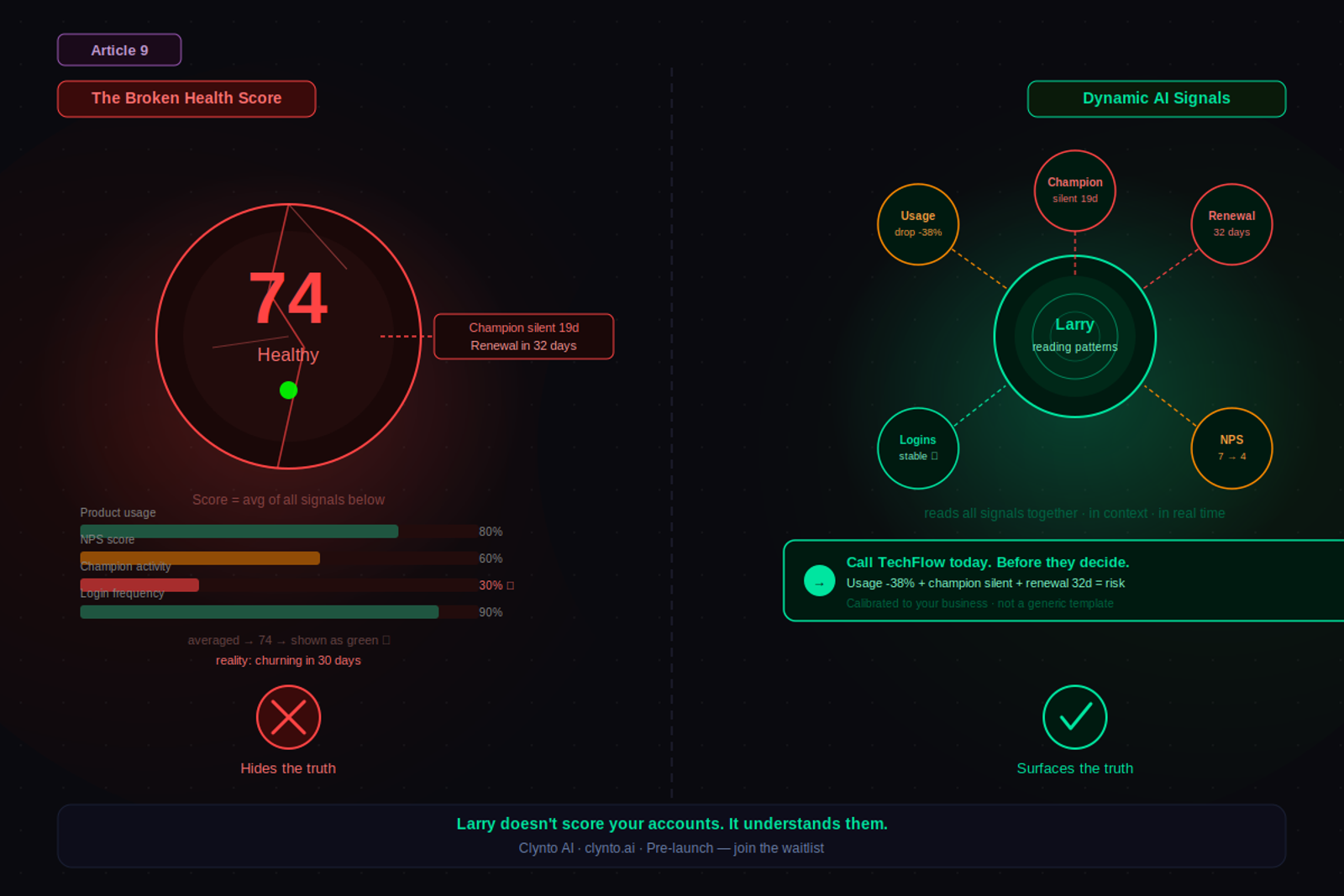
On paper: healthy. Score: 74. Colour: green.
In reality: the champion has quietly started evaluating alternatives. The VP who bought your product has left. The new stakeholder doesn't know your tool exists. Nobody is driving internal adoption any more.
The score never caught any of it. Because the score doesn't read intent. It reads activity.
💡 What a real signal looks like
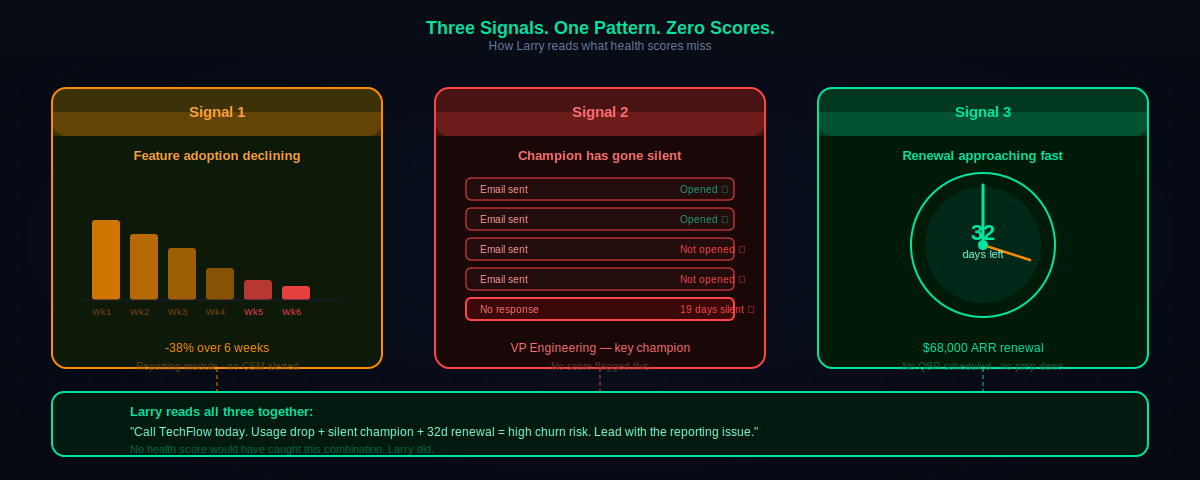
Three signals, read together, in context: Login frequency stable → but feature adoption dropped 40% → and champion hasn't opened an email in 19 days.
Individually: unremarkable. Together: a churn indicator.
This is what health scores can't do. This is what AI does.
What Should Replace Health Scores
The answer is not a better formula. It's a fundamentally different approach to what customer intelligence means.
Instead of one score, you need three things working together:
Dynamic signals, not static scores Real-time reading of every data point — not a weekly recalculation. When an account's usage drops on Wednesday, that information is useful on Wednesday. Not next Monday when the score updates.
Pattern intelligence, not individual metrics Churn doesn't announce itself with a single red flag. It arrives as a combination of signals that, read together, tell a story. The question isn't "is usage down?" — it's "is usage down, AND is the champion quiet, AND is the renewal in 45 days?"
Contextual calibration, not generic benchmarks A signal that predicts churn in a 90-day onboarding account is different from the same signal in a 3-year enterprise account. Intelligence means knowing the difference. Generic health scores don't. AI trained on your specific business does.
How Clynto AI Replaces Health Scores
Larry — Clynto AI's AI CSM layer — was designed specifically around the limitations of health scores. Not as an improvement on the existing model. As a replacement for it.
Larry reads signals, not averages. Instead of collapsing everything into one number, Larry tracks every individual signal across every account — usage patterns, login behaviour, support velocity, stakeholder activity, billing changes, NPS movement — and reads them in combination, not isolation.
Larry updates continuously. There's no weekly recalculation. Every signal change is processed in real time. An account that starts drifting on Tuesday is on Larry's radar by Tuesday afternoon — not the following Monday.
Larry knows your context. Before Larry starts monitoring your accounts, it interviews your CS team. How do you define a healthy account at 90 days? What does churn look like in your enterprise segment versus your SMB segment? Which signals matter most in your specific customer base? Larry's pattern recognition is built on your answers — calibrated to how churn actually happens in your business, not a generic SaaS template.
Larry surfaces stories, not scores. Instead of a dashboard of numbers, Larry tells your CSM: "This account needs attention today. Here's why — usage dropped 38%, the champion hasn't opened an email in 14 days, and renewal is in 32 days. Here's what we'd recommend leading with."
That's not a score. That's intelligence.
The Question to Ask Your Current Platform
Pull up your three most recent surprise churns — accounts that left without obvious warning. Check what their health score was 60 days before they churned.
If any of them were green or amber, your health score system failed. Not because the CSM missed something. Because the score didn't tell them where to look.
A number isn't accountability. It's false confidence.
What your team needs isn't a better score. It's a layer that reads the signals a score can never capture — and tells them what to do before the account has already decided.
Clynto AI is in early access. Larry doesn't score your accounts. It understands them. [Get teh early access → https://clynto.ai/demo]
Lucas Bennett
Clynto AI
Customer Success practitioner with over 10 years building CS teams from scratch across US, Canada, Singapore as a CSM, team lead, CS leader, and consultant.
Book 20 min with Lucas