AI in Customer Success
How AI Is Changing Customer Success in 2026
AI isn't coming to customer success. It's already here — and the teams that understand what it actually changes are pulling ahead of the ones still debating whether to adopt it. Here's what's shifting right now, and what it means for your team.
On this page
How AI Is Changing Customer Success in 2026
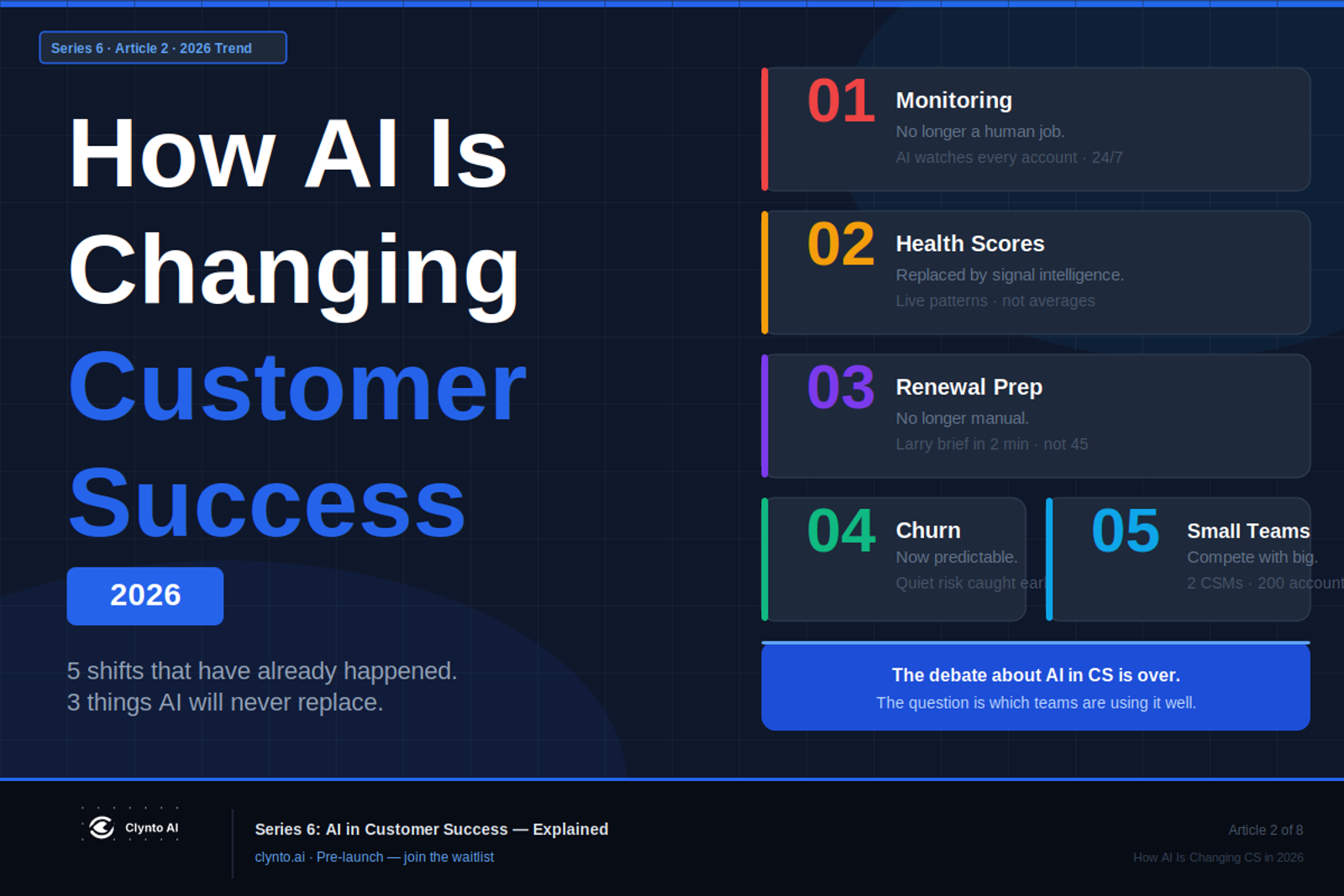
The debate about whether AI belongs in CS is over. The question now is which teams are using it well — and which are falling behind.
The Shift Has Already Happened
Two years ago, AI in customer success meant a chatbot on your help centre page and an auto-generated email sequence. CS leaders talked about AI as something coming. Something to watch.
That's no longer the conversation.
In 2026, the CS teams pulling the highest NRR numbers share one thing: an intelligent layer sitting across their portfolio that processes signals faster than any human team can. Not instead of their CSMs. Underneath them.
The shift isn't dramatic. It doesn't look like science fiction. It looks like a Monday morning where your team opens their laptop and already knows exactly which three accounts need attention today — and why.
That's what AI in CS looks like in 2026. Quiet. Specific. Relentless.
Five Things AI Has Already Changed
1. Monitoring is no longer a human job
In 2024, monitoring meant a CSM logging into a dashboard, scanning health scores, and making judgment calls about what to check next. In 2026, monitoring happens continuously and automatically — across every account, every signal, every day.
Usage drops, champion silences, support spikes, billing changes — these get caught the moment they happen, not the next time someone has bandwidth to look.
2. Health scores have been replaced by signal intelligence
The static health score — a weekly number that averages usage, NPS, and support tickets into a colour — has been exposed for what it is: a confident approximation of something it can't actually measure.
AI-powered signal intelligence reads individual data points in context and combination. Not one number. A live picture of what's actually happening in an account — and what it means.
3. Renewal prep is no longer manual
The 45-minute morning ritual of pulling data from three tools before a renewal call is being replaced by a brief that's ready before the CSM opens their laptop. Full account trajectory. Stakeholder changes. Unresolved friction. Recommended opening.
Generated automatically. Every renewal. In under two minutes.
4. Churn has become more predictable
The accounts that used to churn without warning — the quiet ones, the ones that never complained, the ones with a champion who left three months ago and nobody noticed — are now the accounts AI catches earliest.
Not because the signals weren't there before. Because before, no human had the bandwidth to watch for them across a full portfolio.
5. Small teams are competing with large ones
In 2024, a 2-person CS team managing 200 accounts was a bandwidth crisis. In 2026, it's a configuration choice. An AI layer that monitors the full portfolio means two CSMs can focus entirely on the accounts that need a human right now — while AI handles the rest.
The headcount advantage of large CS teams is narrowing fast.
What Has NOT Changed
Before the hype runs ahead of reality, it's worth naming what AI hasn't changed in CS — and won't.
Relationships are still human. The trust that renews accounts and drives expansion is built through dozens of human interactions — a well-timed call, an honest conversation, a CSM who goes off-script and says exactly the right thing. AI doesn't replicate that. It makes more space for it.
Judgment is still human. When a champion is nervous about their internal standing, when a customer is close to churning but could be saved with the right conversation, when the renewal negotiation gets complicated — that's human terrain. AI surfaces the context. The human navigates it.
Strategy is still human. What your CS team prioritises, how you segment customers, what outcomes you're driving for — these are leadership decisions. AI executes within the strategy. It doesn't define it.
What Clynto AI Does That's Different
Most CS platforms added AI features to an existing architecture. A chatbot here. An AI-generated email there. A "smart" health score that's still a static number underneath.
Clynto AI was built differently. Larry — our AI CSM layer — is the core of the product, not a feature bolted onto it.
Here's what that means in practice today:
Larry monitors 6 signal types across every account: Churn Risk, Renewal Risk, Expansion Ready, Champion Loss, Disengagement, and Executive Misalignment. Plus 6 billing signals from Stripe — payment failures, subscription downgrades, trial expiries.
Larry connects to your full data stack — HubSpot, Freshdesk, Stripe, Google Calendar, Mixpanel — and reads signals across all of them simultaneously. Not separately. Together.
Larry learns your business first. Before monitoring starts, Larry interviews your CS team about your specific motion — your segments, your onboarding process, your definition of early churn. Every signal and recommendation is calibrated to how churn actually happens in your customer base.
Larry is live today. Not a roadmap item. Not a beta feature. In production, used by real CS teams, generating real insights. Onboarding takes 40 minutes.
The Question Every CS Leader Should Ask Their Vendor
"Does your platform tell my team what to do tomorrow morning — without anyone logging in and looking?"
If the answer involves a dashboard your CSM needs to open, that's 2024 CS technology.
In 2026, the answer should be yes. Every morning. Before your team opens their laptops.
Clynto AI is currently in pre-launch. Larry monitors every account so your team can focus on the ones that need a human today.
[Get the early access → https://clynto.ai/demo]
Lucas Bennett
Clynto AI
Customer Success practitioner with over 10 years building CS teams from scratch across US, Canada, Singapore as a CSM, team lead, CS leader, and consultant.
Book 20 min with Lucas