AI in Customer Success
How Larry (Clynto AI) Reads Customer Signals
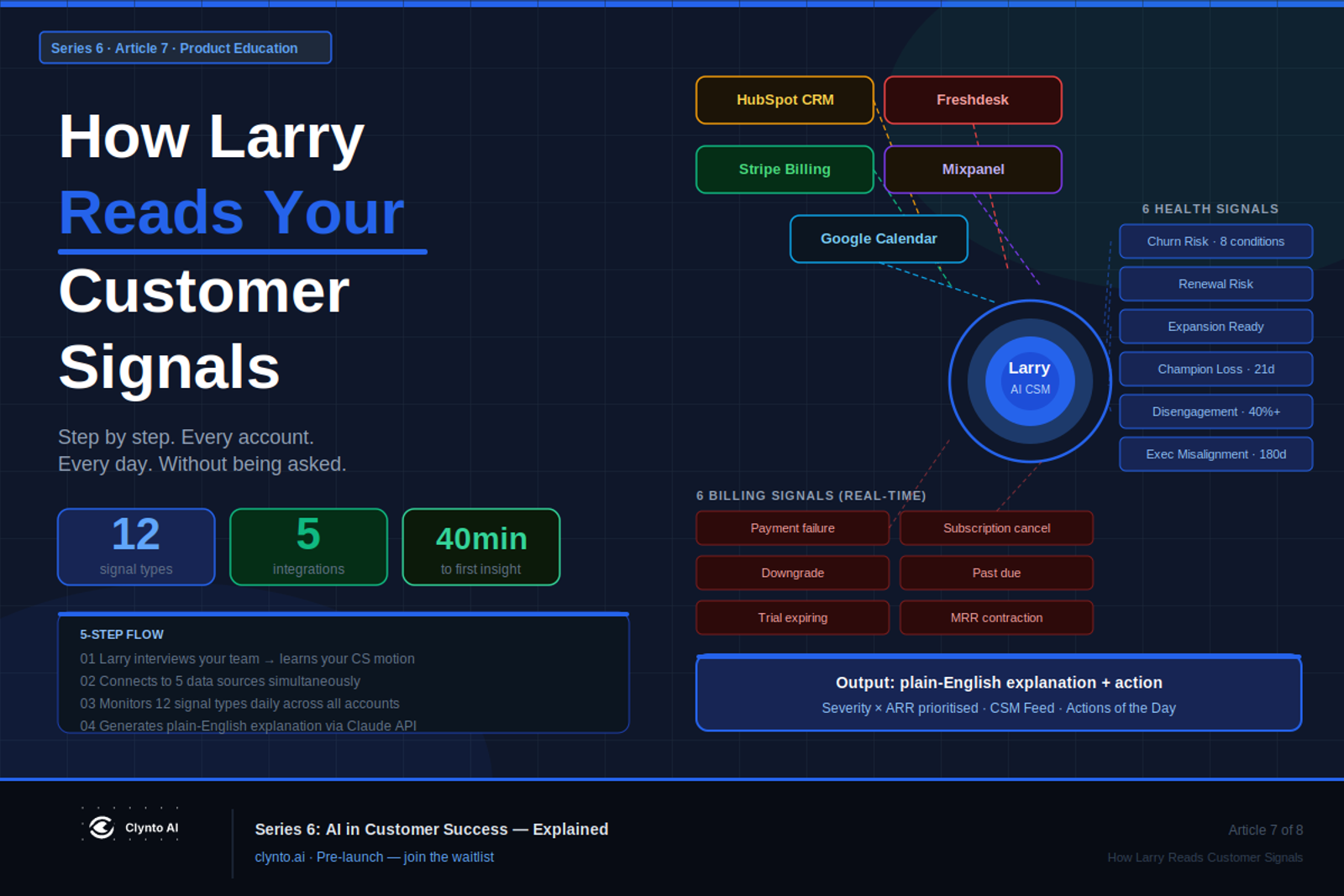
Larry isn't a dashboard or a chatbot. It's a signal intelligence layer that reads 12 signal types across five data sources simultaneously — and tells your team exactly what to do next. Here's exactly how it works, step by step.

On this page
How Larry (Clynto AI) Reads Customer Signals
Not a chatbot. Not a dashboard. A signal intelligence layer. Here's exactly what Larry reads, how it connects the dots, and what it surfaces to your team.
What Larry Actually Is
Most CS platforms have a chatbot feature they call AI. You ask it questions, it answers them. It's a search interface with a conversational skin.
Larry is built differently.
Larry is a signal intelligence layer — not a question-answering tool. It doesn't wait to be asked. It monitors every account in your portfolio continuously and surfaces what matters before your team thinks to look.
The distinction: A chatbot is reactive. Larry is proactive. You don't open Larry when you have a question. Larry tells you what you need to know before you know you need it.
Step 1: Larry Learns Your Business First
Before Larry monitors a single account, it interviews your CS team.
An 8-topic onboarding interview covers:
- How you segment your customers
- What your onboarding process looks like
- How you define the adoption journey
- How you run renewals
- What early churn signs look like in your context
- How you want health scores configured
- What schedule signals should run on
- Any special instructions for your CS motion
Your answers become Larry's persistent memory — stored as versioned interview responses that inform every recommendation Larry makes. When Larry flags an account, it's not firing a generic rule. It's applying pattern recognition calibrated to how churn actually happens in your specific business.
This is what separates Larry from every health score template ever built.
Step 2: Larry Connects to Your Data Stack
Larry reads signals across five integrated data sources simultaneously:
HubSpot — CRM data: account contacts, deal stages, stakeholder activity, closed-won triggers. Larry tracks when contacts go quiet, when stakeholders change roles, when deal context shifts.
Freshdesk — Support data: ticket volume, resolution time, CSAT scores, conversation threads. Larry correlates support spikes with account health and flags when ticket patterns suggest friction that hasn't surfaced elsewhere.
Stripe — Billing data: MRR, subscription status, payment history, trial windows. Larry monitors for payment failures, subscription downgrades, and billing contact changes — all early churn signals that sit outside the CS platform in most teams.
Mixpanel — Usage data: feature adoption breadth, login frequency, 7/30-day stickiness, time-to-value, WoW usage trends. Larry understands what healthy usage looks like in your account base and flags deviations that matter.
Google Calendar — Meeting data: touchpoint frequency, meeting history, upcoming calls. Larry tracks engagement cadence and flags accounts where customer-facing activity has dropped below your baseline.
Step 3: Larry Monitors 12 Signal Types Daily
Every day, on the schedule your team configured during the interview, Larry evaluates 12 signal types across your entire portfolio:
6 Health Signals:
- Churn Risk — 8 conditions evaluated, including usage decline, engagement drops, champion silence, and combined pattern indicators
- Renewal Risk — 4 conditions including renewal proximity combined with health indicators
- Expansion Ready — accounts showing usage breadth and engagement patterns that suggest readiness for additional modules or seats
- Champion Loss — stakeholder silence exceeding 21 days, flagged before the relationship goes cold
- Disengagement — 40%+ usage drop week-on-week, caught before it becomes a churn signal
- Executive Misalignment — senior stakeholder silence exceeding 180 days, indicating a relationship that needs rebuilding
6 Billing Signals (triggered by Stripe in real time): 7. Payment failure 8. Subscription cancellation 9. Past due status 10. Subscription downgrade 11. Trial expiring 12. MRR contraction
Each signal receives a score from 0–100 and a severity band: Low, Medium, High, or Critical.
Step 4: Larry Generates the Explanation
When Larry detects a signal, it doesn't just flag the account. It generates a root-cause explanation in plain English — powered by Claude (Anthropic's API).
Not: "Account health score: 42 (amber)"
But: "TechFlow's reporting module adoption dropped 38% over the last 4 weeks, their primary champion (Sarah Chen, VP Customer Experience) hasn't opened an email in 14 days, and their renewal is in 32 days. This combination matches the pattern you identified during setup as an early churn indicator in your enterprise segment. Recommended action: reach out to Sarah directly with a specific update on the reporting module roadmap before the renewal conversation."
The explanation references your Larry Memory — the interview responses that define what matters in your business. Every signal is interpreted in the context of how your CS team actually works.
Step 5: Larry Surfaces Prioritised Actions
Larry doesn't produce a list of 40 amber accounts for your team to triage.
The CSM Feed — Larry's primary output — orders active signals by severity × account ARR. The highest-value risks at the highest severity sit at the top. Your team opens their day knowing exactly which accounts need attention, in which order, and why.
Additionally, every morning Larry proactively surfaces Actions of the Day — three portfolio priorities your team should act on today, without being prompted.
Signals auto-resolve when conditions clear. CSMs can acknowledge without resolving — marking as reviewed while keeping the signal visible. Every signal links directly to the account for one-click context switching.
What Larry Does in 40 Minutes
From zero to first insight in 40 minutes:
- 0–5 min: Connect your CRM — accounts imported automatically
- 5–15 min: Connect analytics, billing, support, calendar
- 15–30 min: Larry interview — 8 topics, your CS motion captured
- 30–40 min: First signal surface — Larry has read your accounts, applied your context, and identified the account that needs attention today
No implementation team. No configuration marathon. No six-month wait.
Get the early access: https://clynto.ai/demo
Lucas Bennett
Clynto AI
Customer Success practitioner with over 10 years building CS teams from scratch across US, Canada, Singapore as a CSM, team lead, CS leader, and consultant.
Book 20 min with Lucas