Customer Success Leadership
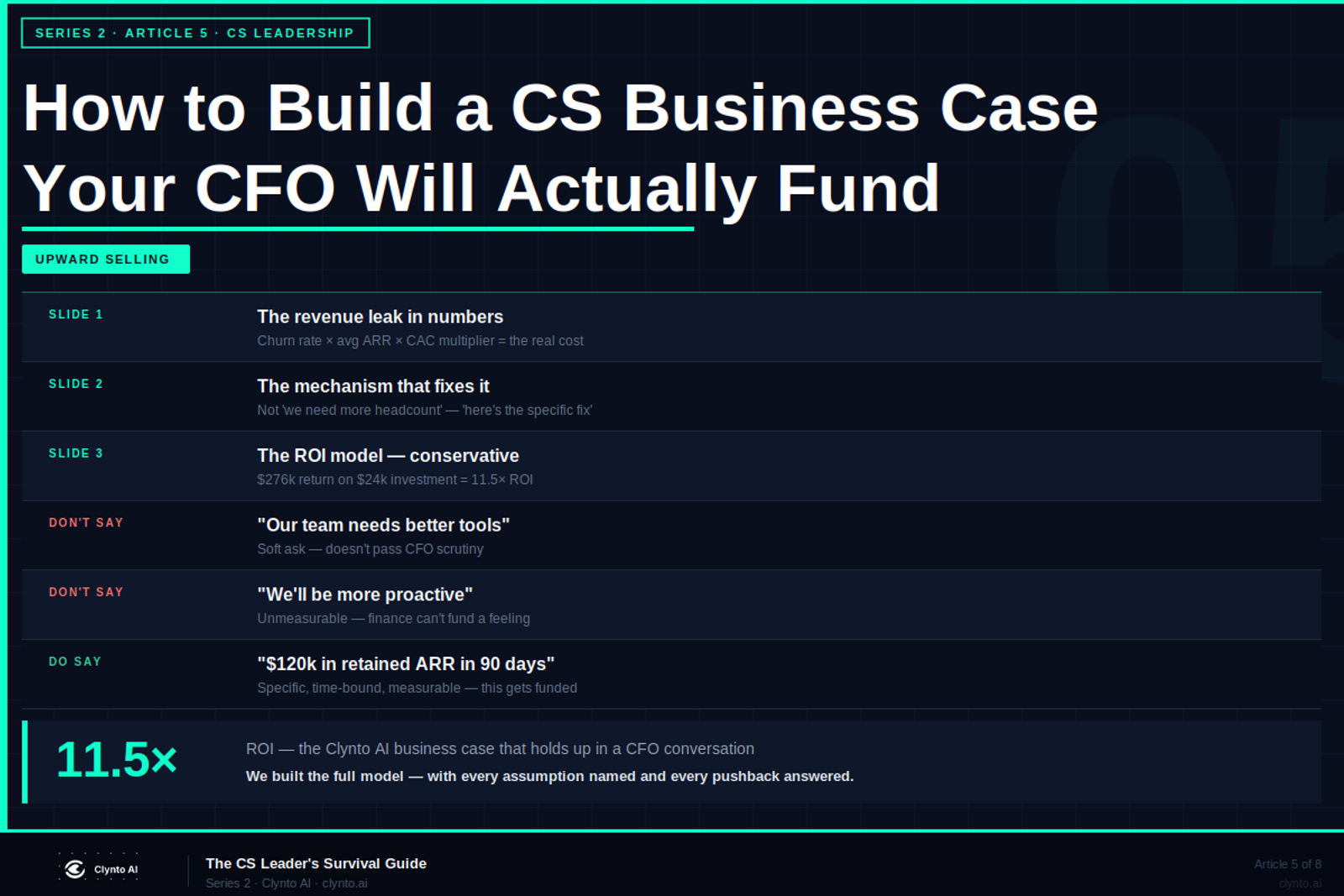
How to Build a CS Business Case Your CFO Will Actually Fund
We need better CS tools" doesn't make it past the CFO. Here's the 3-slide model - with real numbers, named assumptions, and every pushback answered — that gets CS investment approved.
How to Build a CS Business Case Your CFO Will Actually Fund
The CFO doesn't fund feelings. They fund numbers. Here's how to turn your CS investment request into a language finance speaks.
Why Most CS Business Cases Fail
Most CS leaders build their investment case around soft benefits. "We'll be more proactive." "The team will have better visibility." "We'll catch churn earlier." These are real outcomes — but they're not fundable outcomes. Finance can't model them. The CFO can't approve what can't be measured.
The CS leaders who get funding speak a different language. They open with the revenue leak in numbers. They identify the specific mechanism that fixes it. They present a conservative ROI model with named assumptions. And they come prepared for every pushback.
Here's the three-slide structure that works.
Slide 1: The Revenue Leak in Numbers
Before asking for anything, show the cost of the current situation.
The formula: Annual churn rate × average ARR × CAC multiplier = the real annual cost of your CS problem.
Example: A CS team with 6% annual churn across a $6M ARR portfolio loses $360,000 per year in ARR. At a typical 3× CAC-to-ARR ratio, each churned account costs $120,000 to replace in sales investment. The real annual cost of that churn is not $360,000 — it's closer to $720,000 when you include acquisition cost.
That number is what you're putting in front of the CFO. Not "we need better tools." A specific dollar figure that represents the cost of the problem you're solving.
Slide 2: The Mechanism That Fixes It
The second slide answers one question: exactly how does the proposed investment address the number on slide 1?
The wrong version of this slide: "Clynto AI will help our team be more proactive and catch churn earlier." This is descriptive, not mechanistic. The CFO can't model it.
The right version: "Larry monitors 12 signal types across every account daily. It catches the 4-signal churn pattern that appears 60–90 days before renewal in our accounts — the combination that our team currently misses because no human can monitor 150 accounts simultaneously. When Larry catches a signal, it surfaces the account with a recommended action. Our CSMs then execute the save. Conservative assumption: 2 additional saves per quarter."
Specific mechanism. Named assumption. Measurable outcome. This gets through CFO scrutiny.
Slide 3: The Conservative ROI Model
The third slide is the calculation — built conservatively, with every assumption visible.
For a typical mid-market CS team:
Line 1: Churn reduction 2 accounts saved per quarter × 4 quarters × 60% save rate × $40k average ARR = $192,000 retained ARR
Line 2: Time reclaimed 213 hours per year of manual prep eliminated × $70/hr CSM cost = $14,910 in direct labour cost
Line 3: Expansion unlocked 4 expansion signals surfaced per quarter × 40% conversion × $8k average expansion = $51,200 incremental ARR
Total annual return: $258,110 Clynto AI annual cost: $24,000 Net ROI: $234,110 ROI multiple: 10.8× Payback period: 45 days
Every assumption is named. Every number is conservative. Every line is verifiable.
The Three Pushbacks — Answered in Advance
"The churn save numbers are soft." Cut them in half. 1 save per quarter at 40% save rate = $64,000 retained ARR. The ROI still exceeds 2× at the most conservative possible assumption.
"Why not just hire another CSM?" A third CSM at $90,000 base + $40,000 overhead = $130,000 per year. They still cannot monitor 67 accounts simultaneously. They add bandwidth. They don't add the intelligence layer that catches the signals a human team misses at scale.
"We can't measure whether AI caused the saves." Run a 90-day pilot. Use Larry for half the portfolio. Compare churn flag rates, renewal close rates, and CSM prep time between the two groups. The data will be clear enough.
What to Ask For
Don't ask for a year commitment. Ask for a 90-day pilot with three metrics: churn accounts flagged and saved, renewals prepared with Larry briefs, and CSM prep time per renewal call. Offer to build the reporting framework before the pilot starts.
This is the ask that gets approved. The one that says: here's the problem in numbers, here's the mechanism, here's the model, and here's how we'll prove it in 90 days.
Lucas Bennett
Clynto AI
Customer Success practitioner with over 10 years building CS teams from scratch across US, Canada, Singapore as a CSM, team lead, CS leader, and consultant.
Book 20 min with Lucas