AI in Customer Success
How to Introduce AI Tools to a Skeptical CS Team
Most AI rollouts in CS fail before the tool is ever used. Not because the technology is wrong — because the rollout was. Here's a practical change management playbook for introducing AI to a CS team that isn't sure it needs it.

On this page
How to Introduce AI Tools to a Skeptical CS Team
Most AI rollouts fail before the tool is ever used. The problem is never the technology. It's the rollout.
Why CS Teams Resist AI
Before the playbook, the honest truth about why AI tools fail in CS teams.
It is not laziness. It is not stubbornness. It is not technophobia.
CS teams resist AI for three specific reasons — and all three are rational.
Fear of replacement. "If AI monitors my accounts, what do I do?" This is a legitimate question. CS leaders who dismiss it without addressing it directly will see passive resistance that kills adoption quietly and consistently.
Past experience with bad tools. Most CS teams have been through at least one platform implementation that promised transformation and delivered a dashboard nobody opened. The scepticism is earned. "We've seen this before" is a reasonable response to a new AI pitch.
Lack of clarity on what changes. Vague promises about AI "transforming your workflow" without specific answers to "what does Monday morning look like for me?" create anxiety, not excitement. People resist what they can't picture.
Address all three directly. Before you launch anything.
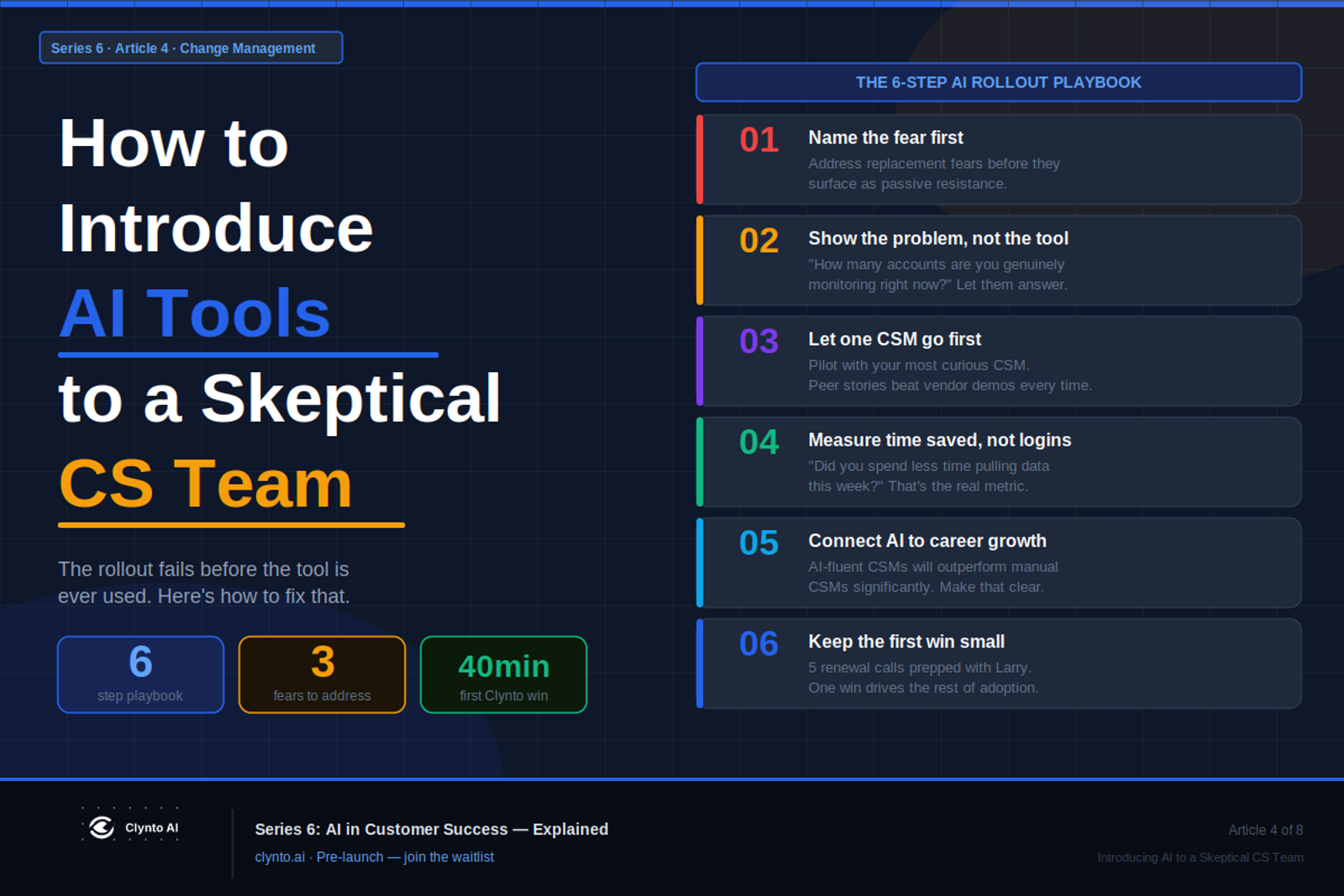
The Change Management Playbook — 6 Steps
Step 1: Name the fear before they do
Open the AI conversation with your team by naming the elephant in the room: "I know some of you are wondering if this is about replacing CSMs. It isn't. Here's exactly why — and here's what it actually changes about your week."
This does two things. It tells your team you've thought about their perspective before presenting. And it removes the fear from the subtext — where it does damage — into the conversation, where it can be addressed.
Never skip this step. Teams that hear the reassurance early adopt faster than teams who hear it defensively three weeks later.
Step 2: Show the problem before the solution
Don't open with the AI tool. Open with the problem it solves.
Ask your team: "How many of your accounts are you actually watching proactively right now? Not reacting to — genuinely monitoring?"
Let them answer honestly. The answer is almost always 15–20% of their portfolio. The rest are covered by gut feel and squeaky wheels.
When your team names the problem themselves — accounts they can't monitor, signals they miss, prep work that takes too long — the AI solution lands as an answer to their problem. Not a tool being imposed on them.
Step 3: Let one CSM go first
Do not roll out to the full team simultaneously. Find your most curious or forward-thinking CSM and run a two-week pilot with them.
Give them a specific problem to solve: "Use Larry to prep for your next three renewal calls. Tell me what you found."
Let them come back with a story. Real results from a peer land differently than a demo from a vendor or a mandate from a manager. When your pilot CSM says "I caught a champion change I would have missed" — that story does more for adoption than any slide deck.
Step 4: Measure time saved, not features used
The wrong adoption metric: "How many CSMs logged in this week?"
The right adoption metric: "How much time did your team spend on manual prep work this week versus last week?"
CSMs adopt tools that give them time back. Measure the outcome they care about — more time for real CS work — not the usage metric that tells you whether they opened the dashboard.
Ask your team directly after week two: "Did you spend less time this week pulling data before calls?" That answer tells you everything about whether adoption is real.
Step 5: Connect AI to career, not just productivity
The most effective framing for AI adoption isn't efficiency. It's skill.
"The CSMs who learn to use AI well in the next two years will have a significant advantage over the ones who don't. Not because AI replaces CSMs — but because AI-fluent CSMs can manage portfolios, catch signals, and prepare for conversations that manually-working CSMs simply can't match."
This reframes AI from a threat to a professional differentiator. It's accurate — and it lands very differently with ambitious CSMs than productivity messaging does.
Step 6: Keep the first win small and specific
Don't ask your team to change everything at once. Pick one workflow and make it undeniably better.
For Clynto AI, the natural first win is renewal prep. Larry builds a complete renewal brief — 90-day account trajectory, stakeholder changes, unresolved friction, recommended opening — in under 2 minutes. Before the call. Before the CSM opens a single tool.
Ask your team to use Larry briefs for their next five renewal calls. Nothing else. Just that one change.
Five renewals where they walk in more prepared than usual. That's the wedge. Once a CSM has that experience, adoption doesn't need managing — it drives itself.
What to Expect — Timeline
Week 1–2: Resistance and curiosity in equal measure. This is normal. Don't over-push. Let the pilot CSM's early results do the talking.
Week 3–4: The first converts. CSMs who were sceptical but curious start trying it. They find one thing they like. They tell a colleague.
Week 5–6: The social proof effect. Once three or four CSMs are using it and talking about it, the holdouts feel the pressure to try.
Week 7–8: Full adoption or clear objections. By this point you know which CSMs have genuine blockers versus which ones haven't prioritised the change. Address blockers directly. Don't let them fester.
How Clynto AI Is Built for Fast Adoption
Most AI tools fail adoption because they require too much change before they deliver any value. Six months to configure. Weeks of training. A new workflow that's unfamiliar and worse before it gets better.
Clynto AI was designed around the opposite principle.
40 minutes to first insight. From sign-up to the first real signal about a real account. Your team sees value before the end of the day they start.
Larry learns your business before it monitors. The onboarding interview means Larry's recommendations are relevant from day one — calibrated to your segments, your renewal motion, your definition of risk. Not a generic tool your team has to learn to interpret.
One action per morning. Larry's daily priorities surface three accounts that need attention today. No new dashboard to manage. No new workflow to learn. Just a prioritised action list that makes Monday mornings better immediately.
The wedge is built in. Renewal briefs are the natural first-win use case. Specific, time-saving, immediately demonstrable. Your CSMs see the difference on the first call they prep for with Larry.
Clynto AI is currently in pre-launch. Larry onboards in 40 minutes. First win before the end of day one.
[Get the early access → https://clynto.ai/demo]
Lucas Bennett
Clynto AI
Customer Success practitioner with over 10 years building CS teams from scratch across US, Canada, Singapore as a CSM, team lead, CS leader, and consultant.
Book 20 min with Lucas