Customer Success Leadership
How to Reduce CSM Burnout Without Adding Headcount
60% of CSM time is spent on work that doesn't require a CSM. That's not a people problem - it's a systems problem. Here's how to give your team back 200+ hours a year without a single new hire.
How to Reduce CSM Burnout Without Adding Headcount
CSM burnout is not a hiring problem. It's a design problem. Here's how to fix the design.
The Misdiagnosis
When CSMs burn out, the default response is to hire more CSMs. This is understandable. The team is overwhelmed. The portfolios are too large. Adding people seems like the direct solution.
It isn't.
The root cause of CSM burnout in almost every CS team that experiences it at scale is not portfolio size — it's how portfolio monitoring is structured. Specifically: CSMs are doing work that shouldn't require them.
60% of the average CSM's working week is spent on activity that doesn't require human judgment: pulling data before calls, triaging health scores, reviewing dashboards, writing account summaries, building renewal briefs. This is monitoring and prep work. AI can handle it. CSMs shouldn't have to.
When the 60% is reclaimed, portfolio sizes that felt impossible become manageable. When it isn't, adding a third CSM just puts another person into the same 60/40 split — and extends the runway by a few months before the same burnout returns.
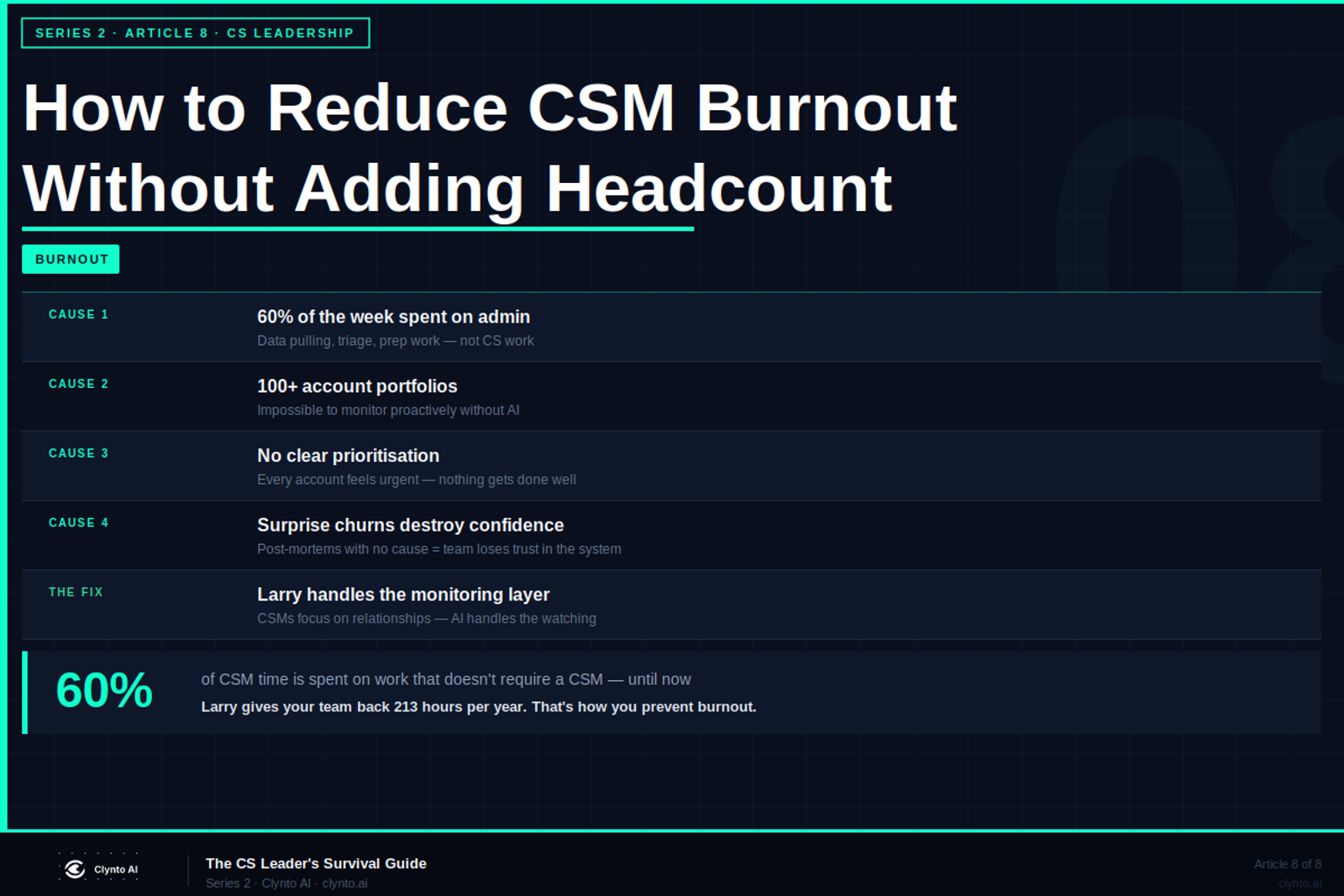
Cause 1: Admin Consuming the Majority of the Week
The detailed breakdown of how CSMs spend their time consistently shows the same pattern: roughly 60% on admin, data, preparation, and triage — and 40% on actual customer work.
That 60% includes: pulling usage data before calls (15–20 min per call), reviewing health scores for the weekly portfolio triage (60–90 min per week), building renewal briefs (45 min per renewal), writing account summaries for handoffs (30–45 min per handoff), and updating CRM records after calls (10–15 min per call).
None of this requires a CSM. All of it exhausts one.
Larry eliminates the monitoring and prep layer entirely. The CSM opens their day to a prioritised action list, a built renewal brief, and a clear signal about which accounts need them — without touching a single dashboard.
Cause 2: Portfolio Sizes Above Human Monitoring Capacity
There is a threshold above which human portfolio monitoring becomes mathematically impossible. Without an AI layer, that threshold is somewhere around 30–40 accounts for proactive monitoring. Above it, CSMs cover accounts reactively — responding to what comes to them rather than watching what's developing.
This is not a failure of effort. It's a structural problem. A CSM managing 80 accounts without an AI monitoring layer will burn out trying to be proactive — and still miss 60% of the signals.
With Larry monitoring every account continuously, that threshold moves dramatically. The CSM doesn't monitor 200 accounts — they act on the 5 that Larry has identified as needing attention today. The monitoring burden disappears from their workload.
Cause 3: No Clear Prioritisation
One of the most underappreciated causes of CSM burnout is the experience of constant urgency with no clear hierarchy. When every account feels potentially important, and there's no system telling you which five to focus on today, the cognitive load of deciding becomes its own source of exhaustion.
This is compounded by fire drill culture: a CSM who has learned through experience that any account can become a crisis without warning develops a low-level chronic stress that doesn't resolve, even on quiet days.
Larry's daily priority list eliminates this decision load. Three accounts that need attention today. Why each matters. What to lead with. The cognitive burden of "what should I work on" disappears — and with it, a significant proportion of the energy drain that produces burnout.
Cause 4: Surprise Churns Destroy Team Confidence
The psychological toll of unexpected churn is one of the most underrated contributors to CS burnout. When an account churns with no warning — and the post-mortem finds no clear cause — the CSM experiences a double hit: the failure of the outcome and the failure of their ability to predict it.
When this happens repeatedly, CSMs stop trusting their own judgment. They become anxious about every account. They overwork in an attempt to monitor everything because the system isn't doing it for them.
Larry removes the surprise churn problem at the source. When signals are caught 60–90 days in advance and surfaced with explanations, the team can see what's building. They can act. And when they do, and the account is saved — the confidence compounds in the other direction.
The 213-Hour Return
Clynto AI's ROI model calculates that a 2-person CS team reclaims approximately 213 hours per year through Larry's renewal brief feature alone — 40 minutes per renewal call, 2 CSMs, 48 working weeks.
213 hours is the equivalent of 5+ working weeks per CSM. That's not efficiency. That's a week every 2.5 months where the CSM does relationship work instead of admin work. Compounded over a year, it's the difference between a CSM who is stretched and a CSM who is performing.
That's how you prevent burnout without adding headcount.
Not by asking people to do more. By building the system that takes the monitoring work off their plate — and gives them back the time to do the work that actually matters.
Lucas Bennett
Clynto AI
Customer Success practitioner with over 10 years building CS teams from scratch across US, Canada, Singapore as a CSM, team lead, CS leader, and consultant.
Book 20 min with Lucas