Churn & Retention
How to Spot Churn 90 Days Before It Happens
Churn doesn't happen at renewal. It's decided 60–90 days earlier — in signals most CS teams never see. Here's the exact timeline of pre-churn behaviour and what to do at each stage.

On this page
How to Spot Churn 90 Days Before It Happens
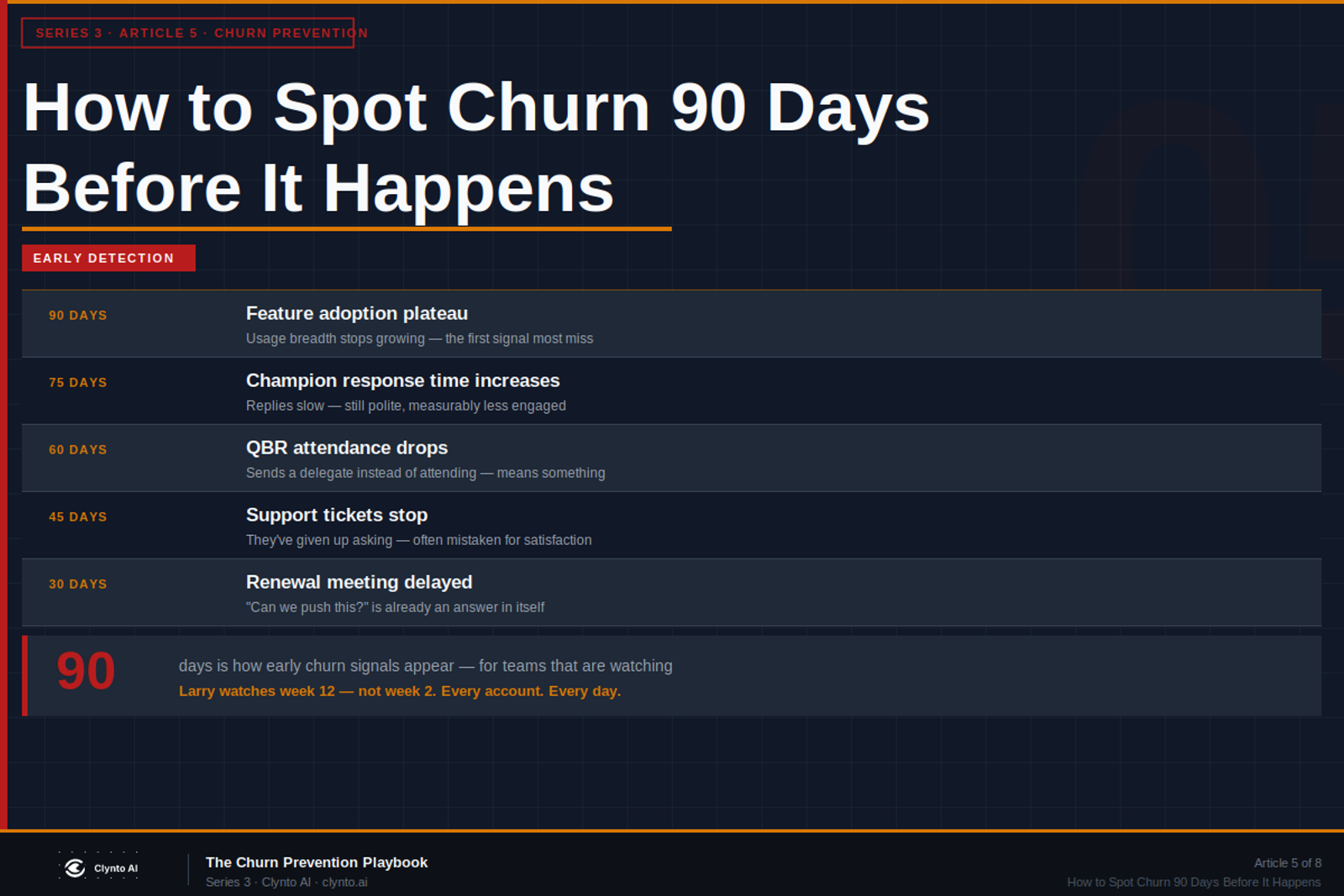
By the time a customer says they're leaving, they've usually been signalling it for three months. Here's the timeline — and what to do at each stage.
Churn Is Decided Long Before Renewal
Most CS teams treat churn as a renewal event. The renewal date approaches. The CSM checks in. The customer says yes or no.
This model is broken — not because the renewal conversation doesn't matter, but because it happens after the decision has already been made. By the time a customer is in a renewal conversation with a churn outcome, they've typically been building toward that decision for 60–90 days.
The signals are there. They're just not being watched.
90 Days Out: Feature Adoption Plateau
The first signal most CS teams never see: feature adoption stops growing.
In a healthy account, feature breadth expands over time as teams discover new use cases, onboard new users, and deepen their integration with the product. When this growth plateaus — when the account was expanding and then simply stopped — it's the first indicator that something has changed.
The account isn't in crisis. The health score is probably still green. But the growth signal that characterises healthy accounts has disappeared.
What to do at 90 days: Reach out with a specific expansion suggestion. Not a check-in — a concrete use case they haven't tried that matches their profile. Reactivate the growth conversation before it dies.
75 Days Out: Champion Response Time Increases
Email response time is one of the most reliable leading indicators in CS that almost nobody tracks.
A champion who previously replied within a few hours is now taking a day. Then two days. Still polite. Still warm. But measurably slower.
This is not always significant — people get busy. But when response time increases alongside other signals, it indicates that the champion's bandwidth for your product has decreased. Their mental share of your relationship is shrinking.
What to do at 75 days: Don't fill the slower cadence with more emails. Request a specific meeting with a specific agenda. Reconnect at a higher level of the relationship — not just the operational one.
60 Days Out: QBR Attendance Drops
The QBR is one of the clearest relationship health indicators in CS. When the champion stops attending — sending a delegate, or rescheduling repeatedly — it signals that the strategic conversation about your product has deprioritised.
Economic buyers and champions who are actively invested in a product attend QBRs. When they stop, it almost always precedes a churn decision by 6–8 weeks.
What to do at 60 days: Don't deliver the QBR to the delegate. Reschedule for the champion. If they can't attend, that's important information. Find out why directly.
45 Days Out: Support Tickets Stop
The counterintuitive signal: an account that used to submit support tickets stops submitting them — not because the product has improved, but because they've given up expecting it to.
Customers who are moving toward churn often disengage from support proactively. They stop investing effort in resolution because they've mentally begun planning their exit. A sudden quiet from a previously active support user is a warning sign, not good news.
What to do at 45 days: Proactively reach out about any previously unresolved friction. Don't wait for them to raise it. Show that you've been paying attention.
30 Days Out: Renewal Meeting Gets Delayed
"Can we push the renewal conversation by two weeks?" is one of the clearest pre-churn signals in CS, and one of the least recognised.
Customers who are confident they're renewing don't delay the renewal conversation. The delay request almost always means one of two things: they're using the time to evaluate alternatives, or they're building the internal case to cancel.
What to do at 30 days: Don't just agree to the delay. Ask what you can prepare to make the conversation more useful for them. This either surfaces the concern or confirms they're still engaged.
Why This Requires Always-On Monitoring
The 90-day churn timeline isn't a theory — it's a consistent pattern across B2B SaaS. The challenge is that watching for it requires someone to be monitoring every account for these signals continuously, not just when a renewal flag fires.
Larry runs this monitoring daily across every account in your portfolio. Feature breadth trends from Mixpanel. Stakeholder response patterns from HubSpot. QBR attendance from Google Calendar. Support cadence from Freshdesk. Renewal engagement from your CS workflow.
When the combination of signals matches the 90-day pattern — calibrated to your specific business through the Larry interview — the account surfaces in your CSM Feed with a timeline of what's changed and when. Your team doesn't predict churn by intuition. They act on intelligence.
Lucas Bennett
Clynto AI
Customer Success practitioner with over 10 years building CS teams from scratch across US, Canada, Singapore as a CSM, team lead, CS leader, and consultant.
Book 20 min with Lucas