Customer Success
What Your Renewal Conversation Would Look Like If AI Did the Prep
Most renewal conversations start with a CSM pulling data from three tools, writing notes, and hoping nothing surprises them in the room. Here's what that same conversation looks like when Larry has already done every minute of prep - and what it changes.

What Your Renewal Conversation Would Look Like If AI Did the Prep
Most renewal conversations start with a CSM who's pulled data from three tools, written a paragraph of notes, and is walking in hoping nothing surprises them. Here's what changes when AI does that work instead.
The Renewal Conversation Nobody Talks About Honestly
Every renewal conversation has two versions.
The version that gets presented in QBRs: a strategic, data-driven discussion where the CSM leads with insight, the customer feels genuinely understood, and the renewal closes with expansion.
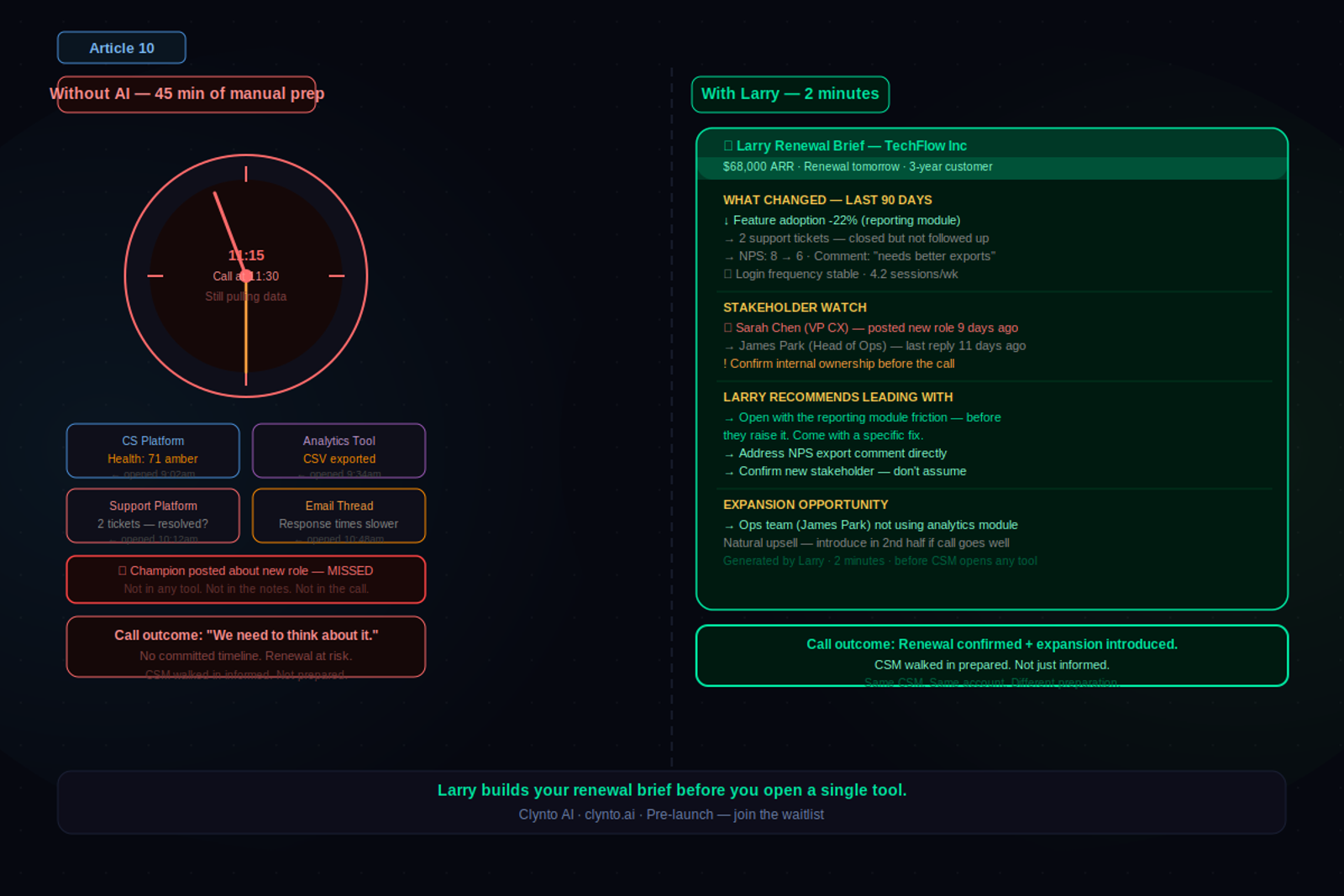
And the version that actually happens: a CSM who spent 45 minutes the morning of the call pulling usage data, checking open tickets, reviewing NPS, and writing notes — then walks into the call and spends the first ten minutes establishing baseline context the customer already knows.
The gap between those two versions isn't skill. It's prep.
And prep is exactly the kind of work AI should be doing — so your CSMs can do the work only humans can.
What Renewal Prep Looks Like Without AI
Here's the actual workflow a CSM runs before a renewal call today:
Step 1: Log into the CS platform. Pull up the account. Check the health score — 71, amber. Note it down.
Step 2: Log into the analytics tool. Pull usage data for the last 90 days. Export a CSV. Open it. Scan for trends. Notice feature adoption has dropped 22% in the last 6 weeks but isn't reflected in the health score yet.
Step 3: Log into the support platform. Check open and recently closed tickets. See two tickets from 3 weeks ago about the reporting module — both marked resolved. Wonder if they're actually resolved or just closed.
Step 4: Check email history. Find the last three threads with the main contact. Notice the response times have been getting longer. Make a note.
Step 5: Check LinkedIn. The champion — VP of Customer Experience — posted about a new role last week. Nobody caught this.
Step 6: Write a one-paragraph call brief. It's now 11:15. The call is at 11:30.
The CSM walks into the renewal call informed, but not prepared. There's a difference.
Informed means they have the data. Prepared means they know what it means, what the customer is feeling, what risks are live, and exactly what to say.
The 45 minutes of manual data-pulling produces the former. It rarely produces the latter.
What Renewal Prep Looks Like With Larry
Larry — Clynto AI's AI CSM layer — doesn't wait for the morning of the renewal call.
It starts building the renewal brief 30 days out. Here's what lands in your CSM's inbox before they open a single tool:
🔔 Larry Renewal Brief — TechFlow Inc — Call Tomorrow 11:00am
Account overview TechFlow Inc · $68,000 ARR · Renewal in 1 day · 3-year customer
What's changed in the last 90 days Feature adoption down 22% — specifically the reporting module, which was the primary use case at purchase. Two support tickets raised and closed in the last month on this module — resolution marked but CSM follow-up not logged.
Login frequency stable — 4.2 sessions/week average, consistent with baseline.
NPS response received 6 weeks ago: score of 6, down from 8 at last survey. Comment: "Would benefit from better export options." Not yet actioned.
Stakeholder watch Primary champion: Sarah Chen, VP Customer Experience. LinkedIn activity flagged — posted about a new role 9 days ago. Status: unconfirmed departure. Secondary contact: James Park, Head of Operations. Last email response: 11 days ago.
Risk assessment Risk level: Elevated. Primary driver: champion uncertainty + unresolved product friction + NPS decline. Renewal at full ARR is achievable but not certain without direct outreach on the reporting issue before the call.
What Larry recommends leading with Open by acknowledging the reporting module friction directly — don't wait for them to raise it. Come with a specific roadmap update or workaround. Address the NPS comment on export options. Confirm who is now the internal owner of the CS platform decision — do not assume Sarah Chen is still in the seat.
Expansion opportunity TechFlow's Operations team (James Park's domain) is not currently using the analytics module. Based on their account type and usage patterns, this is a natural expansion play — worth introducing in the second half of the call if the renewal conversation goes well.
That brief takes Larry under two minutes to generate. It would take a CSM 45–60 minutes to compile manually — and even then, they'd likely miss the LinkedIn signal and the NPS comment.
The Difference in the Room
When a CSM walks into a renewal call with a Larry brief versus a manually compiled set of notes, the conversation is structurally different.
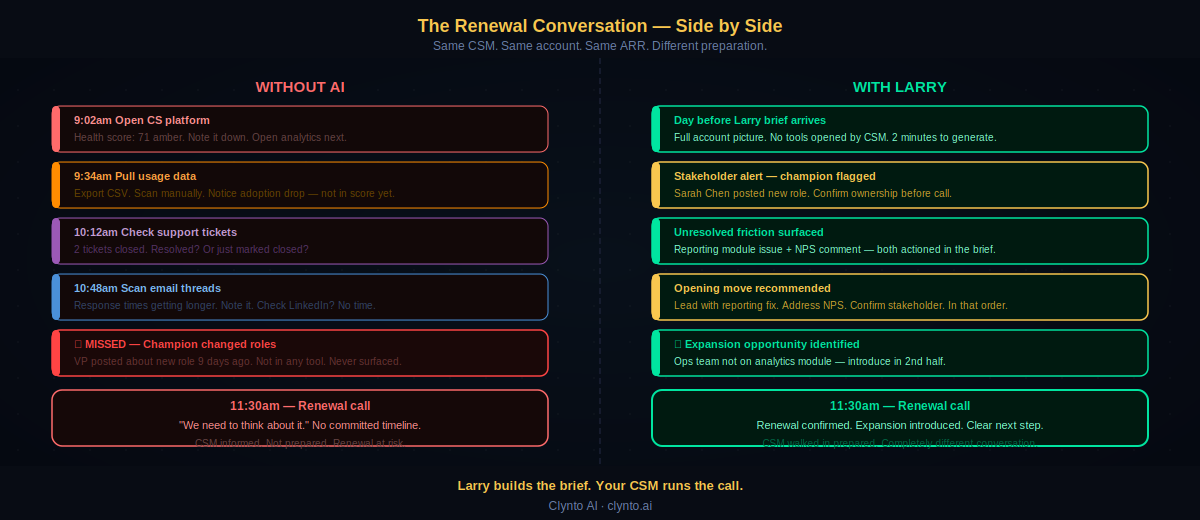
Without Larry: The CSM opens by asking how things are going. The customer says fine. The CSM shares some usage data. The customer nods. The CSM presents the renewal proposal. The customer says they need to think about it. The call ends without a clear next step.
With Larry: The CSM opens by acknowledging the reporting module issue directly — before the customer raises it. The customer is immediately more engaged. The CSM presents a specific fix or roadmap. The CSM confirms who the new internal stakeholder is and makes a direct connection. The expansion opportunity is introduced in the second half. The call ends with a committed timeline.
Same CSM. Same account. Different preparation. Completely different conversation.
What Larry Prepares For Every Renewal
Clynto AI's renewal prep isn't a template. It's a living brief built from everything Larry knows about the account — calibrated to how your specific business defines risk, value, and opportunity.
For every renewal, Larry surfaces:
Account trajectory — not just a snapshot. What has changed in the last 30, 60, and 90 days. What's trending in the wrong direction. What's stable.
Stakeholder intelligence — who is the current internal champion. Who has gone quiet. Who has changed roles. Who the CSM should be building a relationship with before the call, not during it.
Unresolved friction — open support issues, NPS comments that haven't been actioned, feature requests that went silent. The things the customer remembers even when the CSM has moved on.
Risk drivers — not a health score. The specific combination of signals that, in your business, indicate a renewal that's at risk. Calibrated to your segments, your product, and your customer profile.
The opening move — Larry doesn't just surface data. It recommends how to open the conversation, what to address directly, and what to hold for the second half of the call.
Expansion signals — accounts with untapped modules, teams not yet onboarded, or usage patterns that suggest a natural next step. Renewals that could be expansions — if the CSM knows where to look.
The Metric That Changes
When CSMs walk into renewal calls with Larry briefs instead of manually compiled notes, one metric changes before anything else:
Confidence.
Not because Larry makes the call for them. Because they're not walking in hoping nothing surprises them. They're walking in knowing exactly what the landscape is, what the customer is feeling, and what they're going to say.
That confidence lands differently in the room. The customer feels it. The conversation goes somewhere.
That's what renewal prep should always have looked like.
Larry makes it the default.
Clynto AI is currently in Early stage. Larry builds your renewal brief before you open a single tool.
[Get the early access → https://clynto.ai/demo]
Lucas Bennett
Clynto AI
Customer Success practitioner with over 10 years building CS teams from scratch across US, Canada, Singapore as a CSM, team lead, CS leader, and consultant.
Book 20 min with Lucas