AI in Customer Success
The ROI of AI in Customer Success - The Real Numbers
Every CS leader knows AI makes their team more effective. Very few can put a number on it. Here's the actual ROI calculation — churn saved, time reclaimed, revenue retained - built around real CS economics that hold up in a CFO conversation.
The ROI of AI in Customer Success - The Real Numbers
"How do I justify this to my CFO?" Here's the exact calculation - built on CS economics that hold up under scrutiny.
Why This Conversation Is Hard
CS leaders know intuitively that AI makes their teams more effective. Fewer signals missed. Better renewal prep. Faster churn detection. More time for actual customer work.
What they struggle to do is quantify it in a language that lands in a board room.
"Our team will be more proactive" does not make it into a budget approval. "$340,000 in retained revenue against a $24,000 annual investment" does.
This article builds that calculation. From first principles. Using numbers that hold up under CFO scrutiny.
The CS Economics You Need to Know First
Before the ROI model, four numbers your organisation should know cold:
Average ARR per account. What does a typical customer pay annually? For most B2B SaaS companies this sits between $15,000 and $80,000. Use your actual number.
Churn rate. What percentage of your ARR churns annually? Industry average for B2B SaaS is 5–7%. High-performing CS teams run 3–4%.
Cost to replace a churned account. New customer CAC typically runs 5–7x the cost of retention. If your average ARR is $40,000 and your CAC is $12,000, replacing one churned account costs $12,000 in sales spend — on top of the lost ARR.
CSM hourly cost. A fully-loaded CSM (salary + benefits + overhead) at $90,000 base costs approximately $65–75 per working hour. Know this number. It makes the time-reclaimed argument concrete.
The ROI Model — Line by Line
Let's build the calculation for a typical mid-market CS team:
Starting assumptions:
- 2 CSMs managing 150 accounts
- Average ARR per account: $40,000
- Total portfolio ARR: $6,000,000
- Current annual churn rate: 6% = 9 accounts churned per year
- Fully-loaded CSM cost: $70/hour
- Clynto AI annual cost: $24,000
Line 1: Churn reduction value
AI-powered signal monitoring catches signals human teams miss — the slow drift, the silent champion, the cross-signal churn pattern. Conservative assumption: Larry catches 2 additional at-risk accounts per quarter that would otherwise have churned. That's 8 accounts per year.
Not all of those saves are 100% — assume a 60% save rate on flagged accounts.
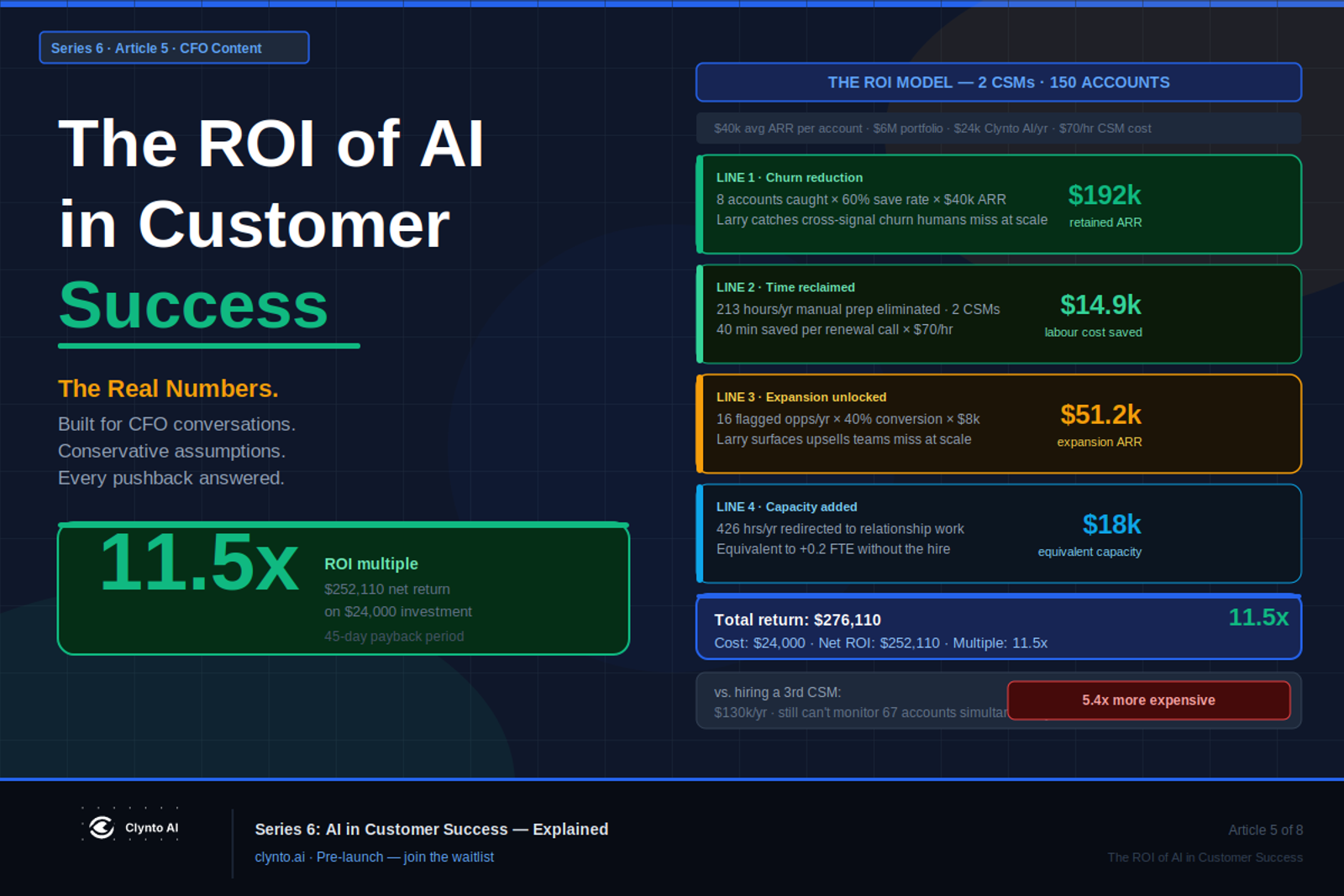
8 accounts × 60% save rate × $40,000 ARR = $192,000 retained annually
Line 2: Time reclaimed — direct cost
Current manual prep per CSM per renewal call: 45 minutes. With Larry brief: 5 minutes. Time saved per renewal: 40 minutes.
Typical CSM handles 2 renewal calls per week = 80 minutes saved per week per CSM. 2 CSMs × 80 minutes × 48 working weeks = 12,800 minutes = 213 hours per year.
213 hours × $70/hour = $14,910 in direct labour cost reclaimed
Line 3: Expansion revenue unlocked
Larry flags expansion opportunities — accounts with untapped modules, teams not yet onboarded, usage patterns that suggest a natural upsell. Conservative assumption: Larry surfaces 4 expansion opportunities per quarter your team wouldn't have identified manually. Assume a 40% conversion rate and $8,000 average expansion ARR.
16 opportunities × 40% × $8,000 = $51,200 in incremental expansion revenue
Line 4: CSM productivity reallocation
213 hours reclaimed from manual prep × 2 CSMs = 426 hours per year of CSM time pointed at relationship work, proactive outreach, and expansion conversations instead of data pulling.
This doesn't have a direct cash value — but it's the equivalent of adding 0.2 FTE of high-value CS capacity without the hire.
At $90,000 base salary: ~$18,000 in equivalent capacity added
The Total:
| Line | Value |
|---|---|
| Churn reduction | $192,000 |
| Time reclaimed (cost) | $14,910 |
| Expansion unlocked | $51,200 |
| Capacity added | $18,000 |
| Total annual return | $276,110 |
| Clynto AI annual cost | $24,000 |
| Net ROI | $252,110 |
| ROI multiple | 11.5x |
What the Sceptical CFO Will Push Back On
"The churn save numbers are soft."
They are estimates. Make them more conservative — cut the save rate to 40% instead of 60%. The ROI still holds: $128,000 in retained ARR versus $24,000 in cost.
"We don't know if AI caused the saves."
Fair. Run a controlled pilot. Use Larry for half the portfolio for 90 days. Compare churn rates. The signal will be clear enough.
"What if adoption is low?"
That's a rollout question, not an ROI question. Low adoption means the tool isn't being used — which is addressable. See Article 4 in this series for the change management playbook.
"Why not just hire another CSM?"
A third CSM at $90,000 base + $40,000 overhead = $130,000 per year. That CSM still cannot monitor 67 accounts simultaneously. They add bandwidth. They do not add the intelligence layer. Clynto at $24,000 adds the intelligence layer and frees your existing team to use their bandwidth better.
How to Present This to Your CFO
Three slides. Not a deck.
Slide 1: The problem in numbers. Current churn rate × average ARR × cost to replace = the annual revenue leak you're trying to fix. Make it concrete. Don't say "churn is a problem." Say "we're losing $240,000 in ARR annually to preventable churn."
Slide 2: The mechanism. Why does AI fix this? Not "it makes us more proactive." Specifically: Larry monitors 150 accounts continuously, catches the 4-signal churn combinations humans miss at scale, and surfaces the accounts that need attention before the decision is already made.
Slide 3: The math. Use the model above with your numbers. Conservative assumptions. Net ROI after cost. Payback period — at $24,000 per year and a conservative $192,000 churn save, payback is 45 days.
Then ask for a 90-day pilot. Not a year commitment. 90 days. Measure churn flags caught, renewals prepped with Larry briefs, and CSM time saved. The data will make the case for renewal on its own.
Lucas Bennett
Clynto AI
Customer Success practitioner with over 10 years building CS teams from scratch across US, Canada, Singapore as a CSM, team lead, CS leader, and consultant.
Book 20 min with Lucas