Churn & Retention
The Silent Churn Problem No One Talks About
Silent churn is the account that leaves with a healthy score and no warning. It's the most common churn pattern — and the one CS platforms are worst at catching. Here's what it looks like and how to stop it.

On this page
The Silent Churn Problem No One Talks About
The most dangerous churn isn't the loud kind. It's the account that leaves while your dashboard says green.
The Churn That Breaks CS Confidence
Ask any CS leader about their worst churn moment and they'll describe the same thing: an account that seemed fine, had a healthy score, had no open tickets, had a pleasant last QBR — and then didn't renew.
This is silent churn. And it's far more common than the industry admits.
Research across B2B SaaS consistently shows that 40–45% of churned accounts had healthy health scores 60 days before leaving. This means that the metric most CS teams rely on as their primary churn indicator is wrong nearly half the time — not because the data is bad, but because it's measuring the wrong things.
Why Health Scores Miss Silent Churn
Health scores are built to catch noise. They respond to activity — support tickets, login frequency, NPS responses, usage volume. When a customer is active but miserable, the score often stays green because the activity signals are positive.
Silent churn accounts have a different profile entirely:
They don't open tickets because they've stopped expecting resolution. They log in because they're habituated, not because they're getting value. They don't submit NPS because they're not invested enough in the relationship to respond. They say "sounds good" in emails because they've mentally moved on and don't want a confrontation.
None of these show up as red signals. They show up as neutral signals — which the health score ignores.
The 5 Signals of Silent Churn
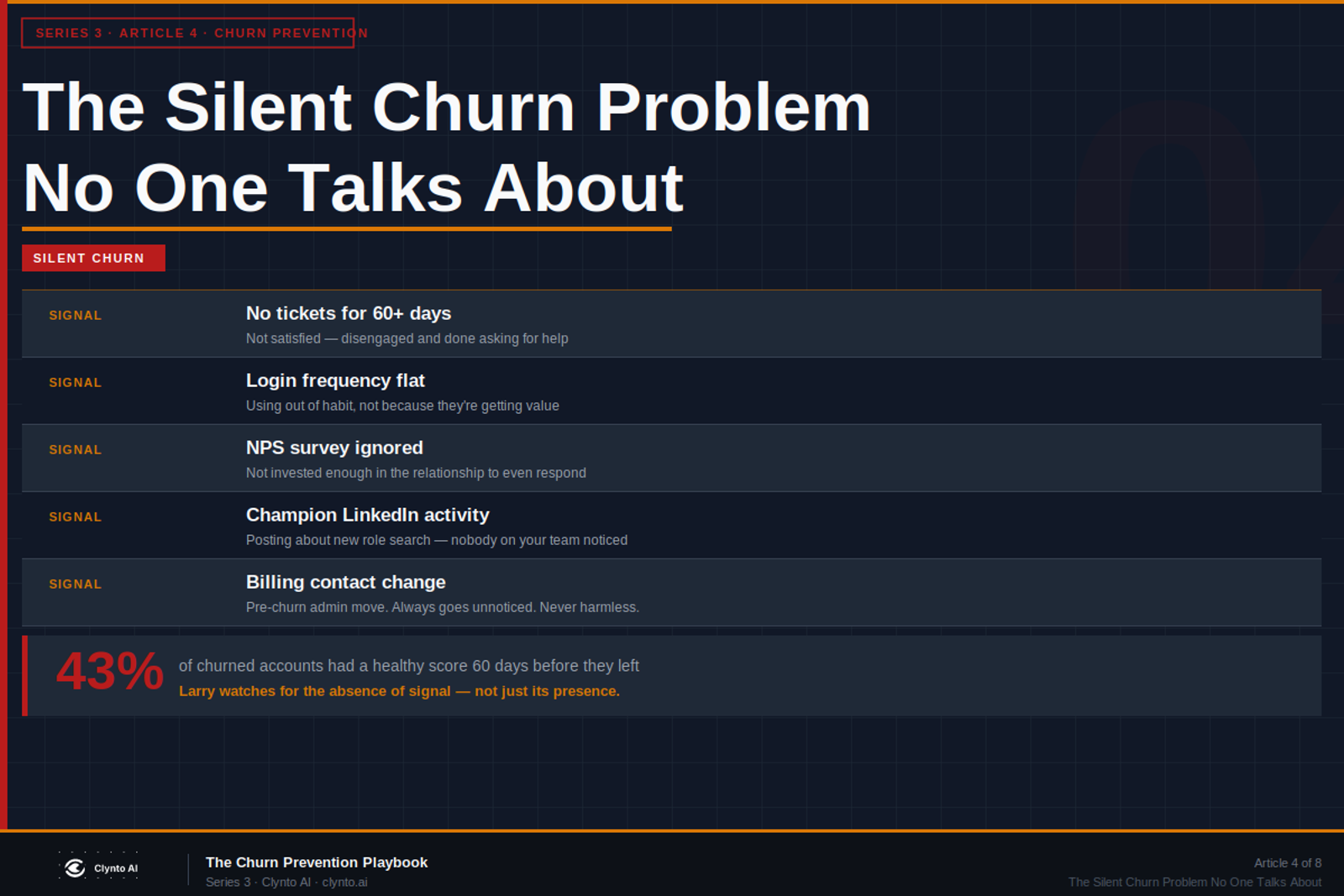
No support tickets for 60+ days. Every SaaS product has friction. An account with zero tickets for two months hasn't eliminated all friction — they've given up reporting it. This is a disengagement signal, not a satisfaction signal.
Login frequency flat, not growing. A stagnant login pattern from an account that should be deepening adoption is a warning. They're present out of habit. Habit churns at renewal.
NPS survey ignored. Customers who don't respond to NPS surveys are the ones most likely to churn. Not the detractors — the ones who say nothing at all. They're not invested enough to give feedback.
Champion LinkedIn activity changes. One of the most reliable pre-churn signals nobody monitors: the champion starts posting about open roles, industry moves, or is listed as "Open to Work." This almost always precedes a relationship disruption.
Billing contact changed. A quiet change in who receives invoices is often a pre-churn administrative preparation. It goes unnoticed in almost every CS platform.
What Silent Churn Costs
The financial cost is obvious — the ARR you didn't see coming. But the less discussed cost is what silent churn does to CS confidence.
When an account churns noisily — with complaints, escalations, documented friction — the team understands why. They can learn from it. They can build better processes.
When an account churns silently, the team is left without a clear cause. The health score said green. The last call was fine. The post-mortem finds nothing actionable. The confidence erosion from unexplained churn is one of the most underrated challenges in CS leadership.
How to Catch Silent Churn
Silent churn requires a different monitoring approach than standard health scoring. Specifically, it requires watching for the absence of signal — not just its presence.
Larry is explicitly designed to catch what standard health scores miss. The signal engine evaluates not just what's happening but what's stopped happening. Tickets that used to come in and don't anymore. Stakeholders who used to engage and have gone quiet. NPS responses that stopped. Logins that continue without feature depth.
Larry monitors these absence patterns daily across every account. When the combination of quiet signals reaches a threshold — calibrated to how churn actually happens in your specific business — it surfaces the account with a plain-English explanation before the decision is made.
You can't build a rule for silence. You need an AI layer that recognises what normal looks like — and notices when it stops.
Lucas Bennett
Clynto AI
Customer Success practitioner with over 10 years building CS teams from scratch across US, Canada, Singapore as a CSM, team lead, CS leader, and consultant.
Book 20 min with Lucas