Customer Success Leadership
What CS Leaders Get Wrong About Customer Onboarding
Most CS leaders think onboarding ends at go-live. It doesn't. Here are the 4 most common onboarding misconceptions holding CS teams back — and what getting it right actually looks like.

What CS Leaders Get Wrong About Customer Onboarding
Onboarding isn't a phase you complete. It's a metric you measure — and most CS leaders aren't measuring the right one.
The Onboarding Misunderstanding at the Core of CS
Ask most CS leaders when onboarding ends and they'll say: go-live, or product training completion, or the end of the onboarding call sequence. These are reasonable-sounding answers. They're all wrong.
Onboarding ends when the customer experiences their first meaningful product outcome — their first value moment. Until that happens, the customer is still evaluating whether the decision to buy was correct. After it happens, the relationship has a foundation.
The misalignment between how CS teams define onboarding and what actually drives long-term retention is one of the most consequential mistakes in CS leadership — and it's nearly universal.
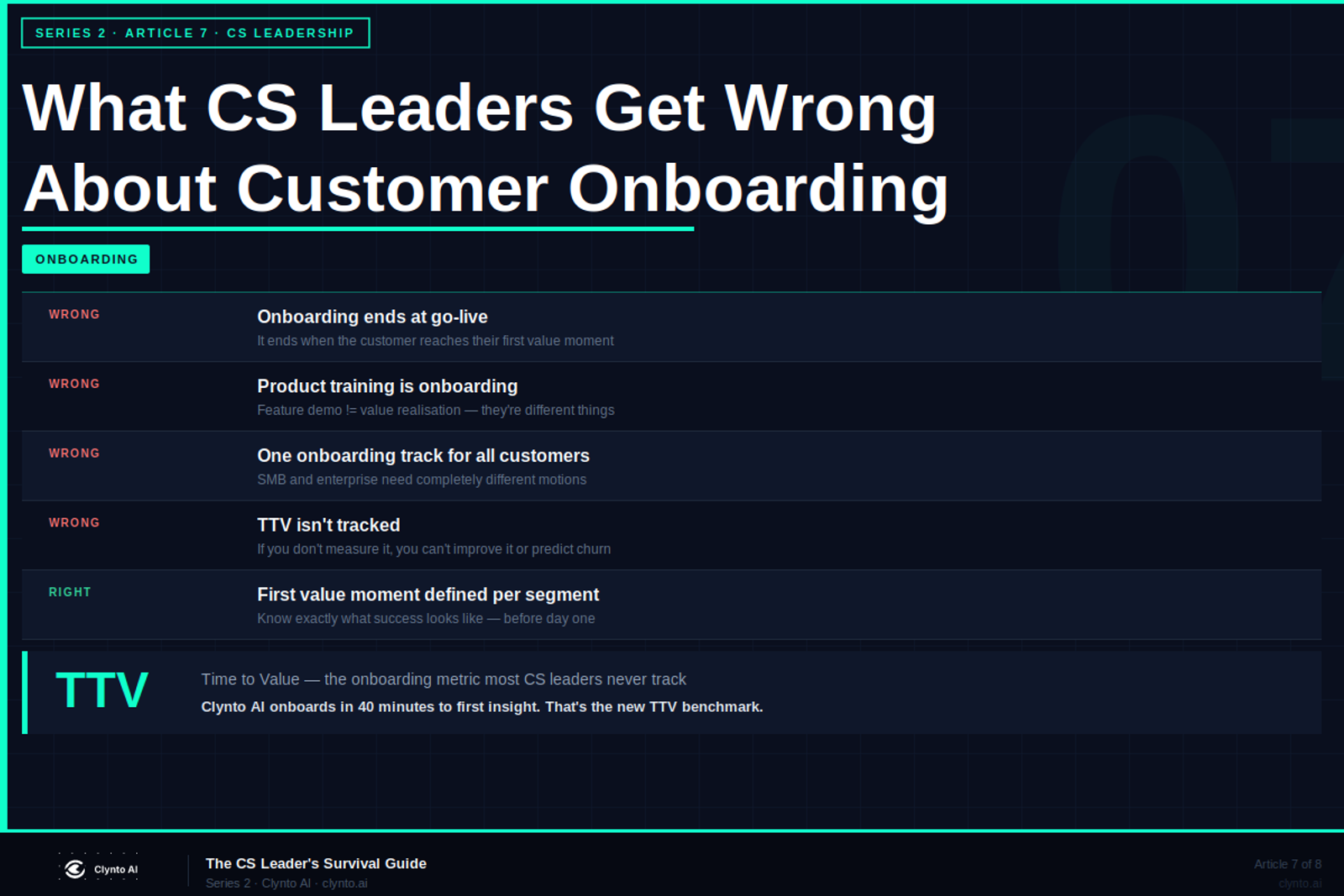
Wrong 1: Onboarding Ends at Go-Live
Go-live means the product is configured and the customer has access. It doesn't mean the customer has derived value. These are completely different events — and treating them as equivalent leads to a CS motion that declares success before the customer has experienced any.
Customers who go live but don't reach a first value moment within their first 30 days are at significantly elevated churn risk by their first renewal. Not because the product failed — but because the success motion stopped too early.
The fix: define what "first value moment" looks like for each customer segment before the onboarding begins. Make reaching it the explicit goal of onboarding — not going live.
Wrong 2: Product Training Is Onboarding
Feature training and value realisation are not the same thing. A CSM who spends the first three onboarding sessions teaching a customer how to use the product's features has done something useful — but hasn't accomplished the goal of onboarding.
The goal of onboarding is to ensure the customer connects the product to a business outcome they care about. Feature training is a means to that end, not the end itself. CS teams that optimise for training completion metrics rather than value moment metrics are measuring the process, not the outcome.
Wrong 3: One Onboarding Track for All Customers
An SMB customer with a two-person team using one primary feature has completely different onboarding needs than an enterprise customer with 50 seats across five departments. Running the same onboarding motion for both produces a mediocre experience for everyone.
The CS teams with the strongest Time to Value metrics have segment-specific onboarding tracks: defined by company size, use case, technical sophistication, and the team structure of the customer. The fastest path to first value is different for every segment — and finding it requires intentional design, not a default playbook.
Wrong 4: TTV Isn't Tracked
Time to Value is the most predictive onboarding metric for long-term retention in B2B SaaS. It is also one of the least commonly tracked metrics in CS teams.
Most CS teams track onboarding completion rates, training attendance, and go-live dates. Very few track the date on which the customer experienced their first meaningful outcome — which is the only metric that actually tells you whether onboarding succeeded.
You cannot improve what you don't measure. And you cannot predict churn accurately without knowing how long your customers are taking to reach value — by segment, by CSM, by product configuration.
What Getting It Right Looks Like
Define first value moment by segment. Before a customer's onboarding begins, know exactly what success looks like for that customer type. Make reaching that moment the explicit goal — with a target TTV.
Measure TTV explicitly. Track the date of first value moment for every account. Build it into your CS platform. Report it alongside onboarding completion.
Design for the fastest path to value. Not the most comprehensive product tour. Not the most thorough feature training. The fastest credible path to the customer experiencing their first outcome.
Close the loop with Larry. Clynto AI tracks adoption milestones through Mixpanel and surfaces accounts where TTV is extending beyond segment benchmarks — flagging them for CSM intervention before the extended onboarding becomes a churn risk.
Clynto AI itself is designed around a single TTV constraint: first insight in 40 minutes from sign-up. That's the benchmark for what fast onboarding looks like in 2026.
Lucas Bennett
Clynto AI
Customer Success practitioner with over 10 years building CS teams from scratch across US, Canada, Singapore as a CSM, team lead, CS leader, and consultant.
Book 20 min with Lucas