Customer Success Leadership
What a Great CS QBR Actually Looks Like in 2026
Most QBRs are slide decks nobody wanted in a meeting that could have been an email. Here's exactly what a great QBR looks like — structure, preparation, and the close that actually works.
On this page
What a Great CS QBR Actually Looks Like in 2026
The QBR is either your strongest retention and expansion tool or your most reliable churn accelerant. Here's the difference.
Why Most QBRs Fail
The QBR has a reputation problem in CS. Many CS leaders have run — or sat through — the version that failed: a 45-minute slide deck that recaps usage data the customer already knows, with two people on the call who have no authority to make decisions, ending with a vague commitment to "stay in touch."
This version of the QBR is worse than no QBR at all. It consumes CSM preparation time, gives the customer a reason to deprioritise the relationship, and provides no value that would justify renewing.
Here's what great looks like — and why the difference is almost entirely preparation.
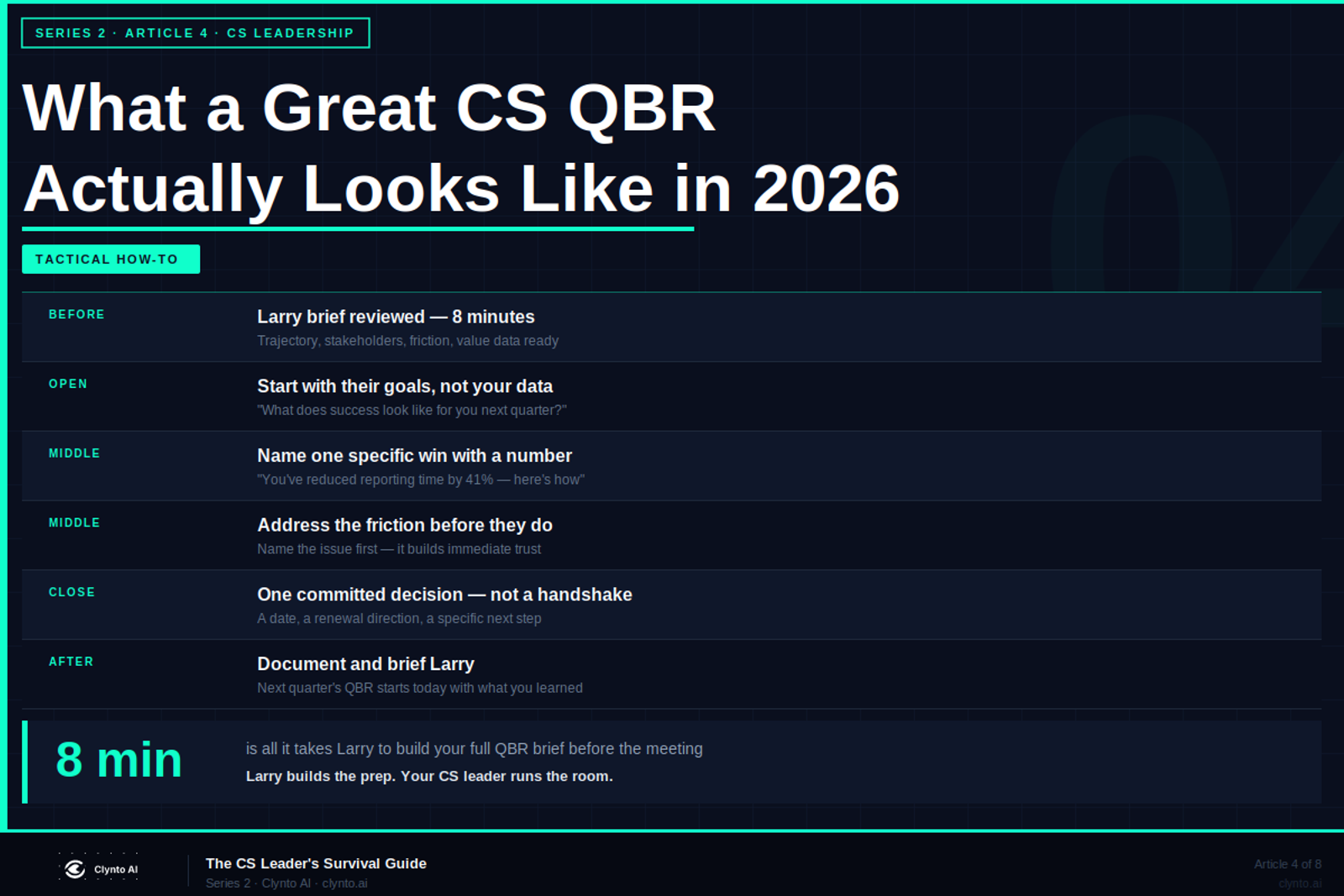
Before the Call: 8 Minutes, Not 45
The number one reason QBRs fail is under-preparation. The CSM pulls data on the morning of the call. They don't know what's changed in the account since the last QBR. They walk in reactive.
In 2026, there's no reason for this. Larry builds a complete QBR brief — 90-day account trajectory, stakeholder changes, unresolved friction points, usage trends against targets, and the business outcomes the customer defined in onboarding — in under 8 minutes. Before the CSM opens any other tool.
The brief covers: what changed, who the current stakeholders are, what friction is unresolved, and what the customer was trying to achieve when they signed. That's everything a CSM needs to walk in prepared.
Opening: Their Goals, Not Your Data
Most QBRs open with data. A usage summary, a feature adoption chart, a health score that's been colour-coded green.
The customers who matter in a QBR — the economic buyers, the champions, the executives who decide whether to renew — don't open the conversation caring about your health score. They open it wondering whether this product is doing what they needed it to do.
Open with their goals: "Before I walk through what we've built this quarter, I want to make sure I understand what you're focused on going into next quarter. What are the one or two things that matter most for your team right now?"
This reframes the entire meeting from a vendor update to a business conversation.
Middle: One Specific Win, One Named Friction
The most impactful QBR moment is a single, specific, quantified business outcome: "Your team has reduced manual report generation time by 41% since we activated the reporting module in Q1. That's approximately 180 hours back in your team's week over the quarter."
Not a feature list. One outcome, tied to their stated goal, with a specific number.
The second most impactful moment is the CSM naming a friction point before the customer does: "I know there was a slow resolution on the [specific issue] in January, and I want to address that directly. Here's what we did and here's what it looks like going forward."
Trust is built faster by naming what went wrong than by presenting what went right. Customers in QBRs are hyperattuned to whether their vendor is being honest with them.
Close: A Decision, Not a Handshake
A QBR that ends with "great to catch up, let's do this again in a few months" has failed. The close of a QBR should produce a committed next step with a specific outcome attached.
"Based on what we've discussed today, I'd like to [confirm the renewal timeline / explore the [specific expansion] / schedule the executive review] by [specific date]. Can we set that up before we hang up?"
A specific date. A specific deliverable. A specific decision point. Not an open-ended "let's reconnect."
After the Call: Brief Larry for Next Time
Immediately after the QBR, document in Clynto: what commitments were made, what concerns were raised, what wasn't fully resolved, and what the customer said their priorities are for next quarter.
This becomes the input for Larry's context on that account — which means the next QBR starts today, not 89 days from now.
Lucas Bennett
Clynto AI
Customer Success practitioner with over 10 years building CS teams from scratch across US, Canada, Singapore as a CSM, team lead, CS leader, and consultant.
Book 20 min with Lucas