Customer Success
What If Your CSM Never Missed a Signal?
Your CSMs are good. Great, even. But they're human — and humans miss things. Not because they don't care, but because 150 accounts generate more signals than any person can track. Here's what changes when AI fills that gap.
On this page
What If Your CSM Never Missed a Signal?
Your CSMs are not the problem. The system they're working in is. Here's what happens when you fix the system.
The Uncomfortable Truth About Human CSMs
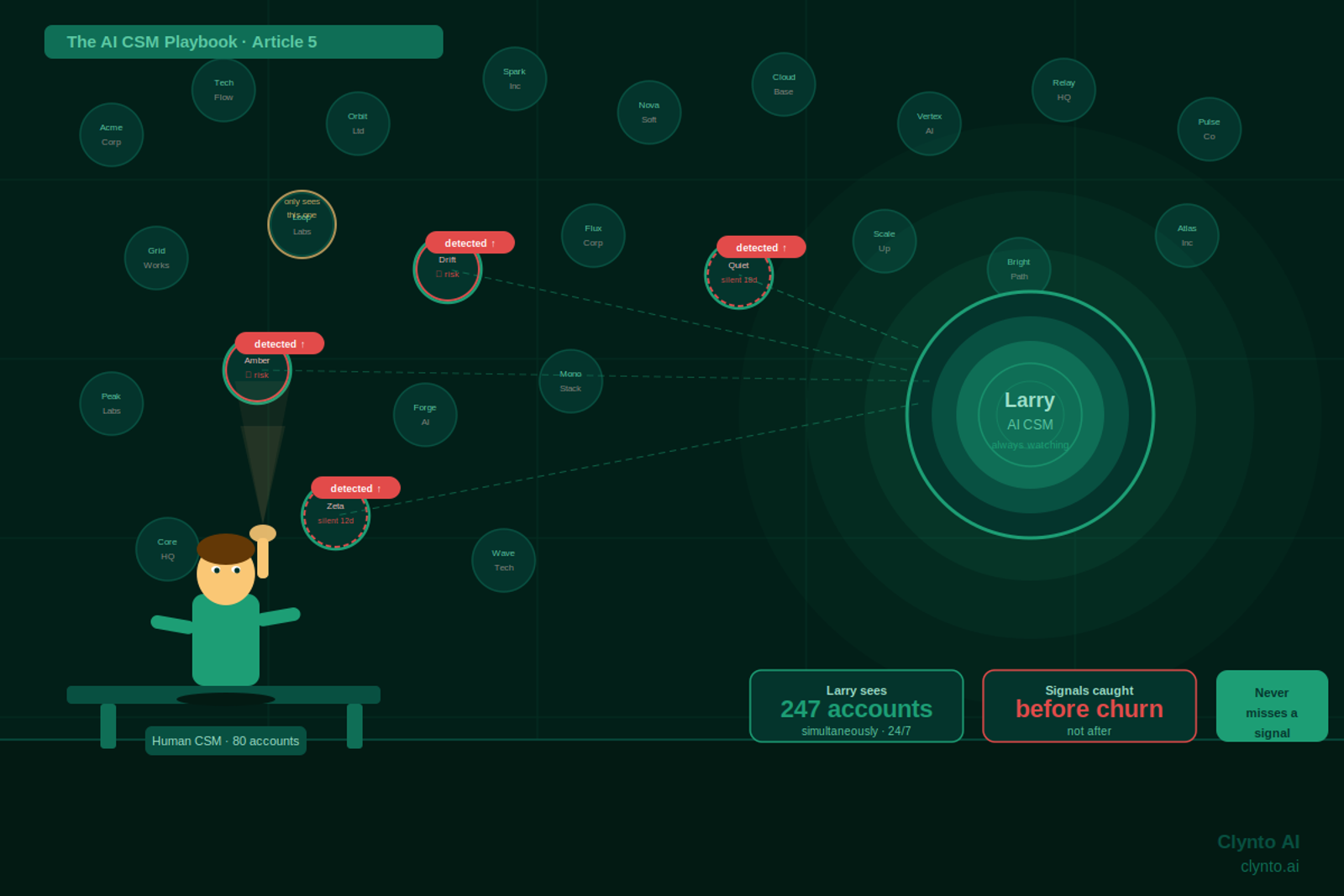
Your best CSM is managing 80 accounts.
On Monday morning they triage their inbox, check in on the accounts they know are struggling, prep for two calls, and update three health scores. By Friday they've covered maybe 20% of their portfolio in any meaningful way.
The other 80%? They got a glance at best.
This is not a performance problem. This is a physics problem.
One human. Eighty accounts. Each generating signals across product usage, support, billing, stakeholder activity, and NPS — every single day.
The math does not work. It has never worked. And no amount of effort, training, or motivation changes the math.
The accounts your CSM missed this week aren't going to announce themselves. The ones drifting toward churn are doing it quietly — a login frequency drop here, a support ticket there, a champion who's gone silent for three weeks.
By the time the pattern is visible to a human, the customer has often already decided.
What Human CSMs Miss — And Why
There are four categories of signals that consistently fall through the cracks — not because CSMs are bad at their jobs, but because these signals are structurally invisible at human scale.
1. Slow drift A gradual decline in usage over eight weeks looks fine week to week. Only when you zoom out do you see the trend. Humans don't zoom out on 80 accounts simultaneously. They check in when something triggers their attention — and slow drift never triggers attention until it's too late.
2. Silence An account that stops raising tickets, stops asking questions, stops pushing back — that's not a healthy account. That's an account that's given up. CSMs are trained to respond to noise. Silence reads as calm. It's often the opposite.
3. Stakeholder change A champion leaves. A new VP comes in. The relationship your CSM spent 18 months building now belongs to someone who doesn't know your product and has their own vendor preferences. If nobody catches the LinkedIn update or the email bounce, that account is now invisible risk.
4. Cross-signal patterns A 10% usage drop alone means little. A 10% usage drop combined with two support escalations, a missed QBR, and a champion who hasn't logged in for two weeks — that's a churn indicator. Humans see signals in isolation. Connecting them across time and across accounts requires processing power no human has.
The Cost of a Missed Signal
We covered this in detail in Article 3 — but here's the short version.
A missed signal isn't just a missed signal. It's a churned account. And a churned account doesn't cost you $40k in ARR. It costs you $230,000 when you factor in replacement CAC, pipeline damage, team morale, and brand impact.
Every signal your team misses is a quiet countdown to that number.
What Never Missing a Signal Actually Looks Like
Imagine your CS team starting every Monday with a clear, prioritised list. Not 40 amber accounts to triage. The three accounts that need attention this week — with specific context on why, what changed, and what the right move is.
Imagine a champion leaving on Thursday and your CSM knowing by Friday morning — before the account goes dark, before the renewal conversation gets complicated.
Imagine slow drift being caught at week three — when a conversation can still change the trajectory — instead of week ten, when the customer is already in evaluation mode.
This is not a hypothetical. This is what happens when you put an always-on monitoring layer across your entire portfolio.
How Clynto AI Solves This
Clynto AI was built specifically around the signal problem — because it's the most preventable cause of churn, and the one the CS industry has done the least to fix.
Here's exactly how it works:
Larry monitors every account, every day — without being asked.
While your CSMs are focused on their priority accounts, Larry is reading signals across your entire portfolio simultaneously. Usage patterns, login frequency, support velocity, billing changes, stakeholder activity — nothing requires a CSM to go looking. Larry never gets tired, never gets distracted, and never has 80 other accounts competing for its attention.
Larry connects signals your team sees in isolation.
A single usage drop is noise. A usage drop combined with a support spike and a 12-day login gap is a pattern. Larry reads across signals and across time — identifying the combinations that, in your specific business, indicate risk. Not generic health score templates. Patterns calibrated to how churn actually happens in your customer base.
Larry learns what matters in your business first.
Before Larry starts monitoring, it interviews your CS team. In a short conversational session, Larry asks how you segment customers, what early churn looks like in your context, what a healthy account looks like at 90 days vs. 2 years. Your answers become Larry's persistent memory — so every alert and recommendation is specific to your business, not a one-size-fits-all framework.
Larry tells your team where to go — not just what's wrong.
The output isn't a dashboard of alerts. It's a prioritised action: "Call this account today. Here's why. Here's what's changed. Here's what we'd recommend leading with." Your CSMs spend their time on conversations — the thing only humans can do — instead of triage.
Larry catches the signals humans structurally can't.
Slow drift. Silence. Stakeholder changes. Cross-signal patterns. All of the four signal categories that fall through the cracks at human scale — Larry catches them systematically, across every account, every day.
The Question Worth Asking Your Team
Before your next CS platform evaluation — or your next quarterly review — ask your CSMs one question:
"Which accounts are you not worried about right now — and when did you last actually check?"
The ones they're not worried about are the ones nobody has time to look at. And somewhere in that list is your next churn surprise.
The fix isn't asking your team to do more. It's giving them a layer that does the watching — so they can do the work that actually requires a human.
What Changes When Nothing Gets Missed
When every signal gets caught — not eventually, but immediately — three things shift for your CS team:
Renewals get easier. You're never walking into a renewal conversation surprised. You know the account's trajectory for the last 90 days. You know what's changed. You know who the stakeholders are. You lead from insight, not from hope.
CSM burnout drops. The most demoralising experience in CS is working hard and still losing accounts to churn you didn't see coming. When the signals are always caught, the work feels like it matters — because it does.
NRR compounds. One saved account is $230,000 not lost. Ten saved accounts across a year is a number that changes the conversation at board level. The compounding effect of catching signals consistently is one of the highest-ROI investments a CS team can make.
Clynto AI is currently in early access. Larry - our AI CSM - was built to do the watching, so your team can do the winning. [Get early access → https://clynto.ai/demo]
Lucas Bennett
Clynto AI
Customer Success practitioner with over 10 years building CS teams from scratch across US, Canada, Singapore as a CSM, team lead, CS leader, and consultant.
Book 20 min with Lucas