CS Education
What Is a CSM — The Role, The Reality, and What It's Becoming
CSM stands for Customer Success Manager — but the definition has never been more in flux. Here's what the role actually involves, what distinguishes great CSMs from average ones, and how AI is changing what the job looks like.

What Is a CSM — The Role, The Reality, and What It's Becoming
The title is straightforward. The job is anything but.
The Definition
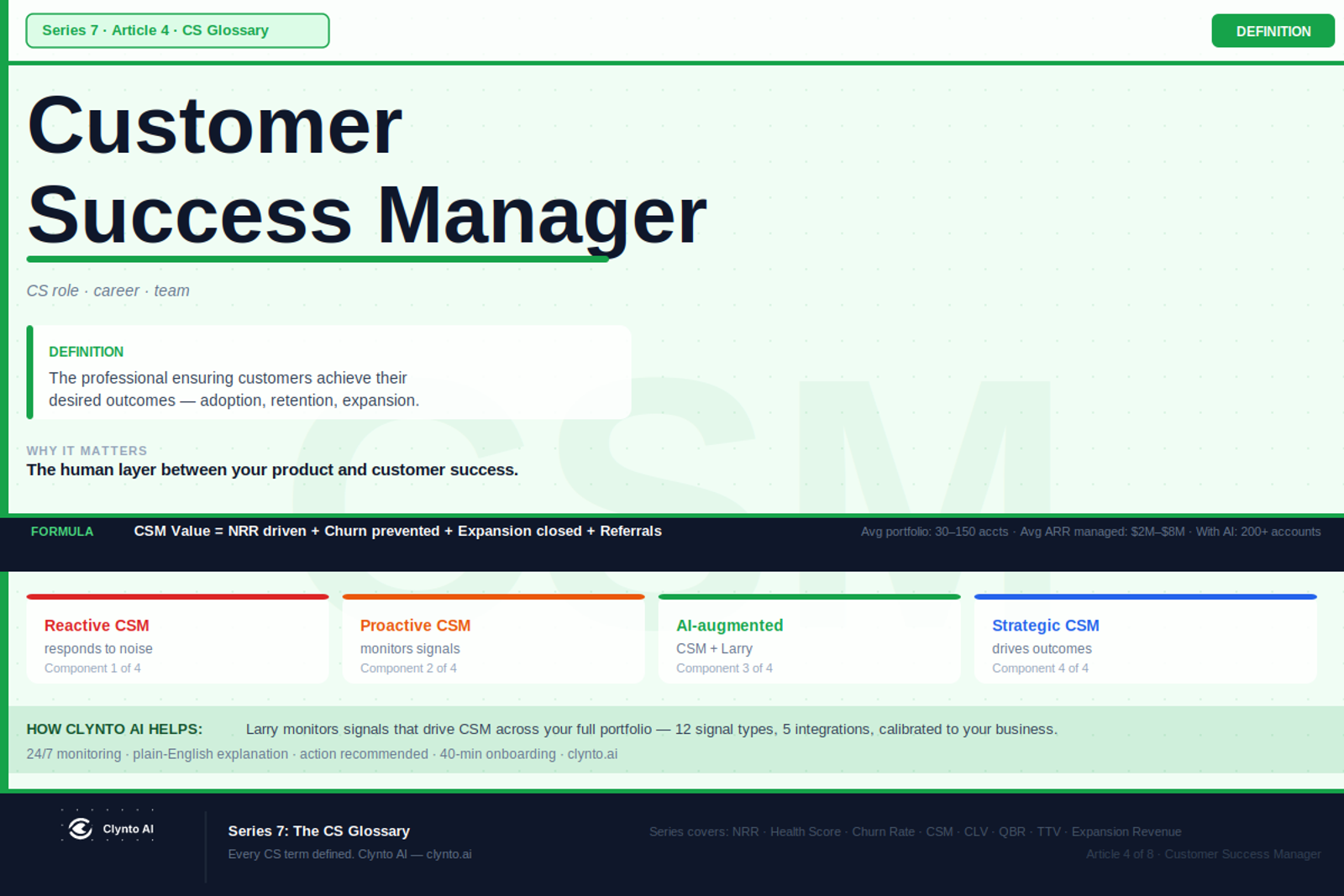
A Customer Success Manager (CSM) is the professional responsible for ensuring customers achieve their desired outcomes with a product — driving adoption, retention, expansion, and the relationships that make all three possible over time.
The CSM is the human layer between your product and your customer's success. When that layer works, customers renew, expand, and refer. When it doesn't, they churn quietly — often before anyone noticed something was wrong.
What a CSM Actually Does
The official job description usually includes: onboarding, relationship management, health monitoring, QBR facilitation, renewal management, and expansion identification.
The honest version of a CSM's week looks more like:
- Monday: triage health scores, review at-risk accounts, respond to overnight tickets
- Tuesday–Thursday: customer calls, renewal prep, QBR delivery, stakeholder management
- Friday: admin, CRM updates, task logging, manual data pulling for next week's calls
The gap between the strategic intent of the role and the administrative reality of it is one of the most common causes of CSM burnout — and one of the strongest arguments for an AI layer that handles the monitoring and triage so CSMs can do the relationship work they were hired to do.
What Distinguishes Great CSMs
Proactive, not reactive. Great CSMs reach out before customers signal distress. They catch drift before it becomes churn. Average CSMs respond to what's in front of them.
Commercially aware. Great CSMs understand the business outcome the customer is trying to achieve — not just the product features they're using. They connect product usage to business value and use that connection to drive renewals and expansion.
Pattern recognition. Great CSMs read the room. They notice when a champion is nervous, when engagement is performative, when "we're fine" means something is wrong. They've seen enough accounts to recognise the patterns.
Portfolio discipline. Great CSMs don't just manage the squeaky wheels. They have a systematic approach to monitoring their full portfolio — not just the accounts that shout.
What the CSM Role Is Becoming
The CSM role is undergoing its biggest structural shift since the function was invented.
As AI layers like Larry handle the monitoring and triage work, CSMs are being freed to spend more of their time on the work that actually requires human judgment — relationship building, renewal navigation, expansion conversations, and the strategic advisory role that the best customers want from their CS partners.
The CSMs who thrive in this shift are the ones who embrace AI as a capability multiplier rather than a threat. They use it to cover more accounts, catch more signals, and walk into every customer conversation more prepared than was previously possible.
The future CSM isn't doing less. They're doing more of the work that matters — and less of the work that doesn't require them.
Clynto AI is currently in pre-launch.
[Get demo→ clynto.ai]
Lucas Bennett
Clynto AI
Customer Success practitioner with over 10 years building CS teams from scratch across US, Canada, Singapore as a CSM, team lead, CS leader, and consultant.
Book 20 min with Lucas