AI in Customer Success
What Is an AI CSM — And Do You Actually Need One?
An AI CSM isn't a chatbot. It isn't a dashboard. It's an always-on intelligence layer that monitors every customer account, reads signals in real time, and tells your team exactly where to act — before it's too late. Here's what it actually is, how it works, and whether your team needs one.
What Is an AI CSM — And Do You Actually Need One?
It's not a chatbot. It's not a dashboard. It's something the CS industry has needed for a decade and only just became possible.
The Definition
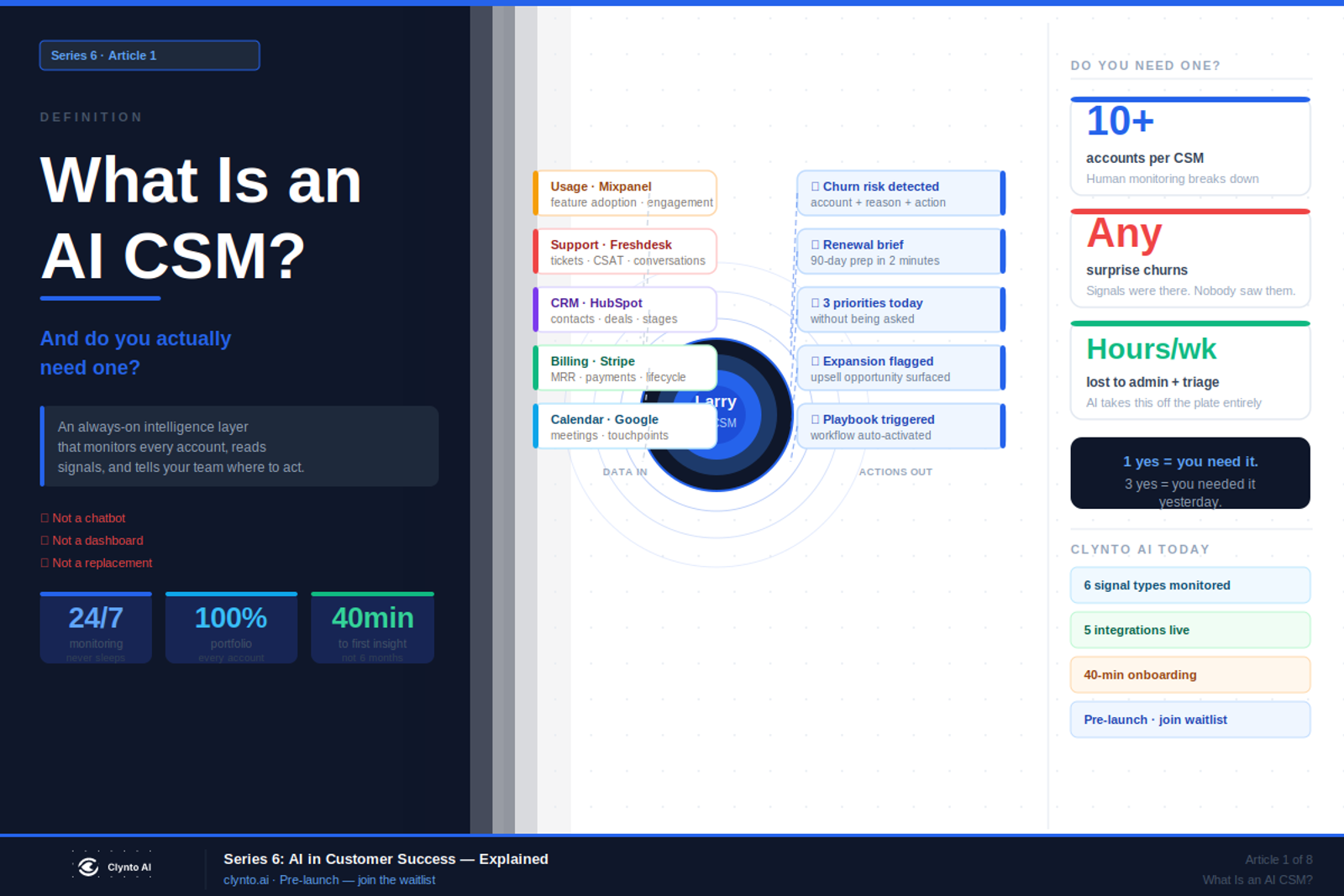
An AI CSM is an always-on intelligence layer that sits across your entire customer portfolio — monitoring every account, reading signals in real time, connecting patterns across data sources, and telling your team exactly where to act, at exactly the right moment.
It doesn't replace your CSMs. It handles everything that gets in the way of them doing their best work.
In one sentence: An AI CSM does the watching so your team can do the winning.
What an AI CSM Is NOT
Before going further, let's clear up three common misconceptions:
It is not a chatbot. Chatbots answer questions when you ask them. An AI CSM monitors proactively — without being prompted. It's the difference between a search engine and a colleague who taps you on the shoulder when something matters.
It is not a dashboard. Dashboards wait to be opened. An AI CSM is continuously reading your data and pushing insight to your team — before they think to check. The insight finds the CSM, not the other way around.
It is not a replacement. An AI CSM does not run QBRs. It does not build relationships. It does not handle the political nuance of a renewal negotiation. Those are human skills — and they get better when humans aren't spending their time on data triage.
How an AI CSM Actually Works
The architecture is straightforward. An AI CSM:
1. Connects to your data sources Product usage from your analytics platform. Support tickets from your helpdesk. CRM data from HubSpot or Salesforce. Billing data from Stripe. Calendar data from Google. Every signal that matters about every account flows into the AI layer.
2. Monitors continuously Not weekly. Not when someone logs in. Every account, every signal, every day. The AI reads usage drops, champion silences, NPS declines, billing changes, stakeholder movements — and holds all of it in context simultaneously.
3. Reads patterns, not just data points A 15% usage drop alone is noise. A 15% usage drop combined with a champion who hasn't opened an email in 14 days and a renewal in 30 days — that's a churn indicator. An AI CSM connects those signals across time and across accounts. Your CSMs can't. The AI does it continuously.
4. Surfaces prioritised actions Not a list of 40 amber accounts. The three accounts that need a human today — with context on why, what changed, and what to lead with. Your team acts on intelligence, not instinct.
What Larry Does — Clynto AI's AI CSM
Larry is Clynto AI's AI CSM layer. Built on Claude (Anthropic's API), Larry is what separates Clynto from a CS dashboard with a chatbot bolted on.
Here's what Larry does specifically:
Larry monitors 6 health signal types: Churn Risk, Renewal Risk, Expansion Ready, Champion Loss, Disengagement, and Executive Misalignment — plus 6 billing signals from Stripe.
Larry learns your business first. Before monitoring starts, Larry interviews your CS team across 8 topics — your segmentation, your onboarding process, your definition of early churn, your renewal motion. Those answers become Larry's persistent memory, calibrated to your specific business.
Larry generates renewal briefs. Before every renewal call, Larry builds a full account brief — what changed in 90 days, stakeholder status, unresolved friction, risk drivers, and what to lead with. In under 2 minutes. Before the CSM opens a single tool.
Larry surfaces daily priorities. Every morning, Larry proactively shows your team their top 3 portfolio priorities — without being asked.
Larry explains every signal in plain English. Not a number. Not a colour. A root-cause explanation and a recommended next action, generated by Claude and grounded in your account data.
Do You Actually Need One?
Three questions. If any answer is yes, you need an AI CSM layer.
Does your team manage more than 10 accounts per CSM? At that scale, human monitoring breaks down mathematically. Signals get missed. Accounts drift silently. You need continuous coverage that doesn't depend on a human having bandwidth to look.
Have you ever been surprised by a churn? Surprise churns mean a signal was present that nobody caught. An AI CSM is specifically designed to catch the signals that don't announce themselves — the quiet drift, the silent champion, the slow disengagement.
Is your team spending time on admin, triage, or data-pulling instead of relationships? That's the job design problem. Every hour a CSM spends pulling a CSV is an hour not spent on a renewal call. An AI CSM takes the prep work off the plate — completely.
If you answered yes to even one of those questions, the ROI case for an AI CSM is not complicated.
The One-Line Summary
An AI CSM is what customer success software should have always been — a system that acts on your data instead of waiting for you to look at it.
Clynto AI is built around this from the ground up. Not a dashboard with AI features. An AI CSM with a platform built around it.
Clynto AI is currently in early phase. Larry - our AI CSM - onboards in 40 minutes. First insight before you finish your coffee.
[Get the early access → https://clynto.ai/demo]
Lucas Bennett
Clynto AI
Customer Success practitioner with over 10 years building CS teams from scratch across US, Canada, Singapore as a CSM, team lead, CS leader, and consultant.
Book 20 min with Lucas