CS Education
What Is a Customer Health Score — And Why Most Are Wrong
A customer health score is supposed to be your earliest warning system. In most CS platforms, it's a confident lie. Here's what a health score actually is, why the standard approach breaks down, and what should replace it.

What Is a Customer Health Score — And Why Most Are Wrong
It's supposed to be your earliest churn warning system. For most CS teams, it's the thing that said "green" 60 days before the account left.
The Definition
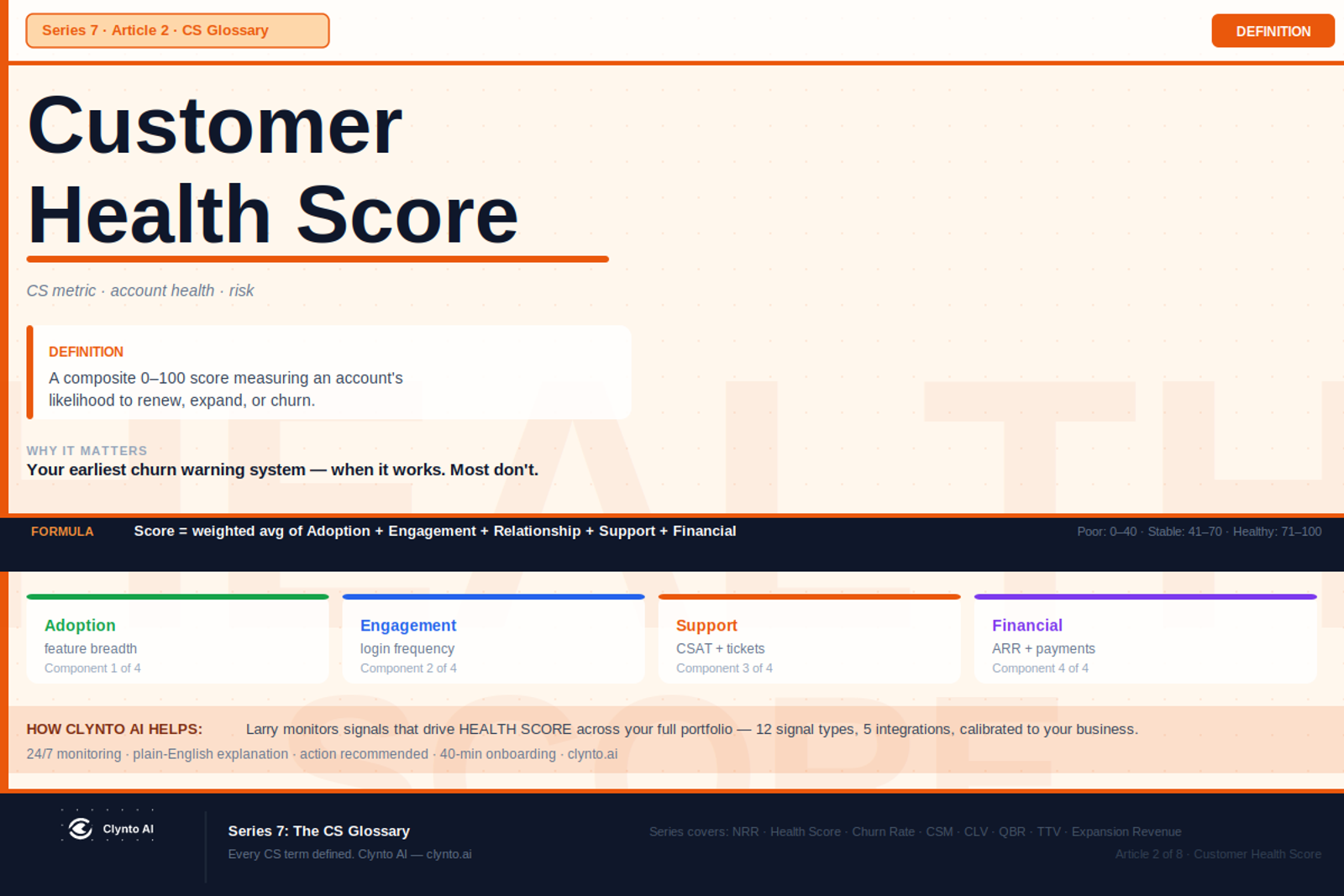
A customer health score is a composite metric (typically 0–100) that measures an account's overall likelihood to renew, expand, or churn. It aggregates signals from multiple data sources — product usage, engagement, support activity, billing, and relationship data — into a single number that represents overall account health.
The score is typically divided into bands: Poor (red), Stable (amber), and Healthy (green).
Standard formula: Score = weighted average of Adoption + Engagement + Relationship + Support + Financial dimensions
Why Most Health Scores Are Wrong
The logic of the health score is sound. The implementation almost always breaks it.
Problem 1: They average signals that shouldn't be averaged. An account with excellent product usage but a silent champion and a missed QBR might score 72 — technically healthy. But any experienced CSM looking at those three signals in combination would flag it immediately. The score averaged the danger away.
Problem 2: They update too slowly. Most health scores recalculate weekly — or only when someone manually triggers it. An account that started drifting on Tuesday isn't reflected in the score your CSM sees Monday. By the time the score turns red, the customer has often already decided.
Problem 3: They're static, not contextual. A score of 65 means something completely different for a 30-day onboarding account than a 3-year enterprise account approaching renewal. Generic scores ignore context entirely.
Problem 4: They measure activity, not intent. High login frequency doesn't mean the customer is getting value. Low ticket volume doesn't mean they're satisfied — it might mean they've given up asking. Health scores measure what's easy to measure. Not what actually predicts churn.
What Good Health Scoring Looks Like
Great health scoring has three properties standard implementations lack:
Continuous, not periodic. Signals update in real time. When usage drops on Wednesday, the health picture reflects it by Wednesday afternoon — not next Monday.
Contextual, not generic. The same signal means different things at different lifecycle stages, in different customer segments, for different account sizes. Good scoring knows the difference.
Pattern-aware, not isolated. One signal is noise. Three signals in combination is a story. Good health intelligence reads combinations — not individual metrics.
How Clynto AI Approaches Health Scoring
Clynto AI's health scoring runs on a configurable daily schedule across five dimensions: Adoption (from Mixpanel), Engagement (login frequency, activity trends), Relationship (manual data), Support (Freshdesk tickets, CSAT, SLA), and Financial (ARR, payment status, renewal proximity).
But Larry — the AI layer — goes further. Rather than collapsing everything into a single averaged score, Larry reads individual signals in combination and surfaces the ones that matter in your specific business context — calibrated through the onboarding interview to how churn actually happens in your customer base.
The output isn't a number that says 74. It's a plain-English explanation: "TechFlow's reporting module adoption dropped 38% over four weeks, their champion hasn't opened an email in 14 days, and renewal is in 32 days. This matches your defined early churn pattern for enterprise accounts."
That's not a health score. That's intelligence.
Clynto AI is currently in pre-launch.
[Get demo→ clynto.ai]
Lucas Bennett
Clynto AI
Customer Success practitioner with over 10 years building CS teams from scratch across US, Canada, Singapore as a CSM, team lead, CS leader, and consultant.
Book 20 min with Lucas