CS Education
What Is Customer Lifetime Value (CLV) - And How CS Drives It
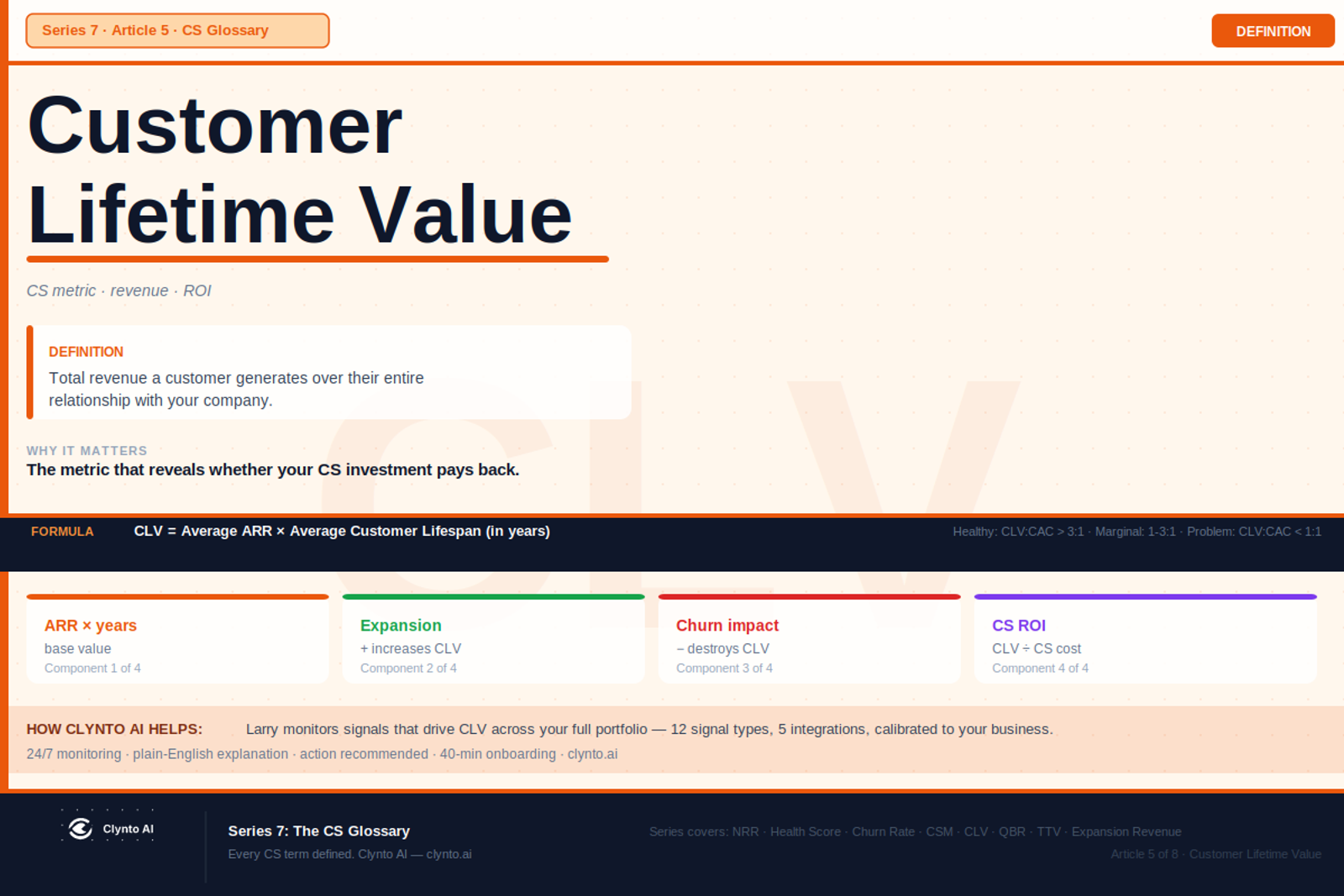
Customer Lifetime Value is the total revenue a customer generates over their relationship with your company. It's the metric that reveals whether your CS investment pays back — and the one that makes the strongest CFO case for CS resources.

What Is Customer Lifetime Value (CLV) — And How CS Drives It
CLV is the number that tells you what a customer is actually worth — over time. CS is the function that determines how that number grows or shrinks.
The Definition
Customer Lifetime Value (CLV) — also written LTV — is the total revenue a customer generates over the entire duration of their relationship with your company.
Formula: CLV = Average ARR × Average Customer Lifespan (in years)
A customer paying $40,000 per year who stays for 4 years has a CLV of $160,000. If your CS team extends that relationship by 2 years through retention and expansion, the CLV becomes $240,000. The additional $80,000 is CS's direct contribution.
Why CLV Is the CS Team's Most Important Business Case
CS leaders often struggle to justify investment in their function beyond "we prevent churn." CLV gives CS a more powerful argument:
We don't just prevent losses. We compound value.
A CS team that increases average customer lifespan from 3 years to 5 years — without changing pricing or acquisition costs — increases CLV by 67%. That's the entire CS function's value in a single number your CFO can model.
The CLV:CAC Ratio
The most important ratio for CS leaders to know: CLV:CAC.
If it costs $12,000 to acquire a customer (Customer Acquisition Cost) and that customer has a CLV of $160,000, your CLV:CAC ratio is 13:1. Excellent.
If CAC is $12,000 and CLV is $24,000 — CLV:CAC of 2:1 — you're barely making money per customer. CS investment that extends that relationship by even one year dramatically changes the unit economics.
Benchmark:
3:1 = healthy business
- 1–3:1 = marginal
- <1:1 = you're losing money on every customer
How CS Drives CLV — The Four Levers
1. Retention. The most obvious. Every additional year a customer stays adds one year of ARR to their CLV.
2. Expansion. Upsells, cross-sells, and seat additions directly increase the ARR component of the CLV calculation. An account that grows from $40k to $60k adds $20k per year to CLV.
3. Time to Value. Customers who reach value quickly stay longer. Shorter TTV = longer lifespan = higher CLV.
4. Referrals. Customers who succeed become advocates who generate new customers at zero CAC. This is CLV extending beyond the customer itself.
How Clynto AI Maximises CLV
Larry works on every CLV lever simultaneously.
Retention: monitoring 12 signal types to catch churn indicators before they materialise. Expansion: flagging expansion signals — usage patterns, untapped modules, growing teams — as prioritised actions. TTV: through structured onboarding playbooks and early adoption tracking in Mixpanel. Referrals: by ensuring customers succeed consistently enough to recommend you.
The cumulative effect: longer relationships, higher ARR per relationship, more referrals, better CLV across the portfolio.
Clynto AI is currently in pre-launch.
[Get demo → clynto.ai]
Lucas Bennett
Clynto AI
Customer Success practitioner with over 10 years building CS teams from scratch across US, Canada, Singapore as a CSM, team lead, CS leader, and consultant.
Book 20 min with Lucas