CS Education
What Is Net Revenue Retention (NRR) — And Why It's the Only CS Metric That Matters
NRR tells you whether your customer base is growing or shrinking — not from new sales, but from the customers you already have. Here's what it means, how to calculate it, and why every CS leader should know their number cold.

What Is Net Revenue Retention (NRR) — And Why It's the Only CS Metric That Matters
Every CS metric tells you something. NRR tells you everything.
The Definition
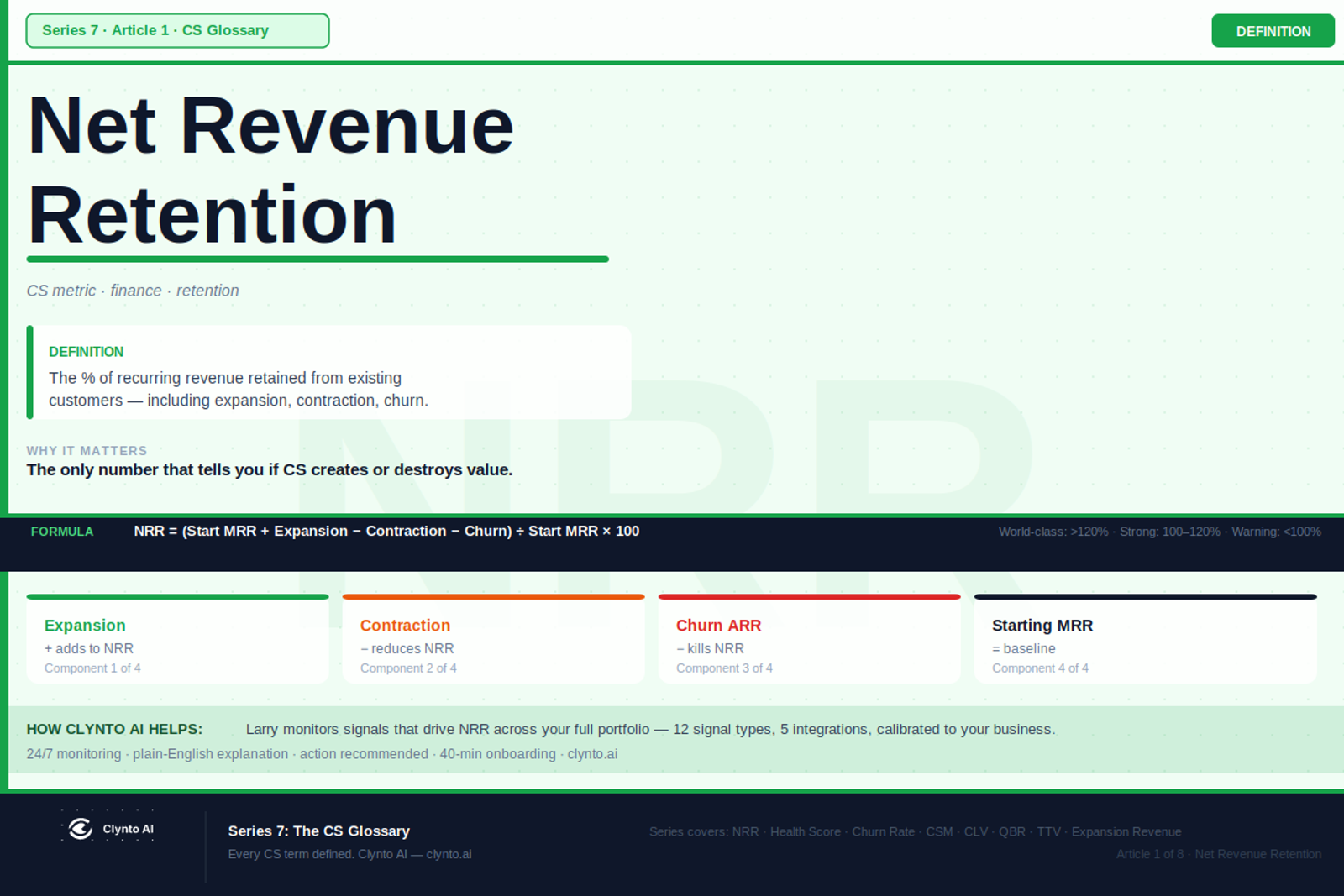
Net Revenue Retention (NRR) is the percentage of recurring revenue retained from your existing customer base over a given period — including expansion revenue, contraction, and churn.
Unlike gross revenue retention, which only measures what you keep, NRR includes what you grow. An NRR above 100% means your existing customers are generating more revenue than they were a period ago — even accounting for every account that contracted or churned.
Formula: NRR = (Starting MRR + Expansion − Contraction − Churn) ÷ Starting MRR × 100
Why NRR Is the Only Metric That Tells the Full Story
Most CS teams are measured on churn. Churn is a meaningful metric — but it only tells you what you lost. NRR tells you whether the CS function is creating or destroying value at the portfolio level.
A CS team with 5% churn and no expansion has an NRR of 95%. A CS team with 8% churn and 15% expansion has an NRR of 107%. The second team's customers are worth more this year than last — despite higher churn.
That's why NRR is the number that VCs, CFOs, and board members watch most closely. It's the single metric that captures the full CS motion — retention and growth — in one number.
What Good Looks Like
World-class: NRR >120% — your existing base grows faster than you lose Strong: NRR 100–120% — you're retaining and expanding Baseline: NRR ~100% — you're keeping what you have, barely Warning: NRR <100% — your existing base is shrinking
Best-in-class SaaS companies (Snowflake, Datadog, Twilio at peak) have sustained NRR above 130%. For most B2B SaaS, 110–120% is a strong benchmark to aim for.
What Drives NRR — And What Destroys It
Expansion drives NRR up:
- Upsells to higher tiers
- Cross-sells to new modules
- Seat additions as customers grow
- Usage-based pricing as adoption increases
Churn and contraction drive NRR down:
- Accounts that cancel
- Accounts that downgrade
- Accounts that reduce seats or usage
This is why CS teams that focus purely on churn prevention are leaving NRR on the table. The teams with the highest NRR are both retaining accounts and systematically growing them.
How Clynto AI Improves NRR
Larry — Clynto AI's AI CSM layer — acts on both sides of the NRR equation simultaneously.
On the retention side: Larry monitors 12 signal types across every account continuously — catching the churn indicators that human teams miss at scale. Slow usage drift. Champion silence. Cross-signal patterns that individually look harmless but together spell risk.
On the expansion side: Larry flags expansion signals — accounts with usage patterns that suggest readiness for additional seats, modules, or tiers — and surfaces them as prioritised actions for your CSMs.
The result: fewer churns, more expansions, better NRR. Without adding headcount.
Clynto AI is currently in pre-launch.
[Get demo → https://clynto.ai/demo]
Lucas Bennett
Clynto AI
Customer Success practitioner with over 10 years building CS teams from scratch across US, Canada, Singapore as a CSM, team lead, CS leader, and consultant.
Book 20 min with Lucas