Churn & Retention
What to Say When a Customer Says They're Leaving
68% of churn decisions are reversible at the moment a customer says they're leaving — but only with the right words. Here's what to say, what to never say, and why the first sentence matters most.

On this page
What to Say When a Customer Says They're Leaving
The churn conversation is winnable more often than most CSMs believe. But the first sentence determines everything.
The Moment That Changes Everything
A customer sends an email. A stakeholder says it on a call. The renewal comes up and they announce they won't be continuing.
The CSM's instinct in this moment is almost always wrong.
Not because CSMs are bad at their jobs — but because the instinct is to respond to the surface statement rather than the real situation. And the surface statement ("we're leaving") rarely tells you the real reason, the real decision-maker, or the real opportunity to reverse it.
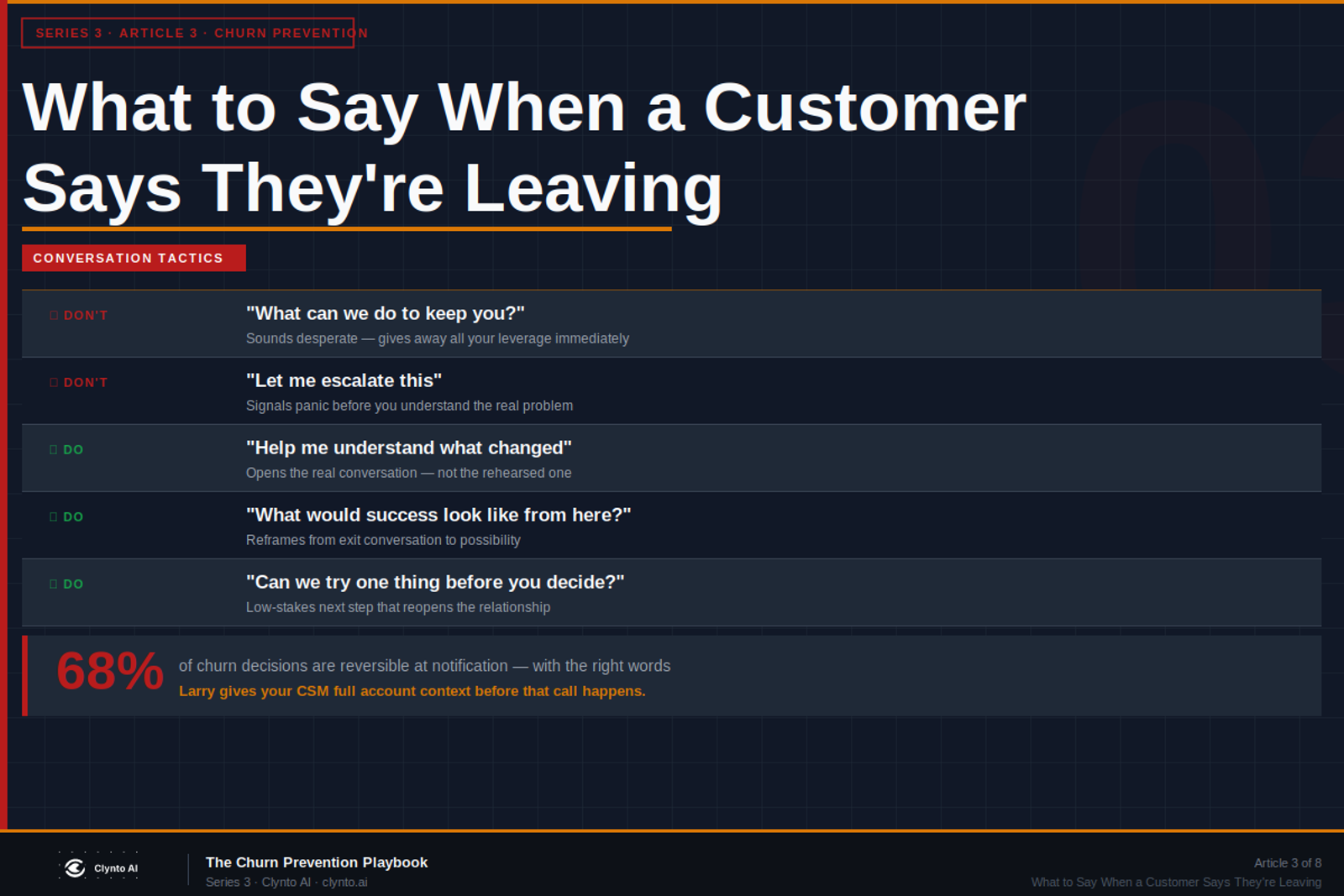
68% of churn decisions are reversible at the moment of notification. But only with the right conversation — and the right conversation starts with not reacting the way most CSMs react.
What Not to Say
"What can we do to keep you?"
This is the most common churn response in CS — and it's one of the worst. It signals desperation. It hands your leverage to the customer immediately. And it implies that the relationship can be saved by offering something (usually a discount) rather than by solving something.
Customers who hear this question either feel sorry for you or see an opportunity. Neither is where you want them.
"Let me bring in my manager."
Escalating before understanding the problem signals that you're not equipped to handle this, that you're going to fight rather than listen, and that the customer is now in a process rather than a conversation. This turns a recoverable situation into a formal one — and formal situations have harder outcomes.
"We've been working on improvements in that area."
Defending the product before understanding the customer's actual problem is the most reliable way to make them feel unheard. If their concern is about a feature, this might be relevant. But most churn conversations aren't really about features — they're about value, relationships, or internal politics. Jumping to product defence usually misses the actual issue entirely.
What to Say Instead
"Help me understand what changed."
Not "why are you leaving" — which puts them in the position of defending a decision. "What changed" opens a different conversation. It acknowledges that something shifted without asking them to justify it. It signals that you're trying to understand the situation, not argue with it.
This is the single most important sentence in a churn conversation. Get this right and you've opened the real discussion.
"What would success look like from here?"
This question does something remarkable: it assumes there's still a path forward and invites the customer to describe it. Most customers who are "leaving" haven't fully committed to a specific alternative. They're expressing frustration, or value uncertainty, or budget pressure. This question surfaces what they actually want — which is often solvable.
"Can we try one specific thing before you make a final decision?"
Not a pitch. Not a product demo. Not a discount offer. One specific thing — a different use case, a different team, a different configuration — that gives the customer a low-risk reason to pause.
This works because it's concrete and time-limited. "Try this for 30 days" is much easier to say yes to than "reconsider your decision."
The Context That Changes Everything
The churn conversation doesn't start when the customer says they're leaving. It starts with how much you know about the account when you walk in.
A CSM who knows what's changed in the last 90 days, which stakeholders are engaged, what friction points have been unresolved, and what the customer's original success goals were — walks into that conversation with leverage. They can name the real issue before the customer does. They can propose a specific solution rather than a generic retention offer.
A CSM who walks in blind has to triage in real time, which leads to the defensive responses above.
Larry builds that context before the call. The renewal brief — stakeholder status, usage trends, unresolved friction, 90-day trajectory — is ready before the conversation starts. Your CSM walks in knowing what they're walking into.
Lucas Bennett
Clynto AI
Customer Success practitioner with over 10 years building CS teams from scratch across US, Canada, Singapore as a CSM, team lead, CS leader, and consultant.
Book 20 min with Lucas