Churn & Retention
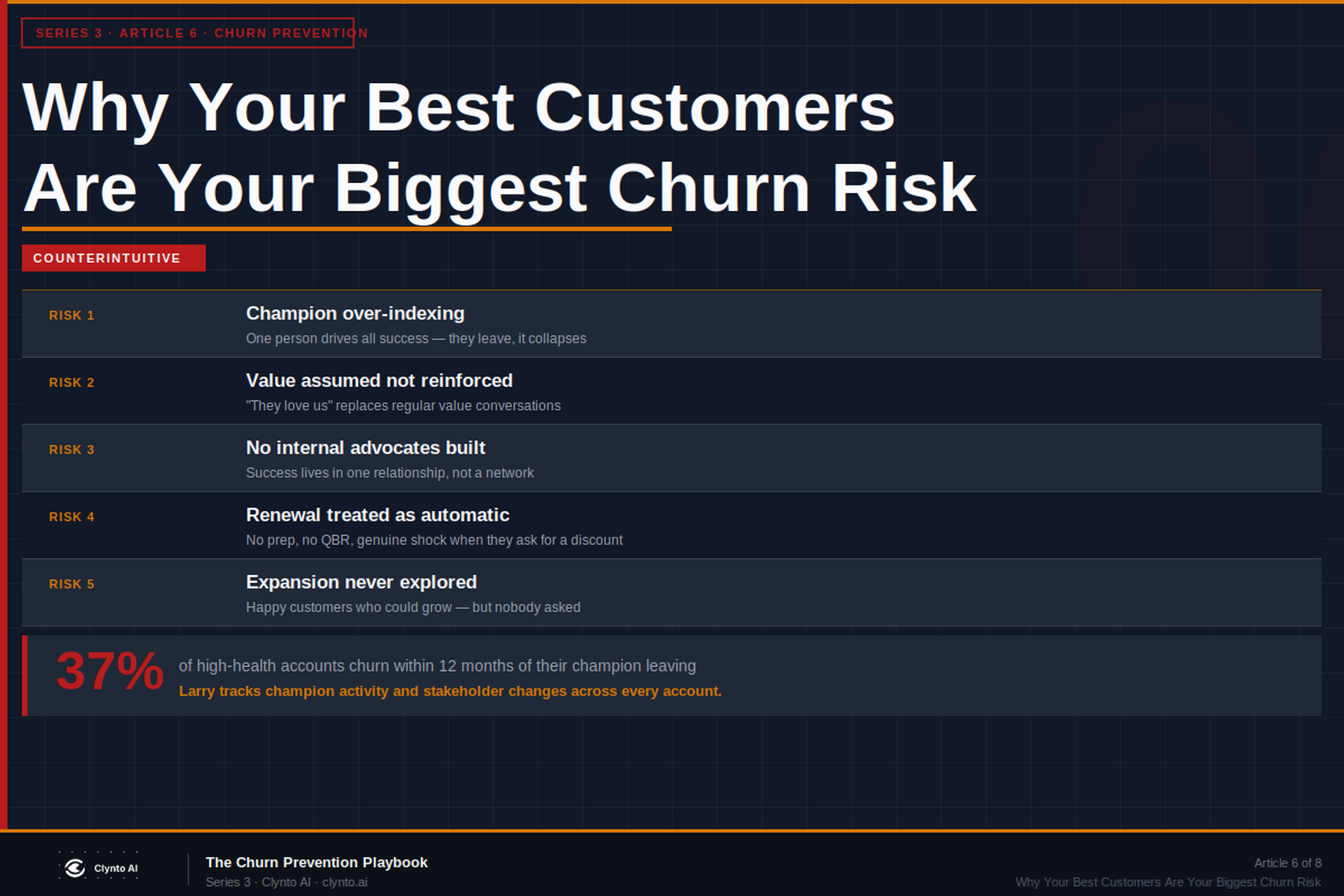
Why Your Best Customers Are Your Biggest Churn Risk
High health scores and strong relationships create a false sense of security. Here's the counterintuitive truth about why your most successful accounts carry the highest churn risk — and how to protect them.

Why Your Best Customers Are Your Biggest Churn Risk
The accounts your team worries about least are sometimes the ones closest to leaving. Here's why.
The Confidence Problem in CS
CS teams optimise for the accounts they're worried about. The red accounts. The accounts with open tickets and declining usage and a champion who's been difficult in QBRs.
These accounts get attention, save attempts, executive escalation, and dedicated CSM time.
The green accounts get check-ins.
This is the confidence problem. The accounts your team is least worried about are often the accounts with the most unexamined risk — because the good relationship has substituted for good monitoring.
Risk 1: Champion Over-Indexing
The most dangerous configuration in CS: a large, healthy, well-managed account whose success depends entirely on one person.
The champion loves the product. They attend every QBR. They reply within an hour. They've built your product into their workflow so deeply that the relationship feels unshakeable.
Then they leave the company. Or get promoted. Or change teams. And the new person has no relationship with you, no context on the product, and no investment in the contract that expires in four months.
37% of high-health accounts churn within 12 months of losing their champion. This is one of the most predictable churn patterns in CS — and one of the least monitored.
The fix: Build a stakeholder network inside every important account. Three relationships at different levels. If any one person leaves, you have two more.
Risk 2: Value Assumed, Not Reinforced
Long-tenured customers are the most under-valued communication targets in CS. They've been with you for two or three years. The relationship is strong. The product is embedded.
So the QBR becomes lighter. The check-ins become shorter. The value conversation gets replaced by a warm catching-up call because everyone already knows the product is working.
Until the customer's CFO asks why they're paying for this tool — and nobody on the customer's team has a clear, current answer.
CS teams stop building the internal business case for their product once the relationship feels secure. But the people who approved the original budget leave. New decision-makers arrive. And the new people don't have your champion's conviction — they have a line item and no context.
The fix: Build the value case every quarter — even with your healthiest accounts. Give your champion the ammunition to justify the contract internally.
Risk 3: No Internal Advocates Beyond the Champion
A single champion is a single point of failure. When CS teams only ever interact with one person inside a customer account, the entire relationship rests on that person's continued employment, continued interest, and continued goodwill.
Healthy accounts need a network of advocates at different levels: the day-to-day users who depend on the product, the managers who see its impact on team output, and the executive who understands its business contribution.
Most CS teams build one. The champion.
The fix: Map the stakeholder network actively. Larry tracks stakeholder activity across HubSpot and Google Calendar and flags when relationships are concentrated in one contact.
Risk 4: Renewal Treated as Automatic
Healthy accounts get the fastest, least-prepared renewal conversations. The CSM opens the meeting with "great news, looking forward to another year" — and is shocked when the customer asks for a discount, a new structure, or time to evaluate alternatives.
The confidence in the relationship has replaced the preparation for the renewal. And the customer, emboldened by their bargaining position as a happy customer, uses the renewal to renegotiate.
The fix: Every renewal gets a full preparation cycle, regardless of health score. Larry's renewal brief covers this in 2 minutes. There is no account too healthy to prepare for.
Risk 5: Expansion Never Explored
Happy customers who could grow but never get asked are one of the highest-value missed opportunities in CS — and one of the most common.
The CSM manages the relationship well. The account is healthy. But nobody has ever asked: "Is there a team in your organisation that could benefit from this? Are there use cases you're not using yet that match what you've built?" The customer would say yes. The conversation never happened.
The fix: Larry surfaces expansion signals from Mixpanel and HubSpot — feature gaps, growing seat patterns, underutilised modules that match the account's profile. Your CSMs don't have to go looking. The opportunities find them.
Lucas Bennett
Clynto AI
Customer Success practitioner with over 10 years building CS teams from scratch across US, Canada, Singapore as a CSM, team lead, CS leader, and consultant.
Book 20 min with Lucas