Customer Success
Why "Proactive Customer Success" Has Been a Lie - Until Now
Every CS platform promises proactive customer success. Every sales deck has the word on slide three. But without AI underneath, proactive CS is just a calendar reminder dressed up as a strategy. Here's what real proactive CS actually requires.

On this page
Why "Proactive CS" Has Been a Lie — Until Now
It's on every CS platform's homepage. It's in every vendor's pitch deck. It's the goal every CS leader sets at the start of every year. And almost nobody actually delivers it.
The Biggest Broken Promise in Customer Success
Ask any CS leader what they want their team to do and the answer is always some version of the same thing:
"Get ahead of problems before they become problems."
That's proactive CS. It sounds simple. It is, in fact, extraordinarily hard — and the industry has been pretending otherwise for a decade.
Every CS platform promises proactive. The word is everywhere. Proactive alerts. Proactive playbooks. Proactive health scores. Proactive engagement workflows.
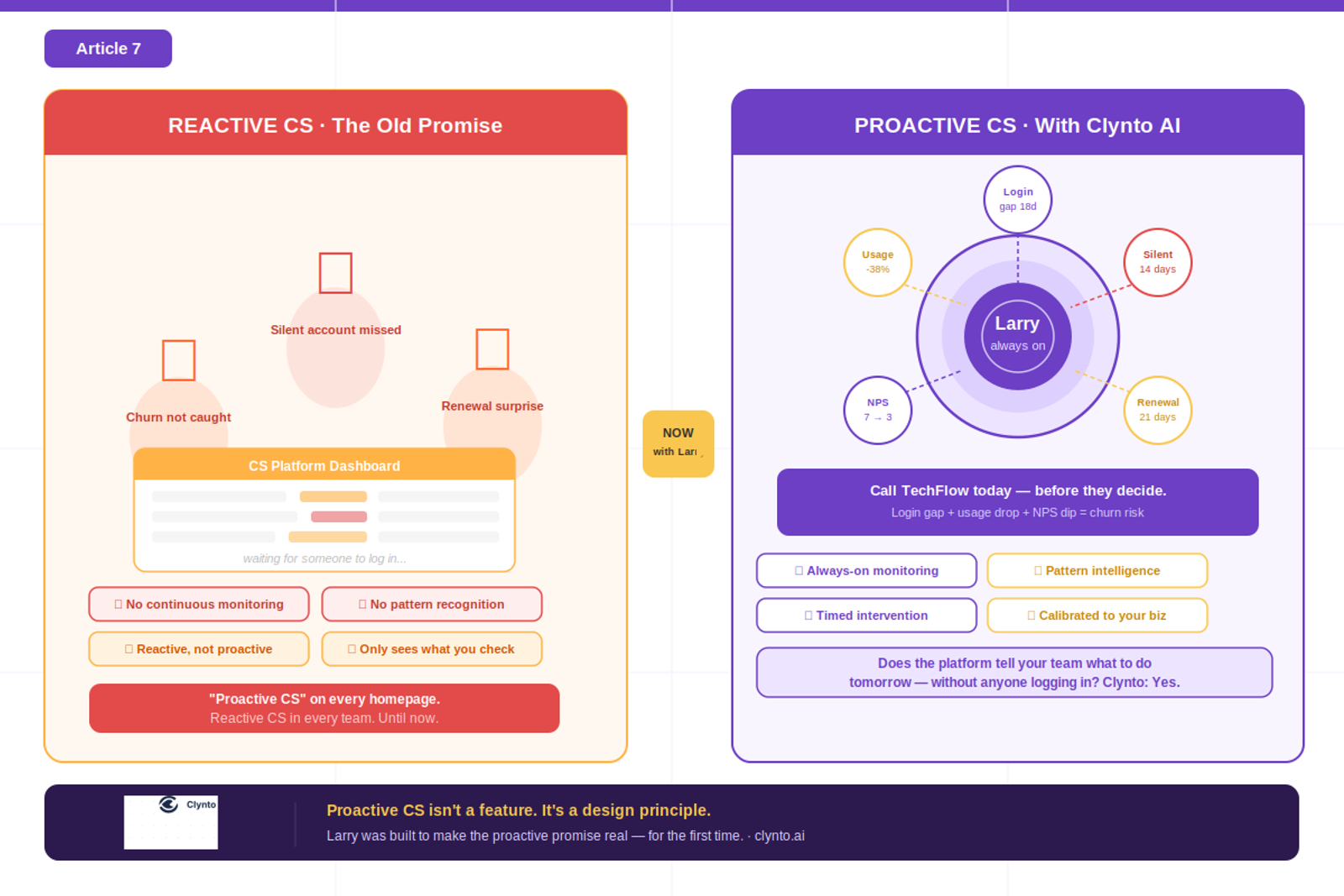
But here's what those platforms actually do when a customer starts drifting:
Nothing.
Until a human logs in, looks at the dashboard, notices the signal, decides it's worth acting on, and reaches out.
That's not proactive. That's reactive with a prettier interface.
Why Proactive CS Has Always Been Reactive In Disguise
The promise of proactive CS has a fundamental structural problem that no amount of dashboard design solves.
Proactive means acting before the customer signals distress. It means catching the slow usage drift at week three, not week eight. It means noticing the champion went quiet before they've already started evaluating alternatives. It means connecting three small signals into a pattern before any one of them looks alarming on its own.
To do that consistently — across every account, every week — you need something that is:
- Always on. Not checking in when a CSM has bandwidth.
- Processing everything simultaneously. Not triaging 80 accounts one at a time.
- Pattern-aware. Not looking at signals in isolation.
- Calibrated to your business. Not running generic templates.
A dashboard is none of these things. A playbook builder is none of these things. A health score — even a well-configured one — is none of these things.
Proactive CS without AI underneath is a goal statement, not a capability.
What "Proactive" Actually Looks Like In Most CS Teams
Here's the real workflow at the average CS team running a "proactive" motion:
Monday morning. CSM logs in. Reviews their account list. Sorts by health score. Opens the 10 accounts in amber or red. Scans for anything obviously wrong. Makes a few notes. Sends two or three emails.
The other 70 accounts? Assumed fine. Because nothing is visibly on fire.
Meanwhile, three of those 70 accounts have had login frequency drop 30% over the past six weeks. One has had a champion go silent for 19 days. Another just had their billing contact change — a classic pre-churn signal that nobody connected to anything else.
None of these made it into the amber pile. None of them got an email.
This is proactive CS as it's practised in the real world. And nobody talks about it because the gap between the promise and the reality is embarrassing.
The Three Reasons Proactive CS Fails Without AI
1. Human bandwidth doesn't scale with account volume A CSM managing 80 accounts cannot proactively monitor 80 accounts. They can reactively monitor the loudest 15 and hope the rest are okay. The math has never worked. Adding playbooks doesn't fix math.
2. Signals don't announce themselves The accounts most likely to churn are the ones generating the least noise. They've stopped engaging — which reads as calm in every dashboard ever built. Real proactive CS requires specifically watching for absence of signal, not presence of it. Humans don't do this naturally. AI does.
3. Pattern recognition requires processing power humans don't have A 10% usage drop this week is noise. That same drop, combined with a support ticket spike three weeks ago, a CSM email going unanswered for 12 days, and a billing contact change — that's a churn indicator. No human connects those dots across 80 accounts in real time. AI does it continuously.
What Real Proactive CS Requires
Real proactive CS has three components that have to work together:
Continuous monitoring — not weekly check-ins. Every account, every signal, every day.
Pattern intelligence — not individual alerts. Signal combinations that mean something in your specific business context.
Timed intervention — not alerts after the fact. Surfacing the right account at the moment when outreach can still change the outcome.
Until AI, none of these three were achievable at scale. That's not a criticism of CS teams. It's a statement about what human-scale work can and cannot do.
How Clynto AI Makes Proactive CS Real
Larry - Clynto AI's AI CSM layer - was built specifically around the three components of real proactive CS. Not as a feature. As the fundamental design principle.
Continuous monitoring, built in. Larry reads every signal across every account every day without being asked. Usage, logins, support, billing, stakeholder activity, NPS - all of it, all the time. Your CSMs don't need to log in and look. Larry is always looking.
Pattern intelligence calibrated to your business. Before Larry starts monitoring, it interviews your CS team. How do you segment customers? What does early churn look like in your context? What signals matter at 90 days vs. 2 years? Larry's pattern recognition isn't generic - it's built on how churn actually happens in your customer base.
Intervention at the right moment. Larry doesn't surface a list of at-risk accounts. It tells your CSM exactly which account needs attention today, why it needs attention now - not next week - and what the right opening move is. The intervention is timed to when it can still make a difference.
This is what proactive CS actually looks like. Not a promise on a vendor's homepage. A capability your team uses every morning.
The Question That Exposes Reactive CS
Here's a simple test for any CS platform - yours included:
"Does the platform tell your team what to do tomorrow morning — without anyone logging in and looking?"
If the answer is no, it's reactive. No matter what the homepage says.
Clynto AI's answer is yes. Every morning, before your team opens their laptops, Larry has already read every account, identified what changed overnight, and queued the actions that matter today.
That's not a feature. That's a fundamentally different approach to what customer success can be.
Clynto AI is currently in Early access stage. Larry was built to make the proactive CS promise real - for the first time. [Get early access → https://clynto.ai/demo]
Lucas Bennett
Clynto AI
Customer Success practitioner with over 10 years building CS teams from scratch across US, Canada, Singapore as a CSM, team lead, CS leader, and consultant.
Book 20 min with Lucas