Customer Success
You Don't Need a CS Tool. You Need a CS Brain.
Every CS platform promises to centralise your data. Almost none of them tell you what to do with it. Here's the difference between software that stores and software that thinks — and why it changes everything for your team.

On this page
You Don't Need a CS Tool. You Need a CS Brain.
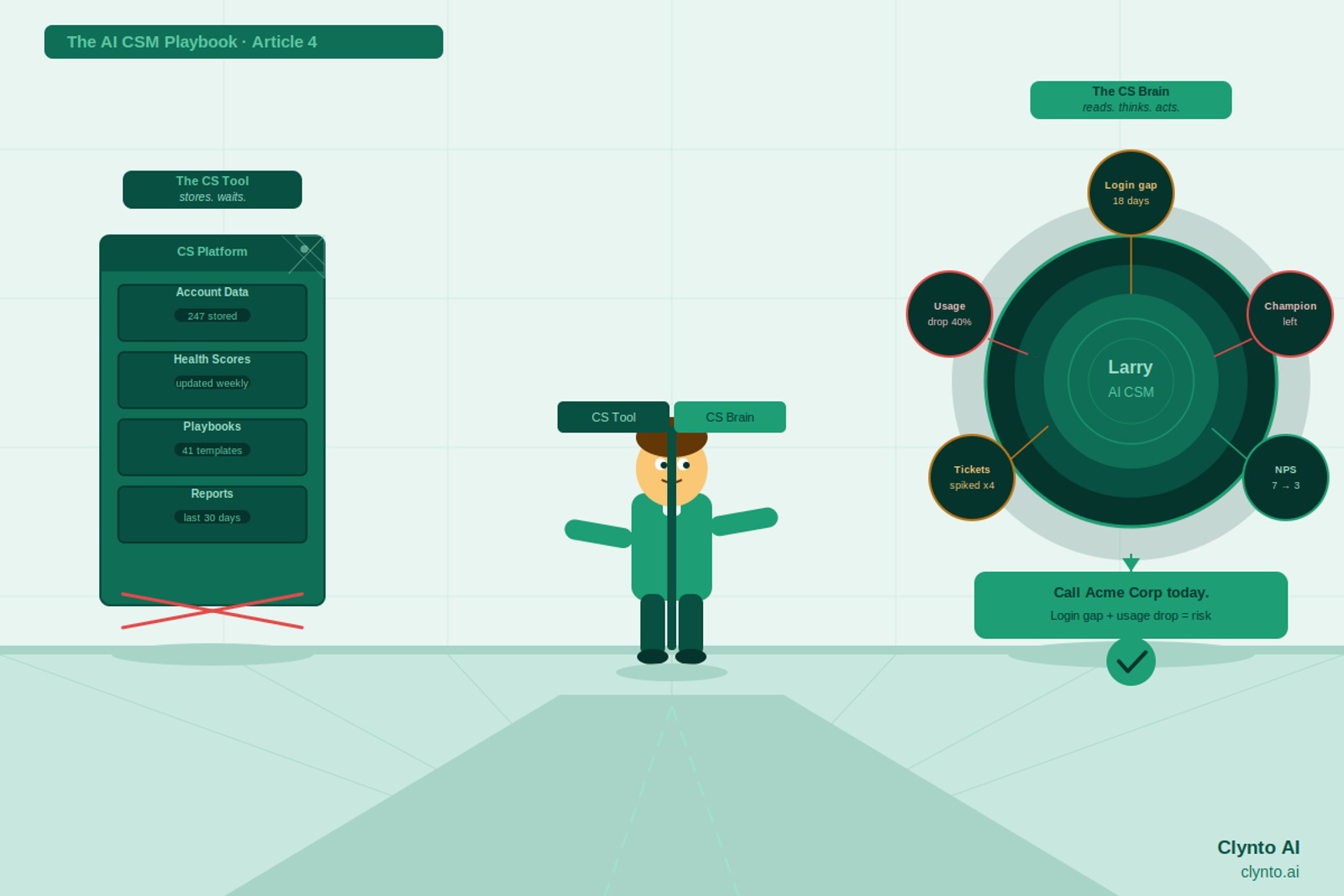
Most CS platforms are sophisticated filing cabinets. Beautiful to look at. Waiting to be opened. Doing nothing on their own.
What a CS Tool Actually Does
Your CS platform stores data.
It pulls in product usage from your analytics tool. It syncs with your CRM. It connects to your billing system and your helpdesk. It organises everything into a dashboard your team can log into and review.
And that's where it stops.
The platform doesn't notice when an account goes quiet. It doesn't flag that a champion just changed jobs. It doesn't connect the dots between three small signals that together spell churn. It doesn't tell your CSM what to do this morning.
It waits. Patiently. For a human to come and find the insight buried in the data.
That's not intelligence. That's organisation.
The Gap Nobody Talks About
There's a fundamental gap in the CS tech stack that the industry has quietly normalised.
On one side: your data. Usage, health scores, NPS, support tickets, billing, stakeholder activity. All of it flowing into your platform, all of it technically visible.
On the other side: your CSMs. Talented, experienced, relationship-driven people who are supposed to turn that data into action.
In the middle: nothing.
No layer that reads the data continuously. No layer that understands what matters in your business. No layer that connects signals across accounts and surfaces the one thing your CSM needs to know right now.
The result? CSMs log in when they have time. They look at the accounts they already know are struggling. The quiet ones — the ones drifting without making noise — stay invisible until it's too late.
What a CS Brain Does Differently
A CS brain doesn't wait to be opened.
It reads every account, every day. It doesn't get tired, doesn't get distracted, doesn't have 80 other accounts competing for its attention.
More importantly — it thinks contextually. It knows that a 15% usage drop means something different for a 90-day-old account than a 3-year account. It knows that silence from a VP of Engineering is more significant than silence from an end user. It knows your renewal cycles, your customer segments, your definition of risk.
And when it finds something that matters — it doesn't add it to a list of 40 alerts. It surfaces the one account, with the specific signal, and the recommended next action.
That's the difference between a tool and a brain. One organises information. The other acts on it.
Why This Matters More Than Any Feature
CS leaders spend a lot of time evaluating features. Health score customisation. Playbook builders. NPS modules. Automated email sequences.
All of those features live inside the tool paradigm. They make the filing cabinet more sophisticated. They don't close the gap.
The question isn't "does this platform have the features I need?"
The question is "does this platform think — or does it wait?"
Because a CS team with a brain working alongside them doesn't just catch more churn. They have better conversations. They renew with more confidence. They spend their time on relationships — the thing only humans can do — instead of triage.
How Clynto AI Is Built Around This
Clynto AI wasn't designed as a feature-rich platform. It was designed as a CS brain.
Larry — Clynto's AI layer — doesn't sit behind a dashboard waiting to be opened. Larry reads every signal across every account continuously and surfaces what matters before your CSMs need to go looking.
Here's what that looks like in practice:
Larry learns your business first. In a short conversational interview, Larry asks how your team segments customers, what early churn looks like in your context, and how you define health. Your answers become Larry's persistent memory — so every signal and recommendation is calibrated to how you actually work, not a generic template.
Larry monitors what humans can't. Login frequency, feature adoption, support velocity, stakeholder engagement, billing changes — across every account, every day. Nothing requires a CSM to go looking.
Larry tells your team where to go. Not a dashboard of 40 amber accounts. The one account that needs attention today, why it needs attention, and what the right move is.
The gap between data and action has always been the hardest problem in CS. Clynto AI is built specifically to close it.
Clynto AI is built by CS practitioners who spent 10+ years staring at dashboards that never told them what to do. [Join the waitlist → clynto.ai]
Lucas Bennett
Clynto AI
Customer Success practitioner with over 10 years building CS teams from scratch across US, Canada, Singapore as a CSM, team lead, CS leader, and consultant.
Book 20 min with Lucas